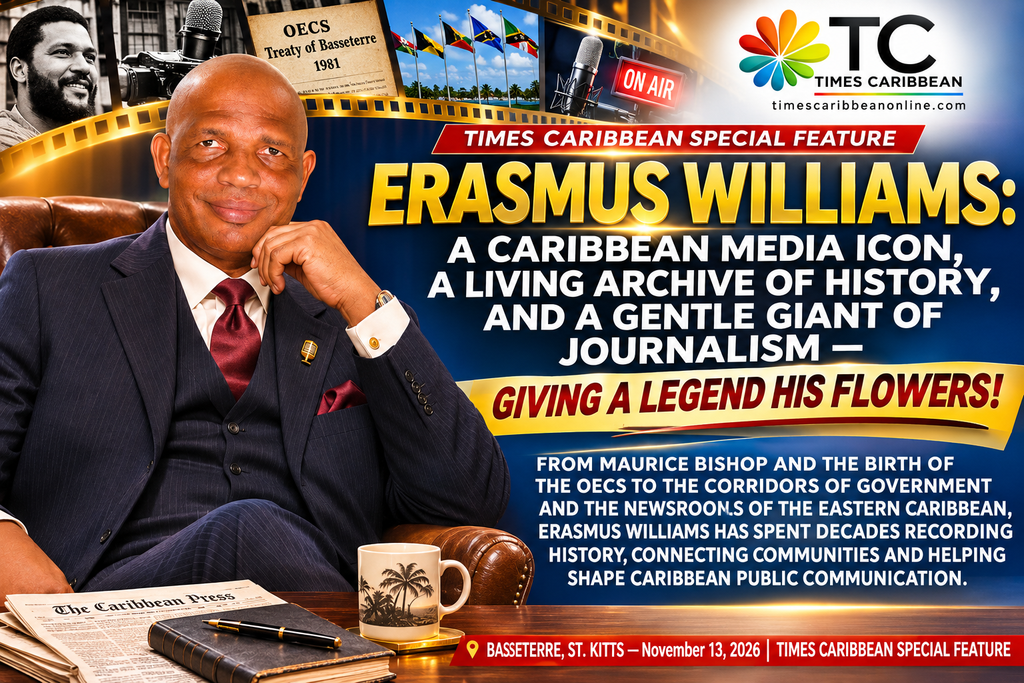
ERASMUS WILLIAMS: A CARIBBEAN MEDIA ICON, A LIVING ARCHIVE OF HISTORY, AND A GENTLE GIANT OF JOURNALISM — GIVING A LEGEND HIS FLOWERS!
FROM MAURICE BISHOP AND THE BIRTH OF THE OECS TO THE CORRIDORS OF GOVERNMENT AND THE NEWSROOMS OF THE EASTERN CARIBBEAN, ERASMUS WILLIAMS HAS SPENT DECADES RECORDING HISTORY, CONNECTING COMMUNITIES AND HELPING SHAPE CARIBBEAN PUBLIC COMMUNICATION.
BASSETERRE, ST. KITTS — November 13, 2026 | TIMES CARIBBEAN SPECIAL FEATURE
Some people report the news. Others become part of the history they report.
And then there is Erasmus Williams.
For decades, the veteran St. Kitts and Nevis journalist, broadcaster, editor and former government press secretary has occupied an extraordinary place in Caribbean media history, moving between newsrooms, radio studios, newspaper offices, international reporting assignments and the highest levels of government communications.
His career spans an era when journalists wrote reports by hand, travelled with cassette recorders, transmitted news across islands using limited technology and relied on professional relationships to get accurate information into the public domain.
Today, as the Caribbean media community celebrates his November 9 birthday, Williams is receiving something that too many outstanding regional contributors receive only after their passing.
His flowers. While he can still enjoy them.
And few have articulated the significance of that recognition more personally than fellow journalist and corporate communications professional Jason Inanga, whose November 12 birthday tribute offers a revealing portrait of the man behind the headlines.
Inanga remembers Williams not simply as a respected media veteran but as a mentor, a professional colleague, a generous supporter and, perhaps most memorably, a gentle media giant.
But the deeper story is considerably bigger than one birthday celebration.
It is the story of a Caribbean journalist whose professional journey mirrors the political transformation, media development and regional integration of the modern Eastern Caribbean.
THE NIGHT HE INTERVIEWED MAURICE BISHOP — AND THE HISTORY THAT FOLLOWED
Imagine Basseterre in 1981.
The Organisation of Eastern Caribbean States was being established through the historic Treaty of Basseterre, marking a significant new chapter in regional cooperation.
Among the political figures present was Grenada’s revolutionary Prime Minister, Maurice Bishop.
And somewhere in the early hours of the morning, at approximately 1 a.m., Erasmus Williams secured an interview with the Grenadian leader.
It was the type of assignment that demonstrates what regional journalism once demanded: persistence, access, preparation and the determination to capture the words of history’s principal actors.
Just two years later, in October 1983, Bishop’s death would plunge Grenada into a profound political crisis and trigger international developments that would reshape Caribbean political history.
Williams was once again documenting events.
This time, with pen and paper.
His three-page handwritten report recorded the reactions of Caribbean political leaders as news of Bishop’s death spread throughout the region.
The document included contemporary responses from prominent figures such as Barbados Prime Minister Tom Adams, Jamaica’s Michael Manley, Barbados opposition leader Errol Barrow and Dominica Prime Minister Eugenia Charles.
These were not reflections written decades later.
They were contemporary accounts produced while the events were unfolding.
And that distinction matters.
In October 2025, Williams rediscovered the original handwritten report while sorting through his personal archives.
Times Caribbean subsequently published material from the document, offering readers a rare opportunity to examine how one Caribbean journalist recorded a defining regional crisis before the arrival of smartphones, social media and modern digital newsrooms.
Williams also revealed that he had accumulated hundreds of cassette recordings, including historical broadcasts concerning Grenada and the regional developments that followed.
Among the material he believed remained in his collection was the early-morning interview with Bishop.
Think about that for a moment.
One Caribbean journalist, quietly preserving records that could help future historians understand not only what happened, but how Caribbean people learned about those events and how regional leaders responded.
That is more than a personal collection. It is potentially an important part of the Caribbean’s documentary heritage.
FROM TORTOLA TO ST. MAARTEN: A JOURNALIST WITHOUT ISLAND BOUNDARIES
Long before the internet made Caribbean news instantly accessible across borders, Williams was operating within a professional network that connected islands through radio, newspapers and regional news agencies.
In the British Virgin Islands, he served as assistant manager and news director at ZBVI Radio, handling the responsibilities of newsroom leadership while continuing to report on community affairs.
His work extended beyond politics.
Business development, local personalities, tourism and environmental protection all formed part of the stories that mattered to island communities.
By early 1990, Williams had moved to St. Maarten, taking up the position of editor-in-chief of The Chronicle.
It was a significant responsibility during a period of increasing competition within the island’s print media industry.
Newspapers such as The Chronicle and, subsequently, The Daily Herald helped connect readers across St. Maarten, St. Martin, Anguilla, Saba, Statia, St. Barths, St. Kitts and Nevis.
For journalists working in that environment, a local story could quickly become a regional story.
And a regional story could carry implications for communities separated by sea but connected through family, commerce, migration and shared history.
Williams belonged to a generation that understood this relationship instinctively.
The Caribbean was never merely a collection of separate reporting territories. It was one interconnected news landscape.
THE PRESS SECRETARY WHO OPERATED AT THE CENTRE OF GOVERNMENT
Following the election of Dr. Denzil L. Douglas as Prime Minister of St. Kitts and Nevis in 1995, Williams entered another major chapter of his professional life.
By July 1996, he was serving as press secretary to the Prime Minister.
The assignment placed him at the intersection of government policy, political leadership, public information and the national media.
It was a position that required a different professional discipline from independent newsroom reporting.
A journalist seeks information, tests claims and reports in the public interest. A government press secretary communicates and explains the positions of an administration.
Those responsibilities are distinct, even when they draw on similar skills.
Williams’s career provides an important case study in how experienced media professionals moved between journalism and institutional communications as Caribbean governments expanded their public information operations.
One especially notable moment occurred in July 1996.
St. Kitts and Nevis staged its first live television broadcast of a parliamentary sitting, carried by ZIZ Television.
Contemporary reporting by the Caribbean News Agency identified Williams as the official who announced the development.
The broadcast gave citizens an opportunity to follow parliamentary proceedings as they happened, rather than depending entirely on later reports or edited accounts.
For a small developing democracy, that represented a meaningful change in public access to legislative proceedings.
It also reflected a broader transition in Caribbean broadcasting as television assumed a more prominent role in the communication of public affairs.
Over the years, Williams became a familiar professional presence around ministerial announcements, parliamentary developments, diplomatic engagements, regional meetings and government press briefings.
His credited reports and photographs helped document an extensive period in the Federation’s political and institutional history.
WHEN ORDINARY PEOPLE GOT TO ASK THE PRIME MINISTER
One of the most recognisable initiatives associated with Williams’s government communications career was Ask the Prime Minister.
Launched in October 2008, the radio programme provided a regular platform through which citizens could contact Prime Minister Douglas, raise issues and offer suggestions.
The programme was initially hosted by Wanda Connor, with Williams subsequently assuming hosting responsibilities.
By October 2014, Williams was hosting its 248th edition.
The broadcast reached listeners through stations including ZIZ Radio, Kyss FM and Choice FM, with rebroadcasts on Freedom FM.
Its significance extended beyond the weekly schedule.
In Caribbean societies where political leaders traditionally communicate through formal speeches, interviews, press releases and parliamentary debates, call-in programming created another channel for direct public participation.
Of course, government-hosted programmes are not substitutes for independent journalistic scrutiny. Questions of editorial control, guest selection and follow-up remain important when assessing such formats.
But regular public access to political leaders can contribute to a wider culture of public discussion.
Williams’s role in producing and hosting these broadcasts illustrates his involvement in the evolution of political communication in St. Kitts and Nevis.
Even after Douglas left office in 2015, Williams continued in political broadcasting.
In January 2017, he moderated Ask the Leader on Kyss FM, providing a call-in platform for Douglas in his new capacity as opposition leader.
It was another example of Williams’s ability to adapt familiar broadcasting formats to changing political circumstances.
THE BIG BROTHER OF THE NEWSROOM
Perhaps the most revealing account of Erasmus Williams does not come from a government archive or a newspaper clipping.
It comes from Jason Inanga.
In his November 12 tribute, Inanga recalls meeting Williams during the period following the 1995 change of government, when he was working as a ZIZ television newscaster and newspaper correspondent.
What began as a professional introduction developed into a longstanding relationship rooted in shared experiences in journalism.
Inanga remembers that colleagues, including the late Vaughn “Rebop” Southwell and Vere Galloway, spoke of Williams’s extensive experience and established reputation.
But professional respect did not mean the two men always agreed.
Inanga was also reporting for The Daily Herald of St. Maarten, and his assignments sometimes required him to seek official comments from Williams on matters involving the Prime Minister.
Differences arose.
That was part of the job.
What Inanga remembers most clearly is that Williams remained respectful and courteous even when their professional perspectives differed.
That observation deserves attention.
The relationship between journalists and government spokespersons can sometimes become strained, particularly when controversial political matters dominate the news cycle.
Yet disagreement does not have to destroy professional respect.
And a communications professional who can maintain that distinction contributes something valuable to the working culture of journalism.
Inanga’s account also includes a gesture that speaks to Williams’s influence away from the public spotlight.
After Inanga relocated to the United States and considered returning to the media profession, Williams readily agreed to serve as a professional reference.
No cameras.
No public ceremony.
Just one experienced journalist supporting another.
That, too, is legacy.
THE ONE-HOUR CONVERSATION THAT REVEALED A LIFETIME OF HISTORY
In November 2025, Inanga was visiting St. Kitts and attempting to obtain a local SIM card at the LIME telecommunications office in Basseterre.
Williams walked in.
Inanga immediately got up to greet him.
What should have been a short exchange reportedly became a conversation lasting more than an hour.
The two journalists talked about reporting assignments, older broadcasting technologies, regional history and the enormous collection of experiences Williams had accumulated over the decades.
Williams recalled carrying cassette recorders, transcribing interviews and preparing reports for international and regional news organisations, including the BBC, Voice of America and the Caribbean News Agency.
For Inanga, the conversation revealed just how much historical knowledge was being carried, almost casually, by a veteran media professional going about his ordinary business.
He encouraged Williams to consider placing his recordings with the National Archives.
He also offered to write his biography.
And in his birthday tribute, Inanga made it clear that the offer still stands.
It is an offer worth taking seriously.
Because Williams’s professional experiences are not simply interesting personal memories.
They provide an opportunity to examine how the Caribbean’s modern information systems were built, how reporting practices evolved and how media professionals navigated the region’s most consequential political developments.
WHY THE CARIBBEAN MUST PRESERVE THE RECORDS OF ITS MEDIA PIONEERS
The story of Erasmus Williams also raises a larger question.
How much Caribbean history remains locked away in private collections, old filing cabinets, deteriorating notebooks and ageing cassette tapes?
Across the region, countless journalists, broadcasters, photographers and editors have accumulated materials that may never have been formally catalogued or preserved.
Some possess original recordings of historic political addresses.
Others hold interviews with national leaders, community pioneers and cultural figures who are no longer alive.
Still others have photographs and documents that could clarify or enrich the historical record.
The problem is that analogue materials are vulnerable.
Cassette tapes deteriorate. Ink fades. Paper becomes brittle. Recording equipment disappears.
And when those materials are lost, future generations may lose access to the original voices and observations that help distinguish documented history from later recollection.
Williams’s archives present an opportunity for cultural and historical institutions to consider a structured preservation initiative.
With his consent and participation, an archival project could catalogue the recordings, digitise suitable material, establish historical context and preserve original documents under appropriate professional standards.
Scholars, journalists, universities and regional institutions could potentially benefit.
So could students.
Imagine a young Caribbean journalism student listening to an original interview with Maurice Bishop, examining a handwritten report from October 1983 and comparing it with the digital reporting practices of 2026.
That would transform a private archive into a powerful educational resource.
The case for preservation is clear.
A DIFFERENT KIND OF CARIBBEAN MEDIA SUCCESS STORY
In today’s media environment, professional influence is often measured by follower counts, online visibility, viral content and the ability to dominate public conversations.
Williams’s career offers a different perspective.
His professional reputation was developed over decades through reporting, broadcasting, newsroom management, government communications, regional assignments and sustained relationships with colleagues.
His career also reflects the complexities of Caribbean media history.
Journalism, public service, political communication and community engagement have frequently overlapped in small societies where experienced communication professionals assume multiple roles over their working lives.
Those overlaps deserve thoughtful examination rather than automatic celebration or dismissal.
What makes Williams’s journey historically significant is the breadth of his experience and the documentary record it has produced.
From the British Virgin Islands to St. Maarten, from the formation of the OECS to the Grenada crisis, and from parliamentary broadcasting to modern online reporting, his career connects several chapters in the region’s media development.
Even in retirement from full-time government service, his credited reports and public affairs updates have continued to appear across regional news platforms, including Times Caribbean Online, SKNVibes, SKN PULSE and NevisPages.
The newsroom has changed.
The technology has changed.
The media landscape has changed.
But the importance of recording events accurately, preserving information and making Caribbean stories accessible has not.
GIVING ERASMUS WILLIAMS HIS FLOWERS — WHILE HE CAN STILL SMELL THEM
Birthdays invite celebration.
But some birthdays also invite reflection.
For Erasmus Williams, this year’s celebration comes with a particularly meaningful reminder of what decades of professional contribution can represent.
Jason Inanga’s tribute is more than a birthday message from one journalist to another.
It is a personal acknowledgement of mentorship, professional courtesy, historical memory and the quiet generosity of a man who has spent much of his life working with words.
Inanga even imagines a future reunion over a bowl of traditional Kittitian goat water and some cook-up, with water to drink.
A simple Caribbean celebration.
And perhaps that is an appropriate ending to a story spanning decades of regional history.
Because behind the historic interviews, government announcements, radio broadcasts and newspaper reports stands a human being whose relationships have proved just as enduring as his professional work.
Erasmus Williams has witnessed extraordinary changes in Caribbean society and the media profession.
He has reported history, communicated government policy, managed newsrooms, hosted broadcasts and preserved materials that may hold lasting historical value.
But perhaps one of his greatest contributions lies in something less easily measured.
He has shown younger media professionals that experience carries a responsibility to share knowledge, preserve records and treat colleagues with respect.
That lesson will remain relevant long after today’s platforms and technologies have been replaced.
HAPPY BIRTHDAY, ERASMUS WILLIAMS!
On behalf of the management, editorial team, contributors and readers of Times Caribbean, we extend warm birthday greetings and heartfelt appreciation to veteran journalist and communications professional Erasmus Williams.
Thank you for the reports filed when deadlines were tight and technology was limited.
Thank you for the stories that connected our islands.
Thank you for the records that help us understand our history.
And thank you for the professional example you have provided to generations of Caribbean journalists and communicators.
Your journey deserves to be documented.
Your archives deserve to be preserved.
And your contributions deserve to be recognised.
Happy belated birthday, Erasmus Williams — Caribbean media icon, veteran journalist, respected communications professional and gentle giant of the Eastern Caribbean newsroom.
Today, we give you your flowers. With respect. With gratitude. And with admiration for a remarkable lifetime in media.
TIMES CARIBBEAN — NOT EVEN THE SUN COVERS THE CARIBBEAN BETTER!
Editor’s acknowledgement: This special feature draws on historical press records, Times Caribbean’s previously published archival reporting and Jason Inanga’s November 12, 2026 personal birthday tribute, “Giving Erasmus Williams His Flowers.” Personal recollections are attributed to Inanga; assessments of Williams’s wider historical significance are editorial analysis.
















Leave a comment
You must be logged in to post a comment.