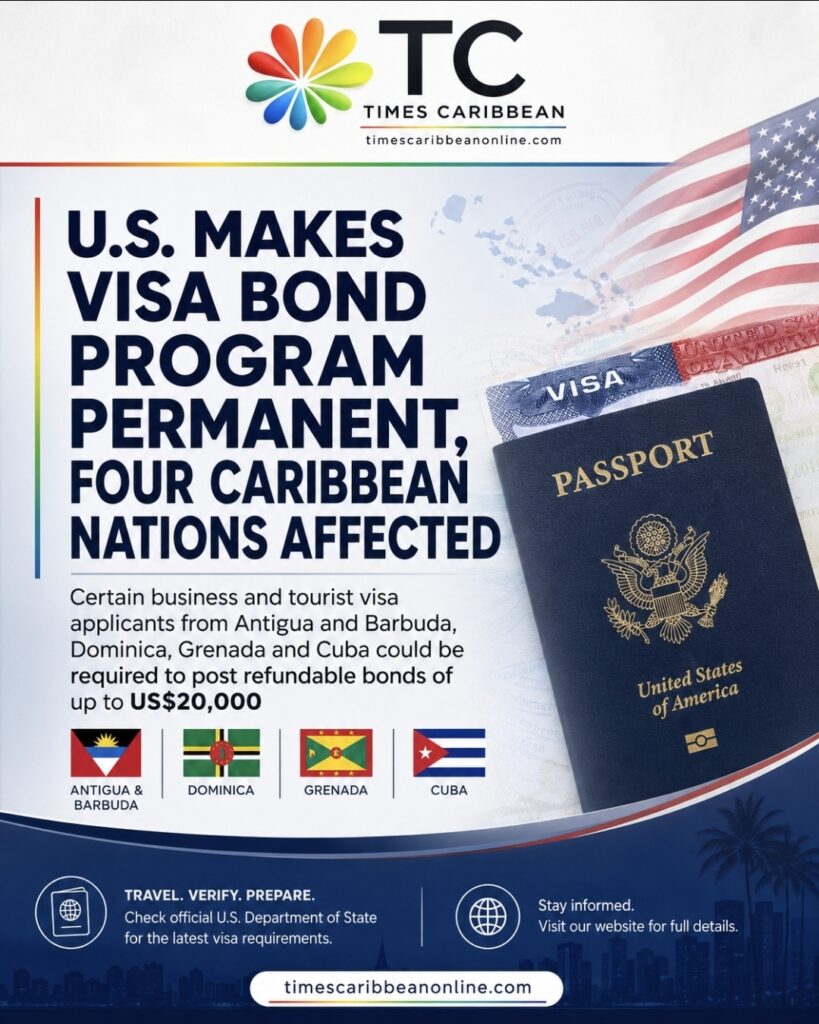
U.S. MAKES VISA BOND PROGRAM PERMANENT, FOUR CARIBBEAN NATIONS AFFECTED
Certain business and tourist visa applicants from Antigua and Barbuda, Dominica, Grenada and Cuba could be required to post refundable bonds of up to US$20,000
WASHINGTON, D.C. — The United States has made its Visa Bond Program permanent, introducing refundable financial guarantees of US$10,000, US$15,000 or US$20,000 for covered applicants seeking B-1 business or B-2 tourist visas.
The final rule took effect on Monday, August 3, 2026, replacing the 12-month pilot programme launched in August 2025. Under the new system, U.S. consular officers may require a bond as a condition of issuing a visa to applicants from designated countries.
The United States Department of State’s current list includes four Caribbean nations: Antigua and Barbuda, Dominica, Grenada and Cuba. Nationals of countries already covered by the pilot programme will continue to be subjected to the requirement unless their country is removed from the list. The United States may also add or remove countries as the programme continues.
What is a visa bond?
A visa bond is not an additional visa application fee, and paying it does not guarantee that a visa will be granted.
It is a financial guarantee intended to encourage visitors to respect the conditions of their visas, maintain their approved immigration status and leave the United States within the period authorised by immigration officials.
Applicants should only make a bond payment after receiving official instructions from a U.S. consular officer. The payment will be processed electronically through the designated U.S. government payment system.
How much could applicants pay?
Consular officers will determine whether the bond should be US$10,000, US$15,000 or US$20,000 after considering the applicant’s circumstances, including the purpose of travel, employment, income, education, skills and connections within the United States.
The rule indicates that officers are generally expected to set the bond at US$15,000. It may be reduced to US$10,000 where appropriate or increased to US$20,000 when an officer determines that a higher guarantee is necessary.
Does every Caribbean traveller have to pay?
No.
The requirement does not apply automatically to every Caribbean national or every type of U.S. visa. It is connected specifically to covered B-1 business and B-2 tourist visa applications from countries included in the programme.
However, applicants from listed countries who fall within the programme’s scope and are otherwise eligible for a visa will generally be required to post the assigned bond before the visa can be issued.
A bond may be waived where U.S. authorities determine that doing so would support a national or humanitarian interest. Applicants cannot submit a separate application requesting such a waiver.
When is the money returned?
The bond is refundable when the traveller complies with its conditions.
The funds may be returned when the visa holder leaves the United States on time, follows the conditions of the visa or does not travel before the visa expires. The money may also be returned if the applicant is subsequently denied the visa or denied admission at a U.S. port of entry.
Travellers covered by the bond must enter and leave through commercial airports, including approved U.S. Customs and Border Protection preclearance locations. Land and sea ports cannot normally be used to satisfy the programme’s entry and departure conditions.
No interest will be paid on the refunded bond.
The full amount may be forfeited if the visa holder remains in the United States beyond the authorised period or substantially breaches other conditions attached to the bond.
Why were these countries selected?
According to the final rule, countries may be selected based on concerns involving visa overstay rates, information-sharing arrangements, identity verification, access to criminal records, screening procedures and the security of travel and civil documents, including procedures connected to the granting of citizenship.
The regulation does not identify Citizenship by Investment programmes as the sole reason for including any country. Instead, it establishes a broader group of factors that U.S. authorities may consider when determining which countries should be covered.
The policy could significantly affect travel planning for some Caribbean residents, particularly families and business travellers who may now have to place substantial funds on deposit before receiving a visitor visa.
Applicants are being encouraged to follow instructions issued directly by U.S. embassies and consulates and to avoid making payments through unofficial websites or third parties.
#USVisaPolicy #CaribbeanNews #ImmigrationUpdate #TimesCaribbean
















Leave a comment
You must be logged in to post a comment.