CANADA TIGHTENS VISA SCRUTINY AS CARIBBEAN CBI PASSPORT HOLDERS FACE GREATER DOCUMENT AND IDENTITY CHECKS
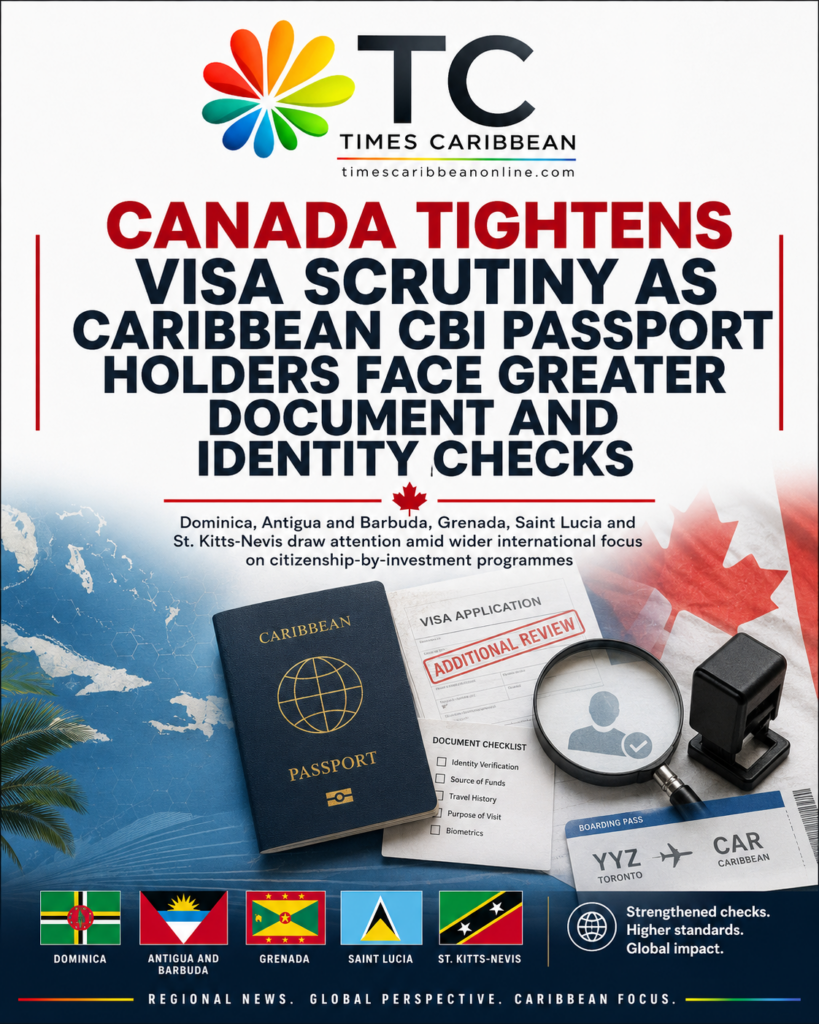
Dominica, Antigua and Barbuda, Grenada, Saint Lucia and St. Kitts-Nevis draw attention amid wider international focus on citizenship-by-investment programmes
Times Caribbean — August 24, 2026
Caribbean nationals seeking to travel to Canada are being reminded that accuracy, consistency and verifiable information are increasingly important as Canadian immigration authorities continue strengthening identity and document checks across the visa system.
Particular attention has been drawn to Dominica, Antigua and Barbuda, Grenada, Saint Lucia, and St. Kitts and Nevis — five Eastern Caribbean states that operate citizenship-by-investment programmes.
But there is an important distinction.
Canada has not announced a new visa ban against these five Caribbean countries, nor has Immigration, Refugees and Citizenship Canada publicly identified a special 2026 verification programme exclusively targeting their nationals.
Instead, official Canadian guidance shows a broader screening system in which immigration officers assess the completeness of applications, verify information supplied by applicants and may request interviews, additional documents, medical examinations or police certificates where necessary. Canada also warns that incomplete applications may be refused.
For applicants, that means even seemingly small discrepancies involving names, employment details, travel history, financial information, family relationships or the stated purpose of travel can potentially lead to further examination or longer processing.
Canadian authorities explicitly state that processing times can depend partly on how easily an applicant’s information can be verified.
Identity verification is another major part of the system. Most temporary-residence applicants who are not exempt must provide fingerprints and a photograph, which Canada says are used to confirm identity and assist in assessing applications.
The issue has particular relevance for Caribbean countries operating CBI programmes, under which qualifying foreign investors may obtain citizenship after completing the required legal and due-diligence processes. These programmes have faced sustained international calls for stronger transparency, due diligence and identity safeguards.
However, possession of a Caribbean passport obtained through a CBI programme does not automatically mean a Canadian visa application will be refused. Each application remains subject to Canada’s immigration requirements and individual assessment.
For Dominican nationals specifically, Canada continues to provide a pathway for visitor-visa applications. Official Canadian instructions state that applications requiring submission by mail from Dominica are handled through the High Commission of Canada in Port of Spain, Trinidad and Tobago.
Meanwhile, citizens of Antigua and Barbuda, St. Kitts and Nevis and Saint Lucia are among nationals of certain visa-required countries who may qualify for an electronic travel authorization, or eTA, when travelling to Canada by air if they meet Canada’s eligibility conditions. Otherwise, a visitor visa remains necessary.
The message for Caribbean travellers in 2026 is therefore straightforward: documentation must add up.
Applicants should ensure that passports, employment records, financial information, invitation letters, previous immigration history and explanations of their travel plans are accurate and consistent before submission.
Canada’s published rules make clear that stronger verification is part of its wider immigration-security framework — not evidence, at this stage, of a newly announced visa crackdown specifically against the five Eastern Caribbean CBI states.
Times Caribbean will continue monitoring any official Canadian immigration changes affecting Caribbean passport holders.
















Leave a comment
You must be logged in to post a comment.