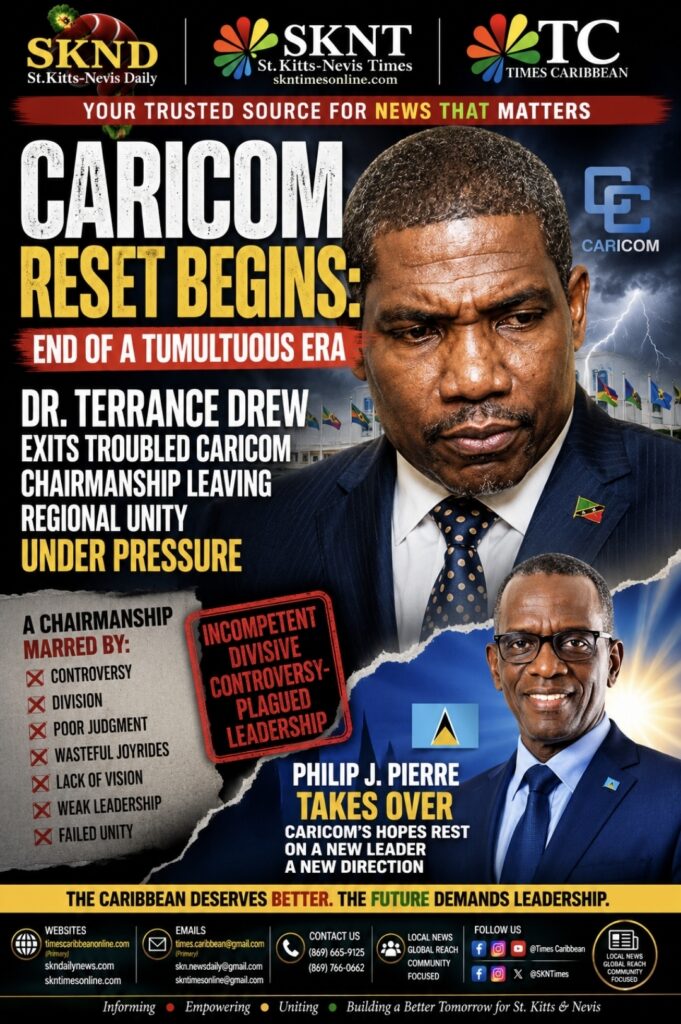
CARICOM RESET BEGINS: End of a Tumultuous Era: Dr. TERRANCE Drew Exits Troubled CARICOM Chairmanship leaving Regional Unity Under Pressure : Philip J. Pierre Takes Over After Incompetent, Divisive, Controversy-Plagued Leadership
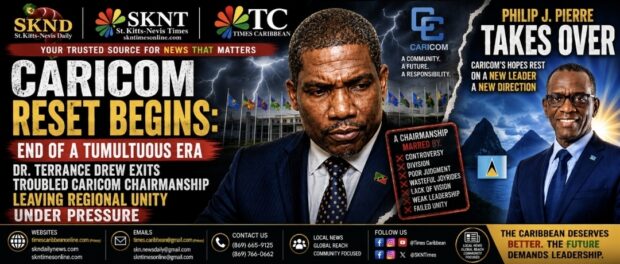
As Saint Lucia’s Prime Minister Philip J. Pierre assumes the CARICOM Chairmanship on 1 July 2026, the region should not simply mark a routine rotation of leadership. It should mark the end of one of the most troubled, divisive and politically bruising chairmanships CARICOM has witnessed in modern times.
Pierre now steps into the chair at a moment when the Caribbean Community badly needs seriousness, discipline and credibility. CARICOM has confirmed that Saint Lucia will host the 51st Regular Meeting of Heads of Government from 5–8 July 2026, under Pierre’s chairmanship, after he formally assumes duties on 1 July.
Dr. Terrance Drew’s six-month tenure, by contrast, will likely be remembered less for regional achievement and more for confusion, controversy and institutional embarrassment.
The defining crisis came with the reappointment of Dr. Carla Barnett as CARICOM Secretary-General. CARICOM stated that the required majority of Heads agreed to her reappointment during the February 24–27 Heads meeting in St. Kitts and Nevis, with her second term beginning in August 2026. But that explanation did not end the controversy. It inflamed it.
Trinidad and Tobago’s Prime Minister Kamla Persad-Bissessar publicly blasted the process, reportedly describing it as “surreptitious, corrupted and flawed,” while accusing CARICOM of failing to respond transparently to concerns raised by Trinidad and Tobago. Caribbean National Weekly also reported her statement that CARICOM could not continue to hide what she described as a “corrupt backroom operation.”
That was not ordinary diplomatic disagreement. That was a sitting CARICOM Head of Government openly questioning the integrity of the regional institution during Drew’s chairmanship.
Even more damning, respected Antigua and Barbuda diplomat Sir Ronald Sanders urged Dr. Barnett to consider resigning, saying that if he were in her position, he would step aside rather than stand in the way of Caribbean integration. When voices of that stature are publicly calling for such a move, the crisis is no longer gossip. It is a leadership failure.
And where was Drew’s steady hand? Where was the regional statesmanship? Where was the ability to cool tensions, command confidence and restore trust?
Instead, CARICOM appeared defensive, divided and flat-footed.
Drew’s chairmanship also unfolded against a wider backdrop of regional fracture. The Associated Press reported that Persad-Bissessar intensified conflict with CARICOM neighbours over U.S. policy, Venezuela and the future of the Secretary-General, while calling for organisational reform and raising concerns about Trinidad and Tobago’s financial contributions to the bloc. The Guardian reported that CARICOM leaders struggled to maintain unity amid U.S.-Cuba tensions, U.S. military actions and competing national positions within the bloc.
This was the period when CARICOM needed a firm, respected, unifying chair. Instead, the region got a chairmanship that critics saw as heavy on optics and painfully light on outcomes.
The much-publicised tour of CARICOM capitals before hosting the very leaders in St. Kitts and Nevis remains one of the most questionable exercises of Drew’s tenure. Supporters may call it diplomacy. Critics saw a costly parade of photo opportunities, brief courtesy calls and symbolic visits that produced no clearly measurable regional breakthrough.
At a time when Caribbean people are demanding food security, climate financing, lower travel costs, stronger regional transport, crime cooperation, energy resilience and meaningful implementation of free movement, Drew’s chairmanship became associated with ceremony, spectacle and crisis management failure.
That is the tragedy of his CARICOM tenure.
He inherited a platform from which he could have strengthened St. Kitts and Nevis’ regional reputation. Instead, his chairmanship became entangled in accusations of poor process, weak communication, institutional distrust and widening division among member states.
Pierre now has an opportunity to reset the tone.
He must move CARICOM away from public relations diplomacy and toward results Caribbean citizens can see and feel. He must prioritise transparency, rebuild confidence among member states, and prove that regional integration is more than speeches, summits and staged photographs.
Drew’s chairmanship is over. For many critics, not a moment too soon.
The Caribbean now needs leadership that is disciplined, credible, transparent and serious. Pierre’s first test is simple: make CARICOM look like a functioning regional institution again.
















Leave a comment
You must be logged in to post a comment.