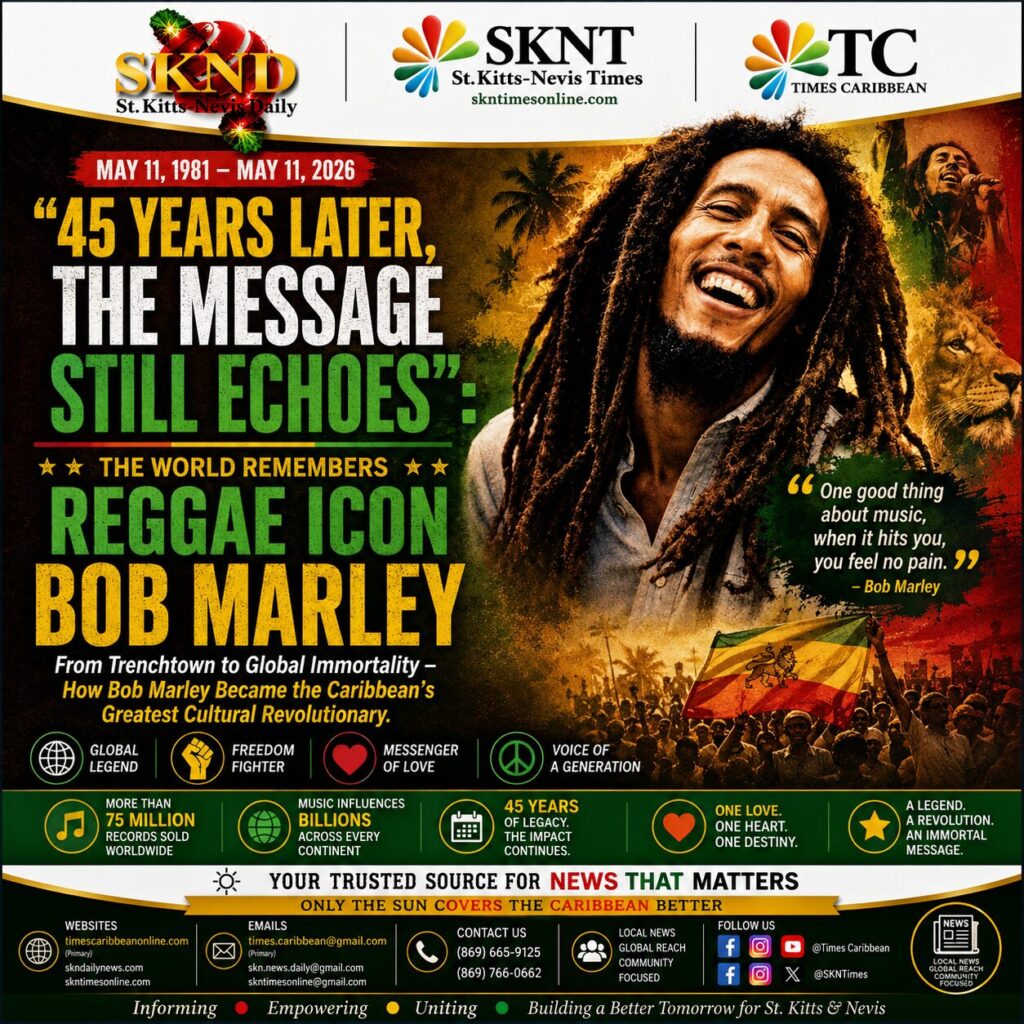
“45 YEARS LATER, THE MESSAGE STILL ECHOES”: THE WORLD REMEMBERS REGGAE ICON BOB MARLEY
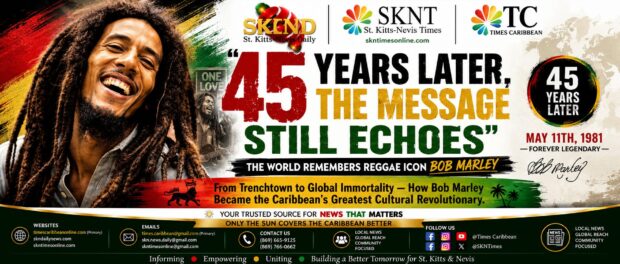
From Trenchtown to Global Immortality — How Bob Marley Became the Caribbean’s Greatest Cultural Revolutionary
TIMES CARIBBEAN | SKN TIMES | ST. KITTS-NEVIS DAILY
Today marks 45 years since the passing of reggae legend , whose death on May 11, 1981, sent shockwaves across Jamaica, the Caribbean, and the wider world — but whose voice, message, and revolutionary cultural impact have only grown louder with time.
Four and a half decades later, Marley is no longer viewed simply as a musician. He has become a global symbol of resistance, Black empowerment, African identity, spiritual consciousness, peace, liberation, and Caribbean pride.
For millions across the world, Bob Marley remains the single most influential cultural ambassador the Caribbean has ever produced.
Born Robert Nesta Marley on February 6, 1945, in Nine Mile, St. Ann, Jamaica, Marley rose from humble beginnings to become one of the most recognizable faces and voices in modern history. Emerging from the tough streets of Trenchtown in Kingston, he transformed reggae music from a local Jamaican sound into a worldwide movement that penetrated every continent, race, religion, and political system.
Today, his music continues to dominate streaming platforms, documentaries, festivals, radio stations, and political rallies worldwide. Songs such as One Love, Redemption Song, No Woman, No Cry, Get Up, Stand Up, Exodus, and Three Little Birds remain timeless anthems of hope, struggle, and survival.
THE MAN WHO GLOBALIZED REGGAE
Before Marley, reggae was largely viewed as a uniquely Jamaican genre with limited international exposure. After Marley, reggae became a global language.
Music historians widely credit Marley and The Wailers with opening the doors for Caribbean music on the world stage long before globalization and social media made cultural exchange easier.
His fusion of reggae rhythms with politically charged lyrics and spiritual messaging created a sound that resonated deeply during an era marked by Cold War tensions, anti-colonial struggles, racial injustice, apartheid, poverty, and political violence.
At the height of his fame during the 1970s, Marley was viewed not just as an entertainer but as a revolutionary figure capable of influencing public consciousness across borders.
Few moments symbolized this more powerfully than the historic 1978 One Love Peace Concert in Jamaica, where Marley famously brought political rivals Michael Manley and Edward Seaga together on stage in a symbolic gesture of unity amid deadly political violence.
A CARIBBEAN ICON WHO BECAME A GLOBAL BRAND
Forty-five years after his death at age 36 from melanoma cancer, the Marley legacy has evolved into one of the most powerful cultural brands in entertainment history.
His image appears on murals, flags, university campuses, clothing lines, tourism campaigns, and protest movements from Africa to Europe, Latin America, Asia, and the United States.
Industry analysts estimate the Marley brand generates tens of millions of dollars annually through music streams, merchandise, licensing, documentaries, and global entertainment ventures.
Yet despite the commercialization surrounding his image, many admirers argue that Marley’s core message remains remarkably intact: liberation of the oppressed, spiritual awakening, African unity, resistance to injustice, and love for humanity.
WHY BOB MARLEY STILL MATTERS IN 2026
In an age dominated by social media algorithms, political division, war, economic instability, mental health struggles, and growing social inequality, Marley’s music has experienced a powerful resurgence among younger generations searching for authenticity and meaning.
Across the Caribbean, Marley continues to represent something even deeper — proof that a small island voice can influence the entire world.
His success fundamentally changed international perceptions of Jamaica and Caribbean culture, helping establish reggae as one of UNESCO’s recognized cultural treasures and opening pathways for countless Caribbean artistes who followed.
Today, reggae, dancehall, soca, Afro-Caribbean fusion music, and Caribbean identity itself owe part of their international acceptance to the foundation Marley helped create.
THE SPIRITUAL AND POLITICAL DIMENSION
Marley’s influence extended far beyond music charts.
Through his embrace of Rastafari philosophy, Pan-African consciousness, and anti-oppression messaging, Marley challenged global systems of inequality while promoting Black dignity and spiritual empowerment.
Songs like War, inspired by a speech from Ethiopian Emperor Haile Selassie I, became powerful declarations against racism and injustice worldwide.
For many scholars, Marley succeeded in doing what few entertainers ever achieve: turning music into a geopolitical and spiritual force.
THE LEGACY LIVES ON
Today, memorial events, tribute concerts, radio specials, documentaries, and social media tributes are unfolding across the Caribbean and around the globe as fans commemorate the 45th anniversary of Marley’s passing.
In Jamaica, Marley remains both a national hero and an international tourism powerhouse whose cultural footprint continues attracting visitors from around the world.
Meanwhile, new generations continue discovering his music decades after his death — perhaps the clearest sign that Bob Marley achieved something very few artists ever accomplish: immortality.
Forty-five years later, the man may be gone, but the message still echoes.
And in many ways, the world may need that message now more than ever.
#BobMarley #ReggaeLegend #Jamaica #CaribbeanCulture #TimesCaribbean #OneLove #Reggae #MusicLegend #CaribbeanIcons #BobMarley45 #RedemptionSong #GlobalImpact
















Leave a comment
You must be logged in to post a comment.