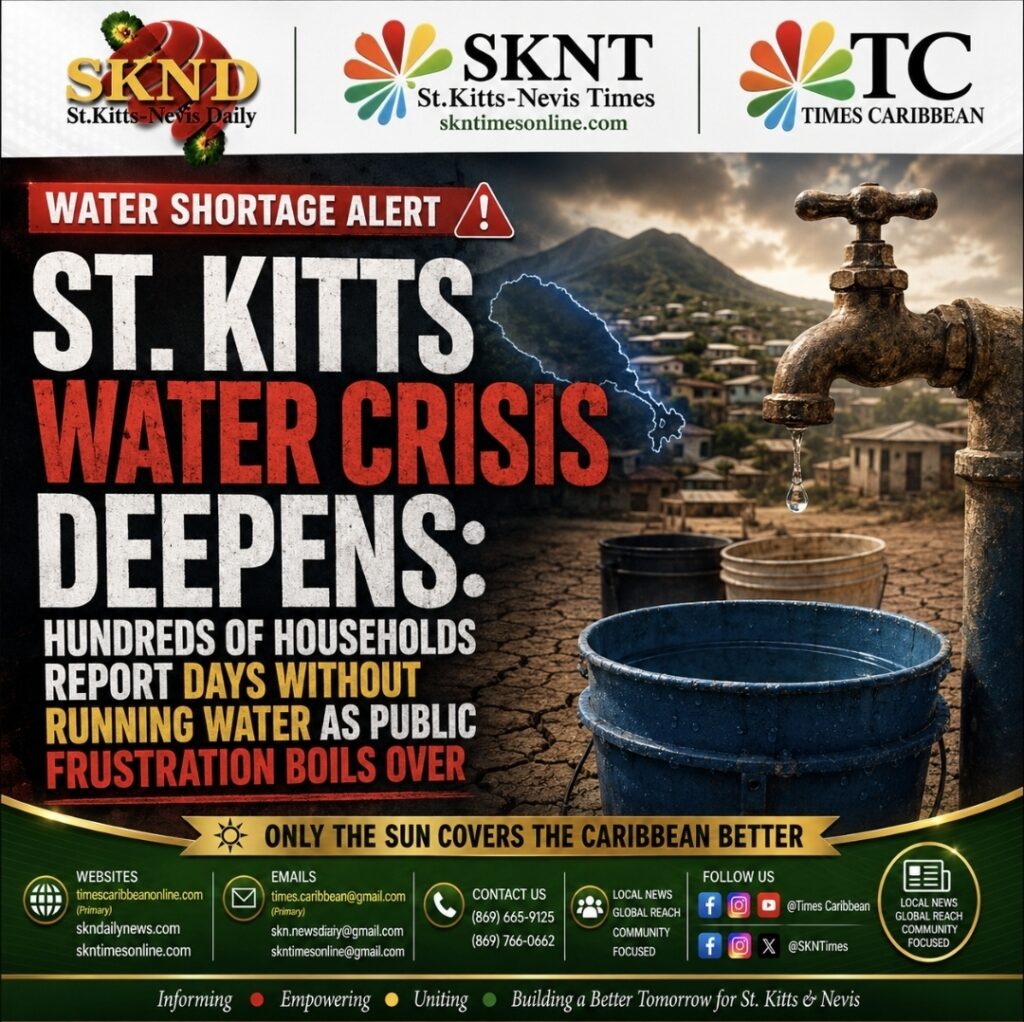
St. Kitts Water Crisis Deepens: Hundreds of Households Report Days Without Running Water as Public Frustration Boils Over

By SKN Times / St. Kitts-Nevis Daily
BASSETERRE, ST. KITTS, Sunday, June 7, 2026 — The water crisis in St. Kitts is once again gripping communities across the island, with hundreds of households reportedly enduring days without reliable running potable water, even as government officials continue to insist that progress is being made.
In some areas, residents say they have gone as long as seven days without a consistent supply. In other communities, households are reporting two to three days without running water, creating growing frustration, hardship and anger among families who say the situation has become unbearable.
Today, Sunday, residents in St. Peter’s were among those raising fresh concerns, complaining that some households have been without running water for at least three days. Similar complaints are being heard from other parts of the country, where residents say the official explanations do not match the daily reality of dry pipes, filled buckets, disrupted routines and mounting inconvenience.
The crisis comes despite repeated public pronouncements by the government that the long-running water challenges in St. Kitts had either improved, were being resolved, or were on a clear path to resolution.
Minister responsible for water, Hon. Konris Maynard, has used the media to explain the current shortage, pointing to drought conditions that are affecting not only St. Kitts but much of the wider Caribbean region. While drought is undoubtedly a serious and legitimate regional challenge, many residents are questioning whether drought alone explains the depth and persistence of the St. Kitts water crisis.
The comparison with Nevis has only intensified those questions. Nevis is facing similar dry conditions, yet has not been experiencing the same level of widespread public frustration over prolonged water outages. To many observers, that contrast raises a difficult but unavoidable question: is Nevis managing its water resources more effectively than St. Kitts?
In February, the country was told that the commissioning of the Basseterre Desalination Plant would bring dramatically improved potable water supply, especially for Basseterre and surrounding communities. That announcement was presented as a major breakthrough in the government’s effort to address chronic water shortages.
But months later, many households say the promised relief has not reached them.
Instead, the public has seen reports and official explanations indicating that the desalination plant has faced operational pauses, including what officials described as routine maintenance — a troubling development for some residents, particularly because the plant had only recently been commissioned.
For many citizens, the issue is no longer the number of announcements made, the number of press releases issued, or the number of speeches delivered. The issue is simple: when they turn on the pipe, water must come out.
And for too many households in St. Kitts, that is still not happening.
The honest and difficult reality is that, despite the government’s repeated assurances, the water situation in St. Kitts has not improved in the way residents were led to expect. In many communities, citizens argue that the situation has worsened.
Minister Maynard has made several efforts to explain the dilemma and outline the government’s response. However, for residents carrying buckets, storing emergency water, adjusting household routines, and worrying about sanitation, those explanations are not making daily life any easier.
For many citizens, the minister’s statements simply do not correlate with the situation on the ground.
The growing public frustration is not merely about inconvenience. Reliable potable water is a basic necessity. It affects homes, schools, businesses, health care, hygiene, food preparation and the dignity of everyday life. When households go days without water, the impact is immediate and deeply personal.
The crisis is also political.
During the election campaign and throughout the past four years, the Drew administration repeatedly promised to tackle and resolve the water crisis. Yet, in 2026, residents are still hearing familiar explanations, still facing dry taps, and still waiting for the promised transformation.
Critics say the water issue has now joined a growing list of high-profile government promises that appear to remain “on the way” — from the new Basseterre High School, to the smart hospital, to thousands of promised NHC homes, and now, reliable 24-hour water.
For affected households, “on the way” is no longer good enough.
The government may point to drought. It may point to infrastructure challenges. It may point to ongoing upgrades, wells, desalination, maintenance schedules and technical constraints. But after years of promises, residents are entitled to ask one basic question:
When will the water crisis actually end?
The bottom line is that, despite his public explanations and visible attempts to address the situation, Minister Konris Maynard and the Dr. Terrance Drew administration have not yet delivered the reliable water solution that was promised to the people of St. Kitts.
For the families in St. Peter’s and across the island facing another day without running water, the issue is not political spin. It is survival, dignity and basic public service.
The pipes are still dry.
The frustration is still rising.
And the people of St. Kitts are still waiting.
















Leave a comment
You must be logged in to post a comment.