THE $4.8 MILLION SUPERCOW: How Brazil’s Viatina-19 Became the World’s Most Expensive Symbol of Beef, Biology and Big Business
By Times Caribbean
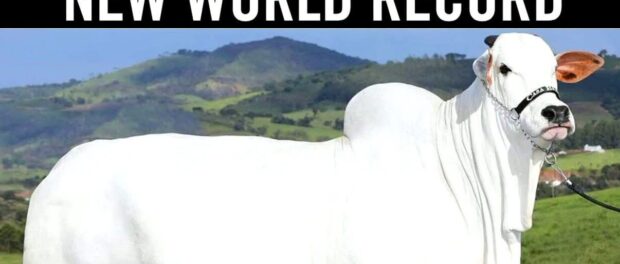
In Brazil, where cattle are not merely livestock but an economic engine, a snow-white Nelore cow named Viatina-19 FIV Mara Movéis has become the unlikely face of a new agricultural gold rush.
She is not being valued for milk. She is not being fattened for slaughter. She is being guarded, studied, bred, cloned and celebrated because of what may be the most valuable commodity in modern cattle farming: her DNA.
Viatina-19 has reportedly been valued at approximately US$4.8 million, making her one of the most expensive cows ever sold. Her egg cells have been valued at around US$250,000 per collection opportunity, a staggering figure that turns cattle breeding into a world of elite genetics, high-stakes auctions and laboratory-assisted reproduction. CBS News, citing the Associated Press and Guinness World Records, reported in 2024 that Viatina-19 was worth about US$4 million at the time and was the most expensive cow ever sold at auction.
At 1,101 kilograms, or more than 2,400 pounds, Viatina-19 is roughly twice the weight of the average adult cow of her breed. But her value is not just her size. Breeders prize her because she gained exceptional muscle unusually quickly, has strong fertility traits, and has reportedly passed those qualities to her offspring.
That is where the real business begins.
A single egg cell from Viatina-19 can be collected, fertilised in a laboratory with sperm from a top bull, and the resulting embryo implanted into a surrogate cow. The surrogate carries the pregnancy, but the genetic value belongs to Viatina-19 and the selected bull. In other words, Brazil’s most famous cow is not just an animal. She is a living genetic franchise.
The numbers are almost unbelievable. An ordinary calf in Brazil may sell for only a few hundred dollars. A regular bull from the same breed may sell for a few thousand. But one collection opportunity involving Viatina-19’s eggs can command more than the value of hundreds of ordinary calves.
That is the economics of elite cattle genetics: the cow herself may be priceless, but her reproductive potential is a recurring revenue stream.
Brazil’s Billion-Dollar Beef Ambition
Viatina-19’s rise is not an isolated curiosity. It is part of Brazil’s massive agricultural strategy.
Brazil has more than 230 million cattle, according to figures cited in the CBS/AP report, giving it one of the largest cattle populations in the world. The country is already a global beef powerhouse and continues to push aggressively into export markets. Recent Reuters reporting describes Brazil as one of the world’s leading beef exporters, with China remaining a major buyer of Brazilian beef.
For Brazilian breeders, cows like Viatina-19 represent a national competitive advantage. If one animal can produce offspring that grow faster, carry more muscle, tolerate heat better and reproduce efficiently, then her genetics can ripple through herds, auctions, ranches and export markets.
That is why she is treated less like a farm animal and more like a national asset.
Reports describe her living under tight protection, with surveillance, veterinary oversight and controlled access. In a country where cattle wealth is serious business, Viatina-19 is a high-value biological investment.
The Nelore Advantage
Viatina-19 belongs to the Nelore breed, a white, hump-backed cattle breed descended from Indian Zebu cattle. Nelore animals are prized in Brazil because they are hardy, heat-tolerant and well adapted to tropical conditions.
CBS/AP reported that Zebu cattle, including Nelore, make up a major share of Brazil’s herd, with the Nelore breed central to the country’s beef production system.
That matters for the Caribbean and other tropical regions as well. In hot climates, cattle that can withstand heat, resist stress, convert feed efficiently and maintain reproductive performance are extremely valuable. The Viatina-19 story is therefore not just a Brazilian story. It is a case study in how climate-adapted genetics are becoming big business.
Beauty, Muscle and Market Power
Viatina-19 has also become a celebrity in the world of cattle shows. She has reportedly won major beauty and breed recognition, including high-profile titles linked to international cattle competitions.
To outsiders, a cattle beauty contest may sound unusual. But in elite breeding circles, the show ring can dramatically increase an animal’s commercial value. Judges assess structure, muscle, posture, breed characteristics, fertility potential and overall presentation. A winning cow can become a brand.
Viatina-19 is now exactly that: a brand.
Her owners and investors are not simply selling biology. They are selling reputation, performance, status and the possibility that her offspring could become the next generation of elite cattle.
Shared Ownership, Shared Profits
Because of the extraordinary cost, cows like Viatina-19 are often owned in shares. Wealthy ranchers and companies purchase portions of the animal, then split earnings from egg sales, breeding rights, embryos, clones and future offspring.
That model turns cattle into an investment portfolio.
One buyer reportedly acquired a major share in Viatina-19 before her valuation surged. As her fame and genetic demand increased, so did the value of ownership stakes. The cow became an appreciating asset, not unlike rare bloodstock in horse racing or elite seed genetics in agriculture.
The difference is that Viatina-19 is a living factory of future value.
The Cloning Frontier
Down the road from elite auctions, laboratories are pushing the next stage of the industry. Companies such as Geneal Animal Genetics and Biotechnology have reportedly worked with surrogate cows carrying cloned embryos of champion cattle. CBS/AP reported that clones of Viatina-19 were expected and that the cloning business forms part of Brazil’s wider cattle genetics industry.
Cloning does not mean every future herd will be filled with identical supercows. Experts caution that elite animals like Viatina-19 require special care and may not be practical for every commercial farming system. CBS/AP quoted an international cattle genetics specialist who warned that she is not “the answer for all cattle everywhere.”
Still, cloning and embryo transfer allow breeders to multiply rare genetic traits faster than traditional breeding would allow. That makes the technology extremely attractive in a world where meat producers want more output, better efficiency and stronger animals.
The Environmental Question
The Viatina-19 story also arrives at a complicated moment.
Brazil’s cattle industry is economically powerful, but it has long faced scrutiny over deforestation, methane emissions and land use. CBS/AP noted that beef production is a major source of agricultural greenhouse gases and has been linked to Amazon deforestation.
Supporters of genetic improvement argue that faster-growing, more efficient cattle could reduce the time animals spend before slaughter, potentially lowering resource use per pound of beef. Critics and environmental experts argue that genetics alone cannot solve the deeper challenges of land management, pasture quality, emissions and forest protection.
So Viatina-19 represents both promise and pressure: promise for productivity, pressure over sustainability.
Why the Caribbean Should Pay Attention
For the Caribbean, Viatina-19’s story is more than a viral headline about an expensive cow.
It points to the future of agriculture in small and climate-vulnerable economies. The region often speaks about food security, agricultural resilience and reducing import dependence. But the Brazilian example shows that modern agriculture is increasingly driven by science, genetics, branding and technology.
The lesson is not that Caribbean farmers need million-dollar cows. The lesson is that livestock development can no longer rely only on traditional systems. Breed quality, climate adaptation, veterinary science, artificial insemination, embryo transfer, data tracking and farmer cooperatives are becoming central to competitiveness.
Brazil is using cattle genetics to strengthen its position in global beef. The Caribbean can use appropriate livestock science to improve local meat production, reduce losses, support farmers and build more resilient food systems.
A Cow Worth More Than Gold
Viatina-19 may live in a pasture, but she belongs to a world of laboratories, investors, auctions, export markets and national ambition.
She is a cow, but also a symbol.
A symbol of Brazil’s determination to dominate global beef.
A symbol of how science is transforming agriculture.
A symbol of how one animal’s genetic traits can become a multimillion-dollar industry.
And perhaps most remarkably, a symbol of a future where the most valuable thing on the farm may not be the animal itself, but the DNA it carries.
In Brazil, Viatina-19 is not heading to market.
She is the market.
















Leave a comment
You must be logged in to post a comment.