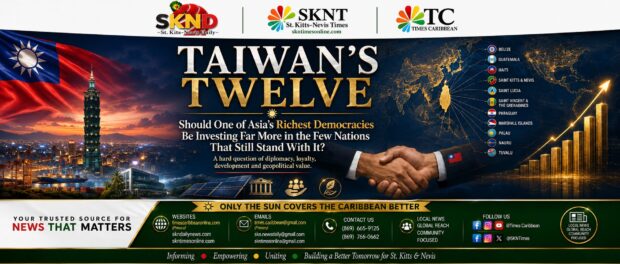
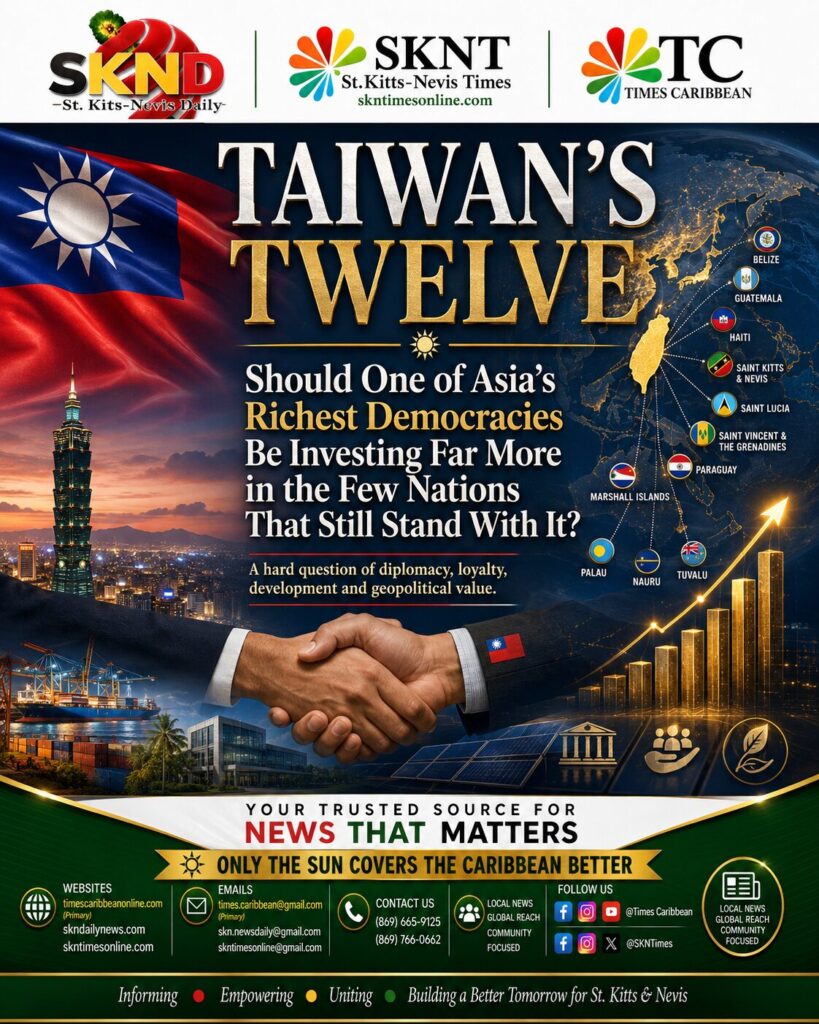
TAIWAN’S TWELVE: Should One of Asia’s Richest Democracies Be Investing Far More in the Few Nations That Still Stand With It?
By Times Caribbean
Taiwan is one of the most technologically advanced, strategically important and economically powerful societies on earth. It is a semiconductor superpower, a pillar of the global electronics supply chain, and a democracy whose very existence has become one of the defining geopolitical questions of the 21st century.
Yet for all of Taiwan’s wealth, influence and global importance, its formal diplomatic recognition rests on a remarkably small circle of friends.
As of 2026, Taiwan’s Ministry of Foreign Affairs lists its diplomatic allies as a short group that includes St. Kitts and Nevis, Saint Lucia, St. Vincent and the Grenadines, Belize, Guatemala, Haiti, Paraguay, Eswatini, the Marshall Islands, Palau, Tuvalu and the Holy See. In the Caribbean and Latin America alone, Taiwan officially lists seven formal allies, including St. Kitts and Nevis.
That raises a serious and uncomfortable question: should Taiwan be investing much more in the countries that continue to recognize its existence on the world stage?
For small states such as St. Kitts and Nevis, the question is not anti-Taiwan. It is not hostile. It is not ungrateful.
It is strategic.
It is diplomatic.
And it is long overdue.
St. Kitts and Nevis: One of Taiwan’s Earliest and Steadiest Friends
St. Kitts and Nevis established diplomatic relations with the Republic of China, Taiwan, in 1983, shortly after gaining independence. Official St. Kitts-Nevis government information confirms that diplomatic relations were established on September 23, 1983.
That timing matters.
St. Kitts and Nevis was not a latecomer to Taiwan’s corner. It did not wait for decades of international uncertainty before choosing a side. It stood with Taiwan at the very beginning of its own independent journey.
For more than four decades, successive administrations in Basseterre have maintained that recognition despite enormous pressure, shifting global alignments, and the growing economic weight of the People’s Republic of China.
In diplomatic terms, that kind of loyalty is not symbolic. It is valuable.
In geopolitical terms, it is priceless.
Taiwan’s Wealth Versus the Realities of Its Allies
Taiwan’s economy is vast compared to most of its diplomatic partners. IMF-linked data places Taiwan’s nominal GDP near US$976.7 billion for 2026, while Taiwan’s own statistical authorities forecast GDP at current prices of more than NT$32 trillion for 2026.
This is not a struggling island searching for spare change. Taiwan is an advanced economy with world-class industries, especially in semiconductors, manufacturing, artificial intelligence-linked supply chains and high-tech exports.
At the same time, several of Taiwan’s remaining diplomatic allies are small, vulnerable, climate-exposed developing states. They face high debt pressures, rising infrastructure costs, limited fiscal space, public health needs, education demands, housing challenges, climate adaptation costs and economic shocks from hurricanes, pandemics and global instability.
That contrast creates the central issue.
If Taiwan’s remaining allies are asked to carry diplomatic weight on the global stage, then the partnership should be deep enough, visible enough and transformative enough to match the value of that recognition.
The $14 Billion Defence Question
The issue has become even sharper because Taiwan’s security needs are enormous. A proposed U.S. arms package for Taiwan has been reported at about US$14 billion, which Reuters described as potentially the largest ever for the island. More recent reporting indicated that the package has been discussed amid U.S.-China tensions, with questions over timing and possible delays.
Taiwan has every right to invest in its defence. Its security situation is complex and serious. Beijing continues to claim Taiwan, while Taiwan’s government rejects that claim and insists its future should be decided by its people. Reuters has reported that Taiwan views U.S. arms sales as vital to maintaining peace in the Taiwan Strait.
But the comparison is unavoidable.
If Taiwan can contemplate defence packages in the tens of billions, then it is fair for its diplomatic allies to ask whether development partnerships should be scaled up as well.
Not as charity.
As strategy.
The Recognition Dividend: What Is It Worth?
Recognition is not a small favour.
For Taiwan, diplomatic allies provide something that money cannot easily buy: international legitimacy. They help ensure that Taiwan is not erased from the diplomatic map. They speak for Taiwan in international spaces. They keep embassies open. They host official visits. They sign agreements. They help maintain the argument that Taiwan has sovereign friends, not merely unofficial commercial partners.
That has real value.
So the question becomes: what is the fair return for that diplomatic loyalty?
Taiwan has supported St. Kitts and Nevis over the years through scholarships, agriculture projects, health cooperation, technical missions, ICT support, community initiatives and infrastructure-related assistance. Those contributions should be acknowledged. They have helped people, improved capacity and strengthened bilateral ties.
But the deeper question is whether the scale of support matches the scale of the geopolitical value.
A scholarship programme is helpful.
A small project is welcome.
A technical mission is meaningful.
But can that be the ceiling of ambition between a trillion-dollar economy and one of the few states that still formally recognizes it?
Surely not.
What Bigger Investment Could Look Like
A modern Taiwan-St. Kitts and Nevis partnership should move beyond ceremonial diplomacy and modest project assistance. It should become a bold model of strategic development.
Taiwan could consider major long-term investments in areas such as:
Health infrastructure: A Taiwan-backed regional medical centre, specialist care partnerships, diagnostic technology and modern hospital systems.
Education and skills: A full Taiwan-Caribbean technology institute focused on AI, coding, cybersecurity, engineering, renewable energy and advanced manufacturing.
Agriculture and food security: Climate-smart farms, greenhouse networks, livestock improvement, fisheries technology and agro-processing facilities.
Renewable energy: Solar farms, battery storage, grid modernization and community energy resilience.
Digital economy: A Taiwan-supported innovation park for small states, helping young entrepreneurs build businesses in software, e-commerce, digital media and tech services.
Housing and infrastructure: Smart, climate-resilient housing projects using Taiwanese engineering and financing models.
Manufacturing and logistics: Small-scale assembly, medical supply production, ICT equipment servicing and regional distribution hubs.
These are not handout ideas. These are investment ideas. They would create jobs, build human capital, deepen loyalty and give Taiwan a stronger development footprint in the Caribbean.
Why Taiwan Should Care
Taiwan’s remaining allies are not just names on a diplomatic list. They are its front line of formal international recognition.
If those relationships are treated too lightly, Taiwan risks allowing frustration to grow quietly beneath polite diplomatic language. Small states may remain friendly, but citizens will increasingly ask harder questions: What is recognition producing? Are we maximizing our diplomatic value? Are our people seeing transformative benefits?
That is not a threat. It is political reality.
Across the developing world, foreign policy is becoming more transactional because national needs are urgent. Countries want roads, hospitals, climate financing, technology, jobs and investment. Sentiment alone cannot carry diplomatic relationships forever.
Taiwan knows this. China knows this. The United States knows this. Europe knows this.
Small states know it too.
The Moral Argument
There is also a moral dimension.
If St. Kitts and Nevis has stood with Taiwan since independence, then that relationship should not feel like a routine aid programme. It should feel like a historic partnership between two nations that chose each other early and stayed the course.
Taiwan often speaks of friendship, democracy, shared values and mutual support. Those words are important. But in the modern world, values must be backed by visible development.
A true friend does not merely thank you for standing with them. A true friend helps you stand stronger too.
The Strategic Case for a New Taiwan-Caribbean Compact
Taiwan should consider a new, ambitious compact with its Caribbean allies. Not scattered projects. Not occasional announcements. Not only scholarships and technical cooperation.
A serious compact.
A multi-year Taiwan-Caribbean Development and Innovation Fund.
A major investment framework tied to health, education, climate resilience, food security, renewable energy and digital transformation.
A programme large enough that ordinary citizens in Basseterre, Castries, Kingstown and Belize City can say: Taiwan’s friendship has changed lives.
That would be good for the Caribbean.
It would also be good for Taiwan.
Because in diplomacy, loyalty must be renewed. Visibility matters. Development matters. Public perception matters.
A Friendship That Must Grow Up
Taiwan and St. Kitts and Nevis have shared more than 40 years of diplomatic friendship. That is a remarkable achievement in a world where alliances shift quickly and pressure is constant.
But the relationship must now mature.
The old model of modest assistance and ceremonial gratitude is not enough for the next 40 years. The world has changed. Taiwan’s wealth has grown. The needs of small island states have intensified. The value of diplomatic recognition has become even more important.
So yes, Taiwan should invest more in the countries that continue to stand with it.
And yes, Taiwan should invest more in St. Kitts and Nevis.
Not because St. Kitts and Nevis is begging.
Because St. Kitts and Nevis has been loyal.
Because recognition has value.
Because friendship should produce transformation.
Because if only a handful of nations still carry Taiwan’s flag in the formal diplomatic arena, then those nations should not feel like footnotes in Taiwan’s foreign policy.
They should feel like priority partners.
For Taiwan, the question is no longer whether it can afford to invest more in its remaining allies.
The real question is whether it can afford not to.
















Leave a comment
You must be logged in to post a comment.