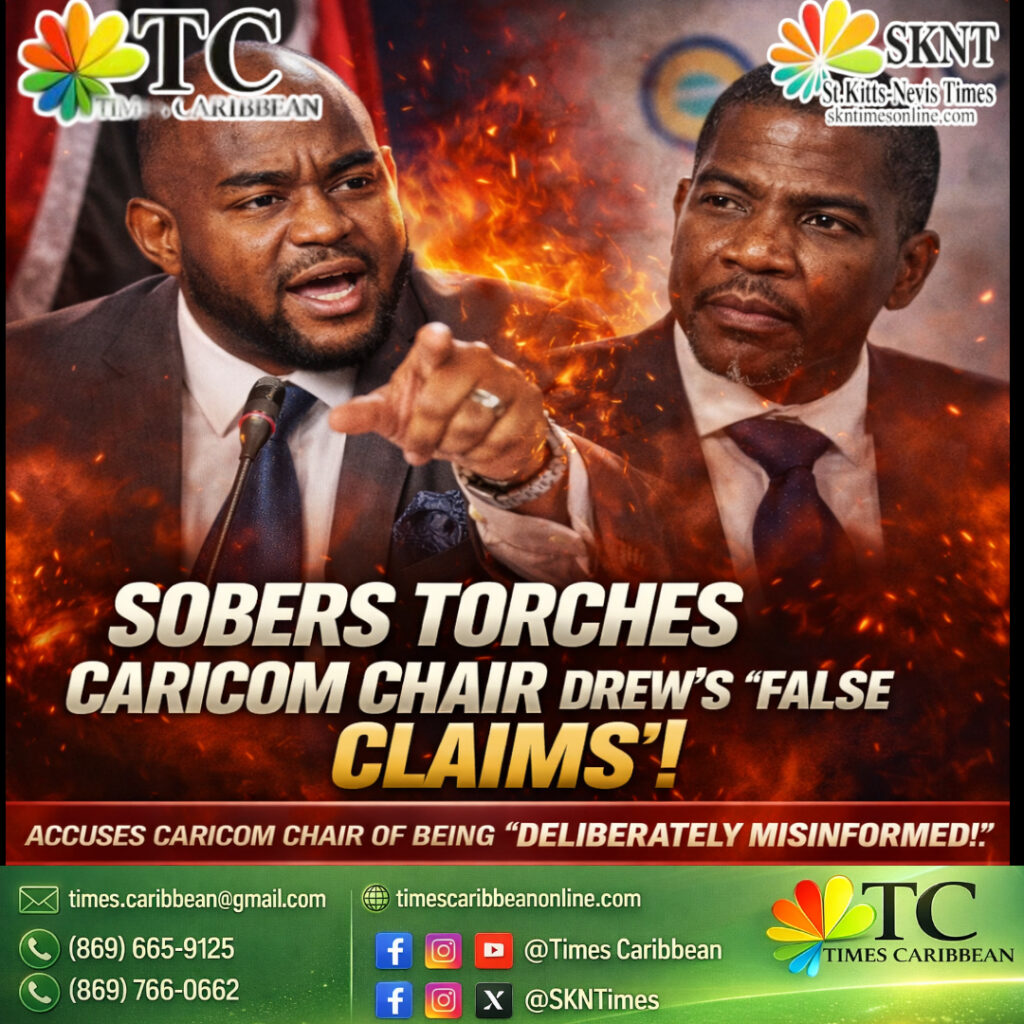
T&T MINISTER SOBERS TORCHES CARICOM CHAIR DR TERRANCE DREW’S “FALSE CLAIMS”. ACCUSES CARICOM CHAIR OF BEING “DELIBERATELY MISINFORMED!’

CARICOM IN CRISIS! T&T FM CALLS OUT “LIES” — DREW UNDER FIRE AS REGIONAL UNITY FRACTURES
A full-blown diplomatic firestorm has erupted at the heart of the Caribbean Community, as has launched a blistering rebuttal against —flatly rejecting claims made by the current Chairman of and accusing the regional leadership of peddling “misrepresentations of fact” in a controversy now threatening to tear at the fabric of regional governance.
In a searing April 9 letter, Sobers dismantled Drew’s assertions surrounding Trinidad and Tobago’s absence from a high-level retreat in Nevis, where a decision was reportedly taken to reappoint for another five-year term. Drew had suggested that Sobers’ non-attendance was linked to seasickness—an explanation now publicly ridiculed and forcefully denied.
“MISREPRESENTATIONS OF FACT” — A DIPLOMATIC REBUKE LIKE NO OTHER
Sobers did not mince words.
He categorically rejected the narrative advanced by Drew, insisting that no such inquiry about his availability was ever made and revealing instead that Trinidad and Tobago was effectively shut out of the process. According to the minister, a last-minute WhatsApp message from the CARICOM Secretariat restricted participation in the retreat to Heads of Government only—despite his official designation as Head of Delegation.
The implications are explosive.
Sobers argues that this exclusion directly contravenes Article 11 of the Revised Treaty of Chaguaramas, which explicitly permits Heads of Government to appoint representatives. In essence, Trinidad and Tobago is alleging that the process was not merely flawed—but potentially unlawful within CARICOM’s own legal framework.
BOYCOTT AND NON-RECOGNITION: T&T DRAWS A HARD LINE
In an unprecedented escalation, Trinidad and Tobago has declared that it will:
- Refuse to participate in CARICOM meetings, including the recent 25th Special Emergency Meeting
- Decline to recognise Barnett’s reappointment beyond August 2026
- Maintain recognition of her authority only for the remainder of her current term (2021–2026)
The language used in Sobers’ letter is nothing short of incendiary, describing the reappointment process as “surreptitious, corrupted and flawed.”
This is not routine diplomatic disagreement—this is a direct challenge to the legitimacy of a major CARICOM decision.
TRANSPARENCY OR TRUST DEFICIT? THE QUESTIONS MOUNT
At the core of the dispute lies a fundamental issue: transparency.
Sobers revealed that the retreat agenda—under “Financing and Governance”—contained no reference whatsoever to the reappointment of the Secretary-General. He questioned why such a critical decision was introduced in what he describes as a limited, opaque setting, rather than at a properly convened meeting of all Heads of Government.
Even more troubling are the procedural inconsistencies:
- The matter was not included in the official Summary of Confirmed Decisions circulated on March 2
- Trinidad and Tobago was allegedly informed nearly a month after the fact
- No formal documentation outlining the process has been produced
- The urgency of discussing the reappointment in February—despite the term ending in August and a July meeting scheduled—remains unexplained
Sobers has now demanded a sweeping list of documents, including minutes, invitee lists, performance appraisals, and even full records from the 2021 appointment process for comparison.
DREW MISLED — OR MISADVISED?
In one of the most politically charged sections of the letter, Sobers suggested that Drew may have been “misadvised” or even “deliberately misinformed” by the CARICOM Secretariat regarding Trinidad and Tobago’s availability.
If proven, this raises deeply uncomfortable questions:
- Who is controlling the flow of information within CARICOM?
- Was the Chairman acting on flawed intelligence—or knowingly advancing a false narrative?
- And most critically—can member states trust the integrity of regional decision-making?
A REGION AT A CROSSROADS
Despite the escalating tensions, Sobers was careful to reaffirm Trinidad and Tobago’s commitment to CARICOM, making it clear that this is not a withdrawal—but a protest.
Yet the implications are profound.
A key regional power is effectively boycotting CARICOM proceedings over governance concerns. The legitimacy of a Secretary-General’s reappointment is now under open dispute. And the Chairman himself stands accused—directly and publicly—of advancing false claims.
This is no longer a procedural disagreement.
It is a crisis of confidence at the highest levels of Caribbean leadership.
THE BOTTOM LINE
CARICOM now faces one of its most serious internal challenges in recent history. With trust eroding, transparency questioned, and unity under strain, the regional bloc must urgently confront a stark
















Leave a comment
You must be logged in to post a comment.