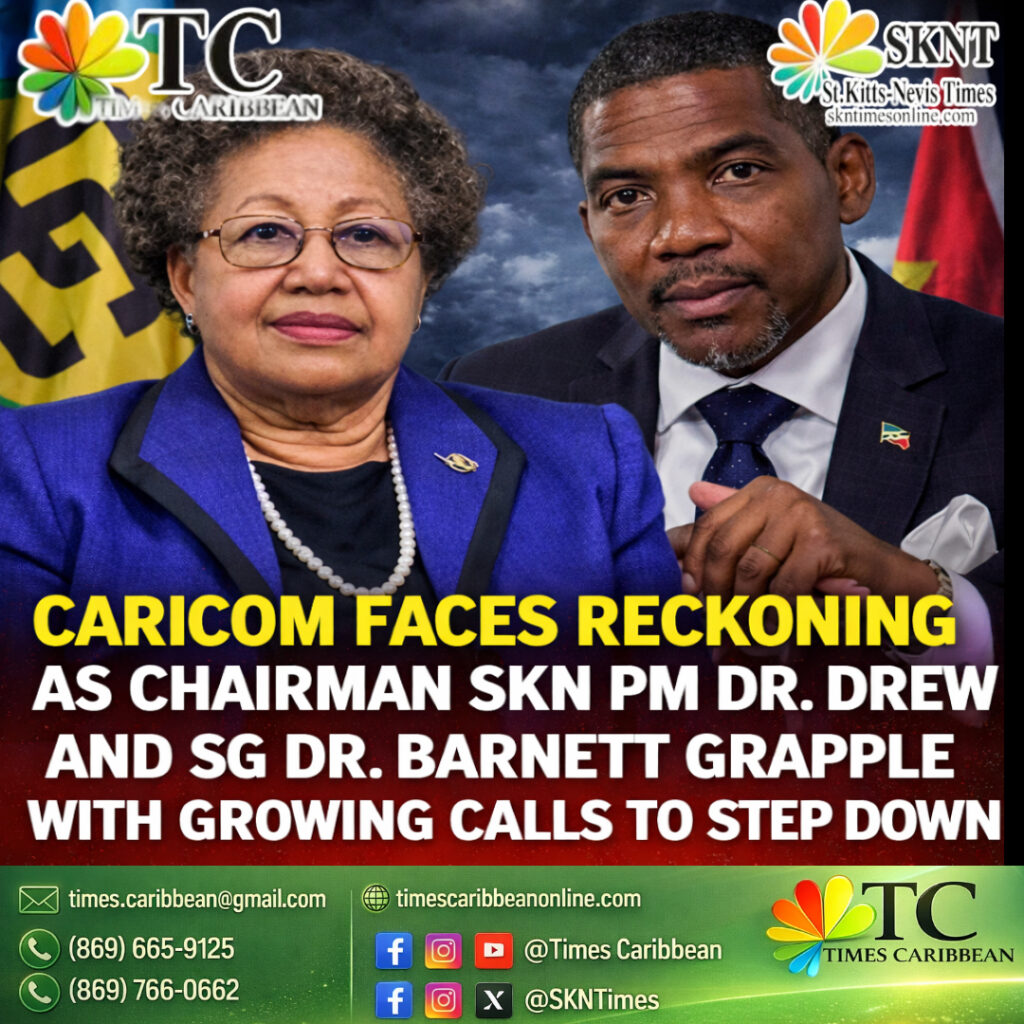
CARICOM FACES RECKONING AS SKN PM DR. DREW AND SG DR. BARNETT GRAPPLE WITH GROWING CALLS TO STEP DOWN
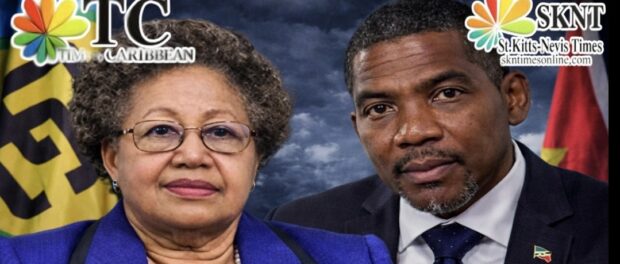
The Caribbean Community (CARICOM) now finds itself gripped by one of the most consequential governance crises in its modern history—one that raises uncomfortable but unavoidable questions about leadership legitimacy, institutional transparency, and the very integrity of regional decision-making.
At the center of the storm are and , whose leadership is now under intense scrutiny following Trinidad and Tobago’s explosive challenge to the process surrounding Barnett’s reappointment.
A PROCESS UNDER FIRE
The controversy stems from claims by that it was either excluded from, or not properly engaged in, the decision-making process that led to Barnett’s reappointment as Secretary-General of .
This is no minor procedural quibble. CARICOM operates on a foundation of consensus-driven governance, where decisions—especially those involving top leadership—are expected to follow strict consultation protocols among member states.
Trinidad and Tobago’s position suggests something far more serious: a potential breakdown in these protocols, raising the specter of institutional overreach or procedural bypassing at the highest levels.
If proven accurate, this would represent not just an administrative misstep, but a fundamental violation of CARICOM’s governance ethos.
THE DREW DILEMMA
As CARICOM Chairman, is now at the epicenter of the crisis.
His role demands neutrality, transparency, and strict adherence to established procedures. Yet, Trinidad and Tobago’s accusations—combined with increasingly sharp diplomatic language—have placed his leadership credibility under a microscope.
The key question now being whispered across regional political corridors is stark:
Did the Chairman preside over—or permit—a flawed process?
If the perception takes hold that Drew either failed to ensure inclusivity or misrepresented the level of consensus, his position could become politically untenable. In regional diplomacy, perception often carries as much weight as fact.
BARNETT’S POSITION: LEGITIMACY VS. CONTROVERSY
For , the crisis presents a different but equally dangerous challenge.
While there is no widespread criticism of her performance or qualifications, her reappointment is now politically tainted by process-related disputes.
This creates a legitimacy paradox:
- She may be technically reappointed,
- But her continued tenure risks being viewed as procedurally compromised.
In diplomatic institutions, legitimacy is everything. Even the perception of an irregular process can weaken authority, undermine confidence, and fracture cooperation among member states.
TRINIDAD AND TOBAGO’S HARDLINE STANCE
The firm posture adopted by —including signals of non-recognition and potential disengagement—has escalated the issue from internal disagreement to regional confrontation.
This is particularly significant given Trinidad and Tobago’s economic and political weight within CARICOM.
Its stance effectively challenges the bloc to answer a critical question:
Can CARICOM function cohesively if a key member openly questions the legitimacy of its leadership decisions?
RESIGNATION: REAL POSSIBILITY OR POLITICAL THEATER?
Calls for resignation—whether explicit or implied—are now part of the regional discourse.
However, the likelihood of either or stepping down depends on several factors:
1. Evidence of Procedural Breach
If clear proof emerges that established protocols were ignored or manipulated, pressure for resignation will intensify dramatically.
2. Regional Consensus
CARICOM leaders traditionally avoid public fractures. A unified call from multiple member states could force decisive action.
3. Political Calculations
Resignations in CARICOM are rare and often avoided unless absolutely necessary. Leaders may instead opt for damage control, clarification, or procedural review.
4. Public and Diplomatic Pressure
Sustained criticism—both domestically and regionally—could erode the moral authority required to remain in office.
A DEFINING MOMENT FOR CARICOM
This crisis is about more than personalities—it is about the credibility of Caribbean regionalism itself.
If CARICOM is perceived as bypassing its own rules, it risks:
- Undermining trust among member states
- Weakening its negotiating power on the global stage
- Eroding public confidence in regional governance
Conversely, a transparent and accountable resolution could strengthen the institution, reinforcing its commitment to fairness and collective decision-making.
THE VERDICT: UNCERTAIN, BUT CONSEQUENTIAL
Will this debacle force resignations?
At this stage, the answer remains uncertain—but no longer unthinkable.
What is clear, however, is that CARICOM stands at a crossroads. The decisions made in the coming days—whether through clarification, confrontation, or compromise—will determine whether this moment becomes:
- A temporary political storm, or
- A defining rupture in Caribbean unity.
One thing is beyond dispute:
The stakes have never been higher for CARICOM’s leadership—and the region is watching.
















Leave a comment
You must be logged in to post a comment.