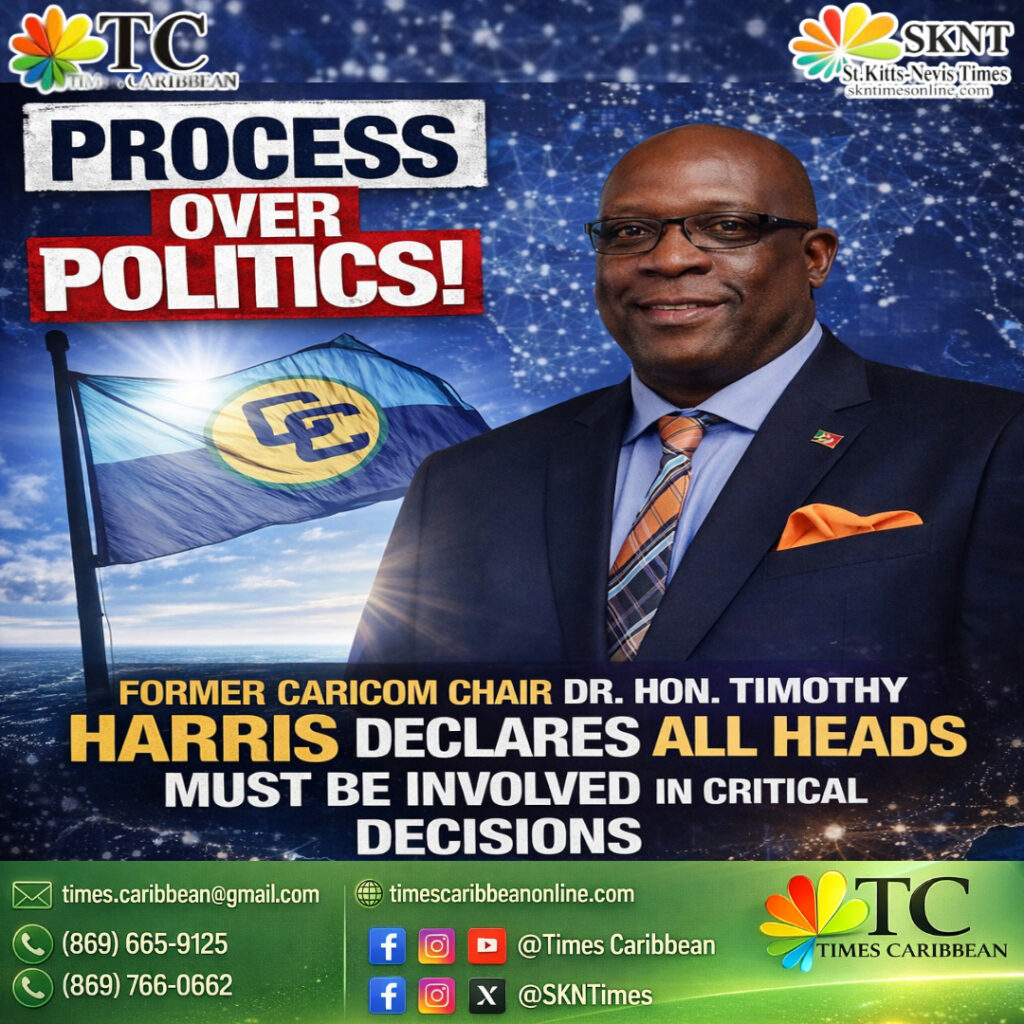
PROCESS OVER POLITICS! FORMER CARICOM CHAIR DR. HON. TIMOTHY HARRIS DECLARES ALL HEADS MUST BE INVOLVED IN CRITICAL DECISIONS

Former CARICOM Chairman Dr. Timothy Harris has taken a firm and principled stand on regional governance, declaring that no critical CARICOM decision—especially one as vital as the appointment of a Secretary-General—should ever be made without the full involvement of all Heads of Government.
In a strong intervention amid the growing controversy surrounding the reappointment of Dr. Carla Barnett, Harris shifted the debate away from personalities and squarely onto process, procedure, and accountability within CARICOM.
“ALL LEADERS MUST BE INVOLVED”
Dr. Harris was unequivocal: every CARICOM leader must be part of decisions that shape the region’s future.
He emphasized that decisions of such magnitude cannot be confined to limited settings or informal discussions, warning that governance by exclusion undermines the very foundation of regional cooperation.
“All leaders must be involved,” Harris stressed, making it clear that collective leadership—not selective participation—must guide CARICOM’s most important decisions.
PROCEDURE IS NOT OPTIONAL — IT IS ESSENTIAL
Drawing on his experience as CARICOM Chair, Harris underscored that proper procedure is not a formality—it is a safeguard.
He pointed to several critical principles that must guide decision-making:
- Clear agenda-setting – major decisions must be formally listed and communicated
- Advance disclosure of nominees – allowing member states to prepare positions
- Full consultation of all Heads – ensuring inclusive participation
- Structured decision-making processes – not ad hoc conclusions
According to Harris, any deviation from these standards risks eroding trust, weakening legitimacy, and creating unnecessary division within the bloc.
NO EXCUSE IN THE MODERN ERA
Harris dismissed any justification for excluding leaders due to absence, noting that technology has eliminated barriers to participation.
With teleconferencing now standard, he argued, there is simply no excuse for failing to engage every Head of Government on decisions of regional consequence.
His message was clear:
process must evolve with the times—but inclusion must never be compromised.
CONSULTATION BEFORE DECISION — NOT AFTER
While current CARICOM Chairman Dr. Terrance Drew indicated that efforts were made to inform leaders after the decision, Harris insisted that true governance requires consultation before any decision is taken—not after the fact.
Post-decision communication, he suggested, cannot substitute for meaningful participation in the decision-making process itself.
A CALL FOR GOVERNANCE REFORM
Harris’ intervention is being viewed as a broader call to strengthen governance standards within CARICOM, ensuring that:
- Transparency is upheld
- Institutional integrity is protected
- Every member state has a voice in critical decisions
Rather than focusing on individuals, Harris framed the issue as one of principle and institutional credibility, warning that process failures today could set dangerous precedents for the future.
DEFENDING REGIONAL DEMOCRACY
In endorsing the position of Trinidad and Tobago Prime Minister Kamla Persad-Bissessar, Harris emphasized that her stance represents a defense of proper governance—not political confrontation.
He described her intervention as a necessary step in upholding transparency and ensuring that CARICOM remains accountable to all its member states.
THE BOTTOM LINE: PROCESS DEFINES LEGITIMACY
At its core, Harris’ message is unmistakable:
The legitimacy of CARICOM decisions depends not just on outcomes—but on how those outcomes are achieved.
And for decisions of regional importance, there can be no shortcuts.
Every Head must be involved. Every procedure must be followed. Every voice must count.
















Leave a comment
You must be logged in to post a comment.