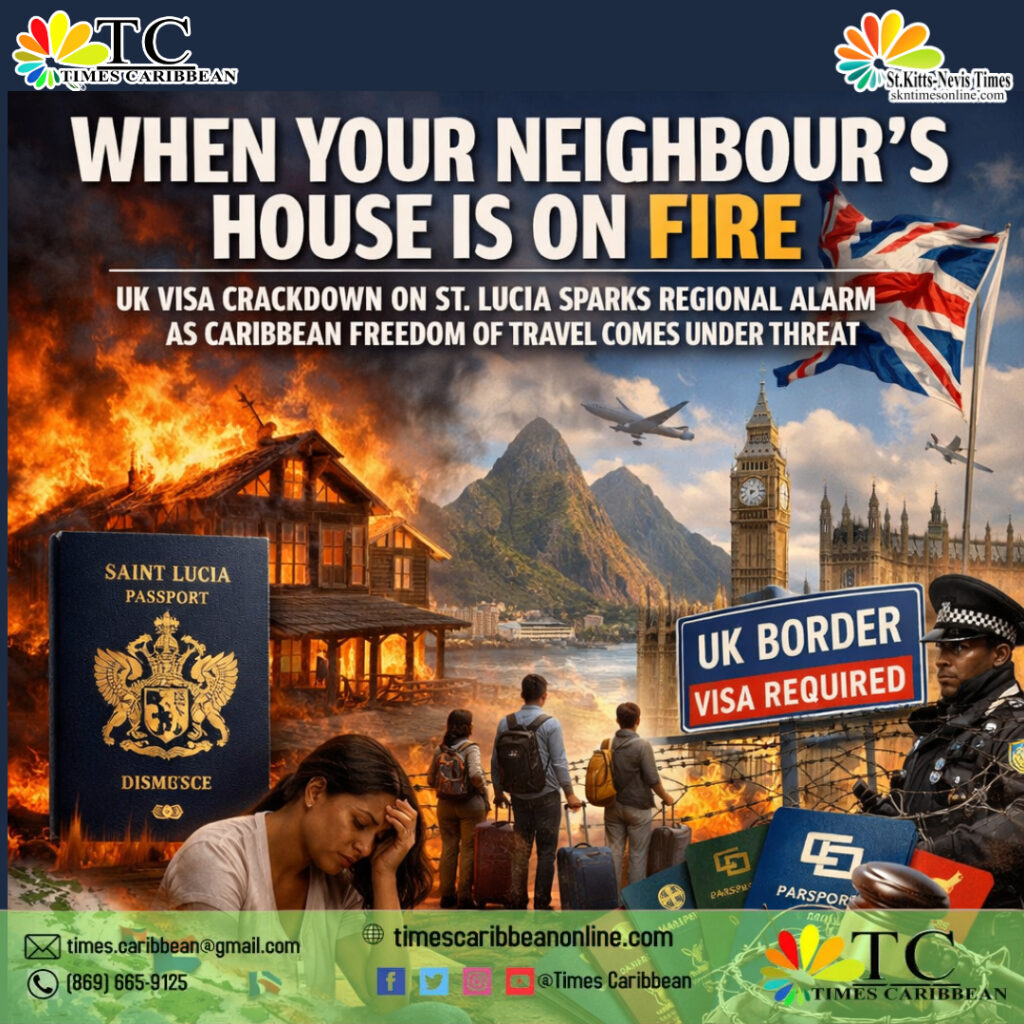
WHEN YOUR NEIGHBOUR’S HOUSE IS ON FIRE: UK VISA CRACKDOWN ON ST. LUCIA SPARKS REGIONAL ALARM AS CARIBBEAN FREEDOM OF TRAVEL COMES UNDER THREAT
A sudden decision by the United Kingdom to impose visa restrictions on citizens of St. Lucia has ignited alarm across the Caribbean, with regional leaders warning that the move could signal a troubling new phase in global immigration policy that may soon engulf other small island states.
In a release issued by the Government of St. Lucia, officials confirmed that effective March 5, 2026 at 15:00 GMT, St. Lucian nationals will now require visas to enter or transit through the United Kingdom. The decision follows what British authorities claim is a surge in asylum applications from individuals travelling on St. Lucian passports.
But the development is reverberating far beyond Castries.
Premier of Nevis and Opposition Leader in St. Kitts and Nevis, Hon. Mark Brantley, issued a stark warning, invoking a Caribbean proverb that carries deep historical resonance: “When your neighbour’s house is on fire, wet your own.”
His message to the region was unmistakable — this is not merely St. Lucia’s problem.
A Widening Caribbean Trend
The UK’s action against St. Lucia follows a similar policy shift targeting Dominican nationals, when London imposed visa requirements on citizens of Dominica on July 19, 2023, also citing asylum concerns.
For many regional observers, the pattern is unmistakable.
The once-routine ability of Caribbean nationals to travel visa-free to the United Kingdom — a privilege rooted in colonial history, Commonwealth ties, and decades of migration — now appears increasingly fragile.
Brantley warned that the region should not interpret the move as an isolated immigration measure, but rather as part of a larger geopolitical shift.
“We should see this as an opening salvo in the abandonment of much of what the Caribbean once took for granted,” Brantley cautioned.
The troubling question now circulating across diplomatic and policy circles is simple but unsettling:
Which Caribbean nation will be next?
Global Immigration Winds Turning
The UK’s visa crackdown arrives amid a sweeping transformation in immigration politics across the global North.
Across Europe and North America, governments are tightening asylum rules, expanding border controls, and responding to domestic political pressure fueled by rising nationalist and far-right movements.
Policies once framed around humanitarian openness are increasingly being recast under the banners of “national security,” “border integrity,” and “immigration reform.”
Small Caribbean states — whose citizens historically benefited from Commonwealth mobility and diaspora networks — now find themselves caught in the crosscurrents of this changing political climate.
Analysts warn that Caribbean passport holders could increasingly face collective suspicion, even where only small numbers of asylum claims are involved.
For island nations with populations often smaller than a single European city, even modest asylum spikes can trigger disproportionate diplomatic consequences.
A Wake-Up Call for CARICOM
Premier Brantley is urging the Caribbean to respond not with panic, but with strategic regional unity.
He called on both the Organisation of Eastern Caribbean States (OECS) and CARICOM to urgently engage the United Kingdom and the European Union diplomatically.
However, his most striking proposal points inward rather than outward.
The Caribbean, he argues, must accelerate its own integration.
Among the priorities he highlighted:
• Full freedom of movement across CARICOM using the OECS model
• Improved transportation links for people and goods across the Caribbean
• Stronger regional labour mobility opportunities
• Greater economic integration to reduce outward migration pressures
In essence, Brantley argues that the Caribbean must build a region where Caribbean citizens increasingly choose to stay and work within the region itself.
“Our solution lies not in begging anyone to enter their shores,” he said, “but in making Caribbean shores more attractive to Caribbean people.”
A Defining Moment for Caribbean Mobility
For decades, visa-free access to the United Kingdom symbolized a lingering bridge between the Caribbean and its former colonial power.
But the erosion of that privilege — first in Dominica, now in St. Lucia — may represent a deeper structural shift.
If more Caribbean passports face similar restrictions, the implications could ripple through tourism, business travel, education, and diaspora connections that have shaped Caribbean life for generations.
In the language of the proverb Brantley invoked, the fire may have started in one house — but the entire neighbourhood is now watching the flames.
















Leave a comment
You must be logged in to post a comment.