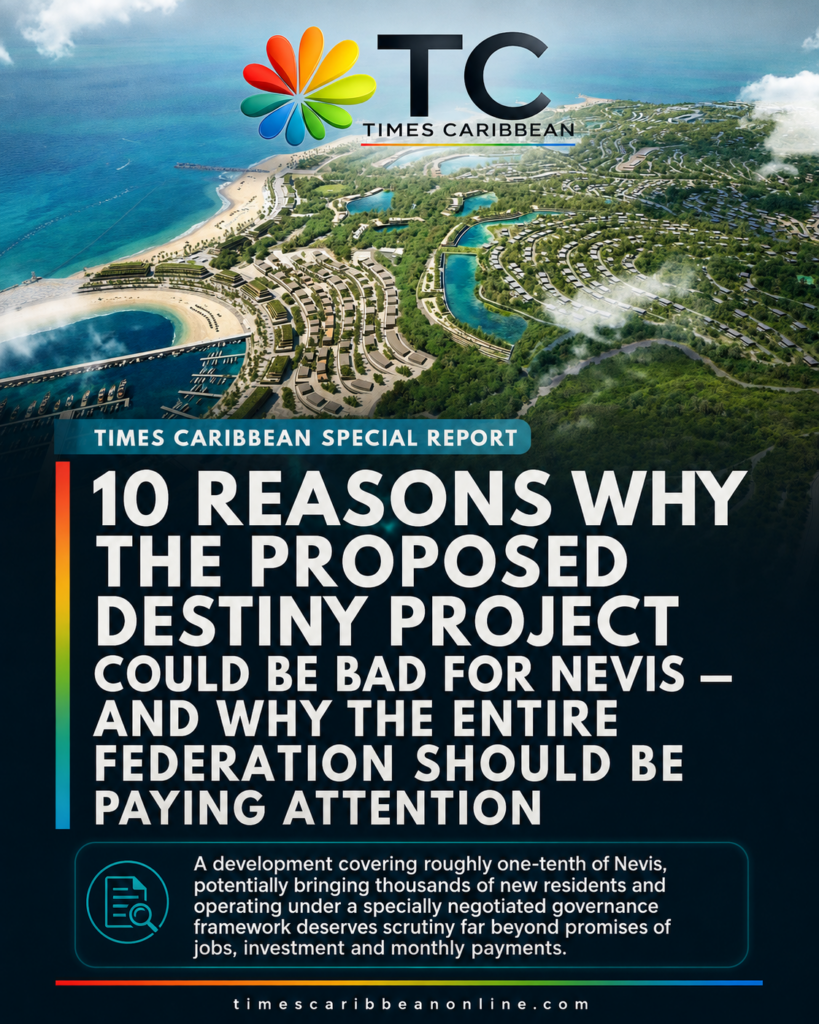
10 REASONS WHY THE PROPOSED DESTINY PROJECT COULD BE BAD FOR NEVIS — AND WHY THE ENTIRE FEDERATION SHOULD BE PAYING ATTENTION

TIMES CARIBBEAN FEATURED ANALYSIS
10 REASONS WHY THE PROPOSED DESTINY PROJECT COULD BE BAD FOR NEVIS — AND WHY THE ENTIRE FEDERATION SHOULD BE PAYING ATTENTION
A development covering roughly one-tenth of Nevis, potentially bringing thousands of new residents and operating under a specially negotiated governance framework deserves scrutiny far beyond promises of jobs, investment and monthly payments.
CHARLESTOWN, NEVIS — August 30, 2026 | Times Caribbean Featured Analysis
Destiny is being sold as transformation.
Its developers promise thousands of jobs, major infrastructure investment, renewable energy, scholarships, healthcare support, profit-sharing and a modern new community capable of dramatically expanding the economy of Nevis.
Those promises deserve to be heard.
But so do the risks.
Destiny is not an ordinary hotel, resort or housing development. It is proposed as a Special Sustainability Zone, operating under legislation that expressly allows specially negotiated arrangements covering governance, concessions, development approvals, dispute-resolution mechanisms, the applicability of legislation, imports and exports, environmental assessments and even the possible leasing of adjacent seabed.
That changes the discussion completely.
The question is therefore not simply whether Destiny can generate money.
The deeper question is whether the economic benefits being promised are large enough, certain enough and permanent enough to justify the extraordinary concentration of land, economic influence and specially negotiated governance arrangements that could accompany the project.
Times Caribbean examined the legislation, official government statements, statements from Destiny, independent commentary and the scale of the proposed development.
Here are 10 major reasons Nevisians and Kittitians have legitimate grounds for serious concern.
- DESTINY IS SIMPLY TOO LARGE TO BE TREATED LIKE AN ORDINARY DEVELOPMENT
Reports place the proposed Destiny development at approximately 2,400 acres along Nevis’s south coast — roughly one-tenth of the island.
That is enormous.
Nevis covers only about 93 square kilometres. A project controlling approximately ten percent of the physical island is no longer merely a private development sitting somewhere within Nevis.
It potentially becomes a major geographical centre of economic activity in its own right.
Size matters because land on a small island is finite.
Once thousands of acres are consolidated into a single development framework, future generations cannot simply manufacture another south coast.
Land that might otherwise support agriculture, housing, recreation, ecological preservation, indigenous enterprise or alternative developments becomes committed to one dominant vision.
That is an unusually high concentration risk.
And Nevis would effectively be betting a substantial portion of one of its most valuable national assets — land — on the long-term success of one project.
- THE POPULATION IMPACT COULD FUNDAMENTALLY CHANGE NEVIS
Premier Mark Brantley has publicly discussed projections that Destiny could eventually bring 7,000 to 10,000 additional people to Nevis.
The official 2021–22 census population of Nevis was approximately 13,182.
Think about those numbers.
At the upper end, the population associated with the development could approach the size of almost the entire existing Nevisian population.
That does not automatically make immigration or population growth undesirable.
Nevis needs workers, entrepreneurs, investment and returning nationals.
But growth approaching that scale has consequences.
Schools would face new demand. Hospitals would need additional capacity. Roads would experience greater traffic. Waste disposal would increase. Water demand would rise. Law enforcement and emergency services would require expansion. Housing prices and rental markets could shift dramatically.
And there is something even less measurable.
Culture.
Nevis is not simply an economic zone. It is a society with its own history, traditions, villages, political relationships and community identity.
Development should strengthen that society.
It should not overwhelm it.
- THE SSZ LAW CREATES AN EXTRAORDINARY GOVERNANCE STRUCTURE
This may be Destiny’s most important issue.
The Special Sustainability Zones Authorisation Act does not merely give developers planning permission.
It creates mechanisms for “Zone Governance,” “Zone Laws” and “Zone Bylaws.”
Under the Act, Zone Laws must ultimately be ratified through the relevant legislatures, and certain sovereign responsibilities—including citizenship, elections, foreign affairs and specified court jurisdiction—remain under governmental authority.
Those are important safeguards.
But the legislation still permits Development Agreements to address matters including environmental approvals, public-health coordination, dispute resolution, applicability of enactments, concessions and Zone Governance.
That is extraordinary for a private development.
The issue is not whether Destiny becomes literally independent from St. Kitts and Nevis. The law does not authorize that.
The concern is subtler.
How much public authority should ever be operationally tailored around a private developer?
Ordinary investors follow the country’s regulatory framework.
Under an SSZ structure, however, the country may negotiate a specialized regulatory framework around the investment.
That reverses the usual relationship.
And once governments become commercially dependent on the success of the same development they regulate, maintaining tough, independent oversight can become progressively harder.
- THE FULL DEVELOPMENT AGREEMENT HAS BEEN TOO IMPORTANT TO REMAIN OUTSIDE PUBLIC SCRUTINY FOR SO LONG
Citizens cannot properly evaluate Destiny from promotional videos.
They need the contract.
As recently as July, the Federal Government said significant discussions and proposed project revisions still had to return through the Independent Oversight Committee and Federal Cabinet. The Federal Government explicitly stated that no final decision had yet been made.
Premier Brantley subsequently said the final proposed agreement would be made public before parliamentary consideration.
That disclosure will be essential.
Because everything ultimately depends on the agreement.
What taxes will be waived?
For how long?
What happens if promised construction never materializes?
What performance guarantees exist?
Who pays if infrastructure demands exceed projections?
Who maintains roads?
Who carries environmental liabilities?
What dispute-resolution procedures apply?
What protections exist if ownership of the developer changes?
What obligations survive a sale?
And exactly how much power will the developer possess over activities inside the Zone?
Until citizens can read the final agreement themselves, the most consequential details remain impossible to independently judge.
That alone is reason for caution.
- THE ECONOMIC PROMISES ARE IMPRESSIVE — BUT PROMISES ARE NOT GUARANTEES
Destiny’s own promotional material promises substantial benefits.
The developer says there will be thousands of jobs, US$50 million in Nevis infrastructure investment, a 20% profit share for Nevis, a US$1 million annual scholarship programme, and other benefits.
Those are substantial commitments if delivered.
But there is an important distinction between projected benefits and guaranteed public revenue.
Profit-sharing is particularly important.
Profit is not revenue.
A company can generate massive sales and still report limited distributable profit after financing costs, depreciation, management charges, marketing expenditure, reinvestment, affiliated-company transactions and other costs.
Therefore, saying Nevis receives a percentage of “profits” tells citizens very little unless the agreement defines:
What constitutes profit?
Who audits it?
Under which accounting standard?
Can costs be charged by associated companies?
Can profits be retained?
Can debt servicing reduce distributions?
What audit rights does government possess?
And what happens during years when the project reports no profit?
A percentage sounds powerful.
The formula behind that percentage matters much more.
- TAX AND DUTY CONCESSIONS COULD MEAN NEVIS GIVES AWAY MORE THAN THE HEADLINE BENEFITS SUGGEST
Section 8 of the SSZ Act expressly allows concessions, exemptions, reductions and rebates on government charges where authorities consider them proportionate to expected public benefits.
Again, concessions are normal in major investment projects.
But scale changes everything.
Imagine decades of exemptions across a development occupying roughly one-tenth of Nevis.
The forgone revenue could become enormous.
Citizens therefore need more than the headline figure of US$50 million in infrastructure spending.
They need a full fiscal-cost analysis.
If Destiny receives hundreds of millions of dollars in long-term concessions while returning a smaller amount through infrastructure projects, scholarships or profit-sharing, the public may ultimately be subsidizing the developer rather than the reverse.
Government should therefore publish both sides of the ledger:
Benefits received versus taxes and charges surrendered.
Without that calculation, nobody can responsibly declare the arrangement a financial success.
- DESTINY COULD CREATE A TWO-TIER ECONOMY INSIDE ONE SMALL ISLAND
Destiny markets itself as an international, high-end community — the developer’s own website describes the concept as the “Monaco-Dubai of the Caribbean.”
That branding tells us something.
The project’s commercial success appears partly dependent on attracting affluent international residents and investors.
But what happens to the surrounding Nevis economy when a wealthy enclave emerges beside communities earning ordinary Caribbean wages?
Land prices can rise.
Construction costs can rise.
Rents can rise.
Professional salaries may be pulled upward in some sectors while lower-income workers struggle with the resulting cost increases.
Businesses inside a wealthy development may prosper while smaller businesses outside it struggle to compete for labour, land and capital.
This phenomenon is familiar across tourism-dependent islands.
A development can increase GDP while simultaneously making ordinary life less affordable.
GDP growth and improved living standards are not automatically the same thing.
That distinction must remain central.
- THE LABOUR MARKET MAY NOT BE ABLE TO SUPPLY A PROJECT OF THIS SCALE WITHOUT LARGE-SCALE IMPORTATION
Destiny promises thousands of jobs.
That sounds attractive.
But it creates a mathematical problem.
Nevis has only about 13,000 residents.
If a development ultimately requires thousands upon thousands of construction workers, engineers, hospitality professionals, technicians, administrators, security personnel, medical workers, teachers, tradespeople and service employees, the local labour market cannot supply all of them.
Some labour importation would therefore be unavoidable.
That could be beneficial where specialist skills are unavailable locally.
But without strong local-content requirements, a project promoted as an employment engine for Nevisians could gradually become dependent on imported labour simply because the development’s manpower requirements exceed the island’s available workforce.
The Government therefore needs enforceable targets.
Not aspirations.
Local employment percentages.
Apprenticeship requirements.
Training obligations.
Procurement quotas for locally owned companies.
Transparent reporting.
Penalties for non-compliance.
Otherwise, “thousands of jobs” could eventually mean thousands of jobs located in Nevis, rather than thousands of jobs held by Nevisians and Kittitians.
There is a major difference.
- ENVIRONMENTAL DAMAGE ON AN ISLAND IS DIFFICULT — SOMETIMES IMPOSSIBLE — TO REVERSE
Destiny emphasizes sustainability, renewable energy, rainwater management and environmentally conscious design.
Those are positives.
The SSZ Act itself requires developers to pursue environmental sustainability and aims for at least 70 percent renewable energy within a Zone.
But green technology does not automatically make a mega-development environmentally benign.
Thousands of acres of development involve roads, foundations, drainage systems, excavation, landscaping, utilities, coastal works, wastewater, stormwater and increased human activity.
The Act also explicitly contemplates the possibility of leasing adjacent seabed and provisions relating to environmental-impact approvals.
That raises questions about coastal ecosystems, fisheries, erosion, marine habitats and public coastal access.
Climate resilience must also be examined over decades, not simply during construction.
Nevis sits in a region facing hurricanes, flooding, drought, rising temperatures and coastal vulnerability.
The environmental impact assessment therefore cannot become a procedural checkbox.
It must be genuinely independent, publicly accessible and peer-reviewed where appropriate.
And the public should know who pays for restoration if something goes wrong.
- THE PROJECT COULD CREATE A DANGEROUS PRECEDENT FOR THE ENTIRE FEDERATION
This is why Kittitians should not view Destiny as “Nevis business.”
The SSZ legislation applies to the Federation.
Destiny is effectively the first major test of the framework.
Whatever government accepts here may influence what future investors demand elsewhere.
If Destiny receives unusually broad governance flexibility, future developers can point to Destiny.
If Destiny receives extensive concessions, others can ask for equivalent treatment.
If specially negotiated rules become the price of securing billion-dollar investment, government negotiating power could weaken with every subsequent project.
And the implications extend beyond planning.
Prime Minister Dr. Terrance Drew has publicly stated that the Federal Government became involved precisely because Destiny touches areas of federal responsibility including immigration, customs, citizenship, law enforcement, courts, treaty obligations, public finance, financial regulation and federal laws.
That is perhaps the clearest evidence that Destiny cannot reasonably be described as just another Nevis real-estate development.
It has national consequences.
THE BIGGEST WARNING MAY ACTUALLY COME FROM GOVERNMENT ITSELF
Perhaps one of the most revealing developments in the entire Destiny debate is that the Federal Government itself established both an advisory review mechanism and an Independent Oversight Body.
The Government said the Independent Oversight Body was created specifically to conduct a structured, evidence-based examination of the Destiny application.
By July, Prime Minister Drew said review of the proposal had already resulted in meaningful revisions and that several major federal issues had required additional discussions.
That should tell citizens something important.
These concerns were not imaginary.
The proposal was significant enough that government itself determined additional safeguards, scrutiny and revisions were necessary.
The proper response therefore cannot be: Stop asking questions.
The appropriate response is the opposite.
Ask better ones.
BUT THE CASE FOR DESTINY CANNOT BE IGNORED
Fair analysis also requires acknowledging why some Nevisians support the project.
Nevis needs economic diversification.
It needs private-sector investment.
It needs better-paying employment.
It needs infrastructure.
It needs greater healthcare capacity.
It needs opportunities capable of encouraging young Nevisians to remain at home or return after university.
The developer has already funded a US$1.3 million dialysis centre at Alexandra Hospital, according to the Nevis Island Administration, including support for its initial operation.
Destiny also advertises major infrastructure spending, scholarships, revenue-sharing and local business opportunities.
Those benefits should not be dismissed simply because controversy exists.
And opposition to Destiny should never become opposition to foreign investment itself.
Nevis needs investment.
But Nevis does not need investment at any price.
THE REAL QUESTION: WHO CONTROLS NEVIS’S FUTURE?
Destiny’s supporters see a once-in-a-generation opportunity.
Its critics see something closer to a once-in-a-generation transfer of economic and territorial influence.
Both views explain why the debate has become so intense.
But the fundamental test should be remarkably simple.
Twenty or thirty years from now, will ordinary Nevisians own more of their economy, possess greater opportunities, enjoy stronger public services and exercise greater control over their island because Destiny happened?
Or will they find themselves living beside an extraordinarily wealthy private community occupying a significant part of their island, operating under specially negotiated arrangements, while land ownership, economic power and decision-making have progressively shifted beyond their reach?
That is the question.
Not whether Destiny looks impressive on architectural renderings.
Not whether US$100 monthly payments sound attractive.
Not whether politicians supporting or opposing it score points.
And not whether investors describe it as transformational.
A development approaching one-tenth of Nevis and potentially accommodating thousands of newcomers deserves a standard far higher than ordinary investment promotion.
It deserves a full public accounting.
Before final approval, citizens should be able to examine the final Development Agreement, independent economic assessment, environmental impact studies, concession package, local-employment guarantees, land-acquisition arrangements, infrastructure obligations, governance provisions, dispute-resolution system, financial guarantees and consequences if the developer fails to deliver.
Then Nevisians can judge.
Because governments come and go.
Developers come and go.
Economic cycles change.
But Nevis cannot be replaced.
Development should happen on Nevis.
It should benefit Nevis.
And above all, Nevisians must never become spectators to the development of their own island.
Times Caribbean Featured Analysis — This article evaluates documented provisions, publicly stated project projections and potential policy risks. References to future impacts are analysis rather than assertions that those outcomes will necessarily occur. As of the latest official federal statement located in this review, the proposal remained subject to the governmental review and approval process.
















Leave a comment
You must be logged in to post a comment.