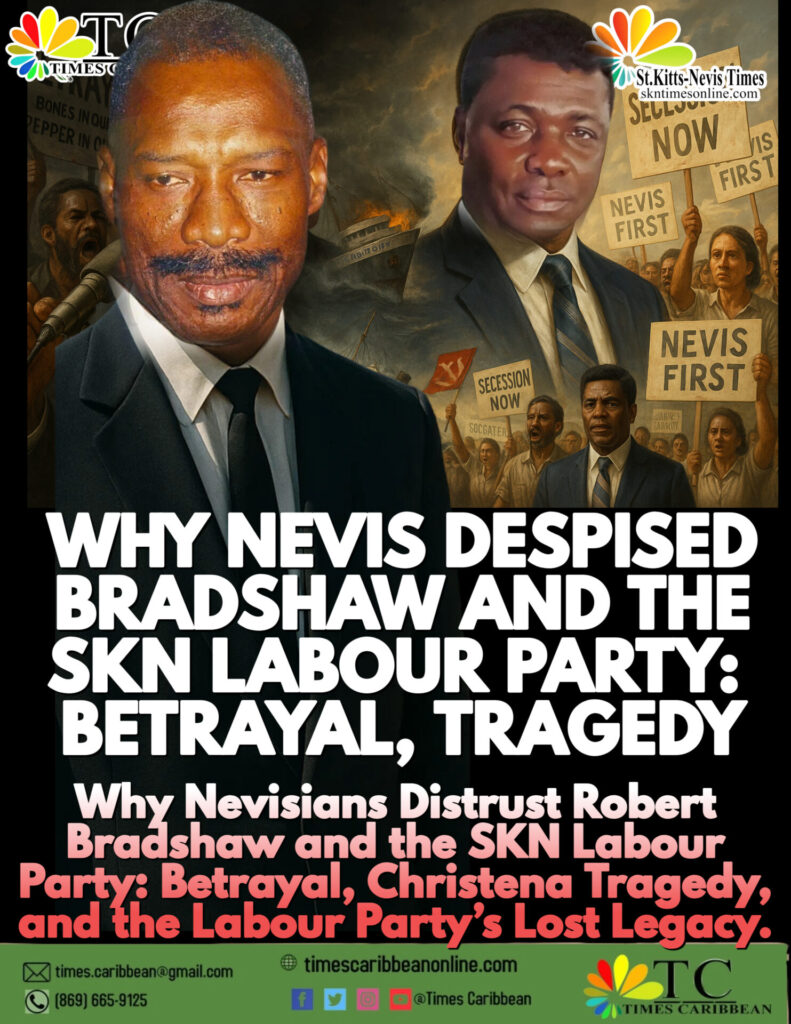
Why Nevisians Despised Robert Bradshaw and the SKN Labour Party: Betrayal, Christena Tragedy, and the Labour Party’s Lost Legacy.
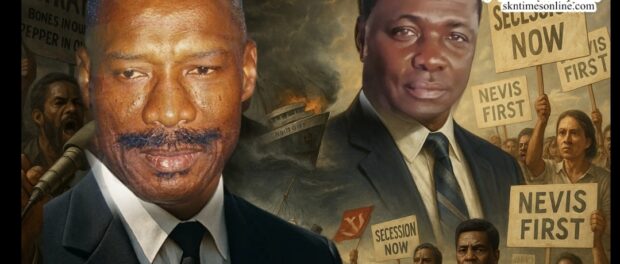
Why Nevisians Distrust Robert Bradshaw’s Legacy and the Labour Party: A Historical Analysis
By SKN Times Commentary Desk
The Federation of St. Kitts and Nevis shares one flag, one anthem, and one government, but beneath the surface lies a history of mistrust, particularly between Nevisians and the Labour Party led in its heyday by the Federation’s first National Hero, Robert Llewellyn Bradshaw. To understand why Nevisians, even today, carry ambivalence—if not outright hostility—towards Bradshaw’s Labour legacy, one must return to the turbulent late 1960s and 1970s, when political neglect, tragedy, and the secessionist impulse reshaped Nevis’ political identity.
1967 and the Politics of Neglect
In the wake of the 1967 constitutional changes and the Anguilla rebellion, the Labour Party under Bradshaw directed most of its political energies toward its fiercest rival, the People’s Action Movement (PAM), in St. Kitts. This left Nevis, with its lone parliamentary representative (Eustace Walwyn) who sided with Labour, in political isolation. Nevisians saw themselves as marginal players in a state where the battles and resources were consumed in Basseterre.
The sense of neglect grew into deep resentment, as Nevisians felt relegated to the “back of beyond” in Labour’s vision. This created fertile ground for an alternative movement—one that would prioritize Nevis first and resist Basseterre’s dominance.
The Christena Disaster: The Breaking Point
The pivotal moment that crystallized Nevisian disaffection came on August 1, 1970, with the sinking of the MV Christena, the government-operated ferry connecting St. Kitts and Nevis. Overloaded with passengers returning from the Emancipation holiday, the ferry capsized, killing 227 people, devastating nearly every family in Nevis.
The Bradshaw-led Labour government was accused of gross negligence in maintaining safety standards and for failing in its duty of care. For Nevisians, the Christena tragedy was more than an accident—it was symbolic of the disregard, neglect, and marginalization they believed Labour had shown toward their island.
Two months later, the Nevis Reformation Party (NRP) was formed, led by Simeon Daniel, and its platform from the very beginning was secession from St. Kitts.
Secession Becomes the Rallying Cry
Through the 1970s, Nevis’ political trajectory diverged sharply from St. Kitts. By 1971, the NRP had entered Parliament, and in the 1975 elections, Nevisian voters gave Bradshaw’s Labour Party a resounding rejection. Labour candidates received only 19 percent of the Nevis vote, while the NRP won decisively, campaigning solely on the issue of secession.
NRP leaders such as Ivor Stevens and Simeon Daniel amplified the call for separation, introducing secession resolutions both in the Nevis Council and in the national House of Assembly. Mass demonstrations in Charlestown in 1974, involving thousands of Nevisians, reinforced that the island was united in its demand for autonomy.
For Nevisians, Bradshaw’s Labour was no longer simply neglectful—it was now the oppressor, denying their right to self-determination.
Clashes with Bradshaw
The relationship between Robert Bradshaw and Simeon Daniel grew increasingly bitter. Their correspondence during independence negotiations in the mid-1970s is filled with acrimony, with Daniel accusing Bradshaw’s government of “neglect, spite, and disregard” for Nevis’ political, social, and economic welfare.
One infamous quote from Bradshaw—promising “bones in our rice, pepper in our soup”—was taken by Nevisians as a metaphor for his disdain toward them, reinforcing the view that Basseterre treated Nevis as an afterthought.
By 1977, Nevisians held their own referendum, voting 4,193 to 14 in favor of secession. Bradshaw dismissed the vote as null and void, but the political rupture was undeniable.
Labour’s Fall, NRP’s Rise
The death of Bradshaw in 1978 did little to heal the divide. His successors, Paul Southwell and later Lee Moore, failed to win Nevisian trust. In the 1980 elections, Labour’s dominance collapsed as PAM captured three Kittitian seats and the NRP won both Nevis seats, forming a coalition government. For the first time in over 30 years, Labour was in opposition, and Nevisians, through Simeon Daniel, held the balance of power.
This coalition paved the way for independence in 1983, with the Nevisian demand for autonomy enshrined in the Constitution through the creation of the Nevis Island Administration and the legal right of Nevis to secede from the Federation via referendum.
Why Nevisians Still Distrust Labour’s Legacy
Today, Robert Bradshaw is celebrated in St. Kitts as a nation-builder and freedom fighter against colonialism. Yet, in Nevis, his name evokes memories of neglect, tragedy, and the denial of their aspirations. The Christena disaster, the dismissal of secessionist demands, and the perception of Basseterre’s arrogance left scars that shaped generations of Nevisians.
Nevisians view Labour not as liberators, but as centralizers—focused on Basseterre’s power at the expense of Charlestown’s dignity. The rise of the NRP was born out of this disillusionment, and the politics of separation remain deeply rooted in Nevisian identity to this day.
Conclusion: A Tale of Two Islands, Two Legacies
The paradox of history is stark: Robert Bradshaw, the Federation’s first National Hero, is simultaneously a symbol of pride in St. Kitts and a figure of disaffection in Nevis. His Labour Party’s neglect, the Christena disaster, and the refusal to accommodate Nevisian autonomy hardened attitudes that still echo across the Narrows.
Nevisians remember not the hero of labour, but the politician of Basseterre who, in their view, failed to honor their lives, losses, and aspirations. It is this divide—rooted in history—that continues to shape the unique and uneasy relationship between St. Kitts and Nevis.
















Leave a comment
You must be logged in to post a comment.