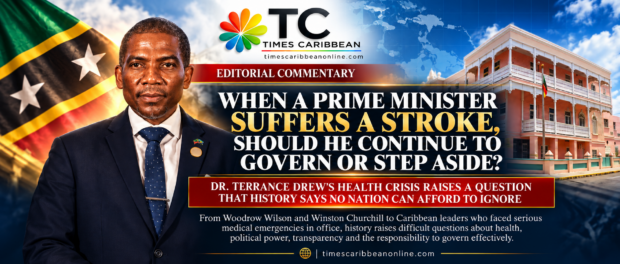
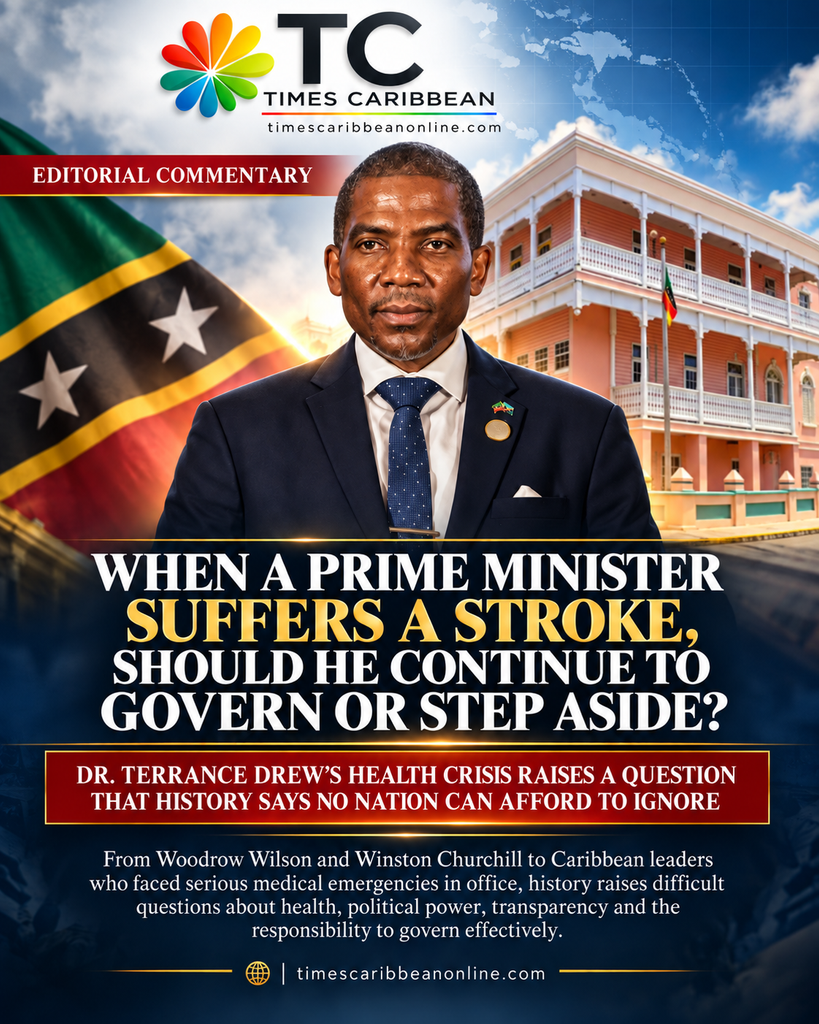
WHEN A PRIME MINISTER SUFFERS A STROKE, SHOULD HE CONTINUE TO GOVERN OR STEP ASIDE? DR. TERRANCE DREW’S HEALTH CRISIS RAISES A QUESTION THAT HISTORY SAYS NO NATION CAN AFFORD TO IGNORE
TIMES CARIBBEAN | SPECIAL COMMENTARY | OCTOBER 9, 2026
From Woodrow Wilson and Winston Churchill to Caribbean leaders who faced serious medical emergencies in office, history raises difficult questions about health, political power, transparency and the responsibility to govern effectively.
BASSETERRE, ST. KITTS — When the leader of a nation suffers a major medical setback, where should the priorities lie? With the personal ambition to remain in office, the medical necessity of recovery, or the national responsibility to ensure that government continues functioning at its highest possible level?
It is a sensitive question. But an important one.
And following Prime Minister Dr. Terrance Drew’s confirmation that he suffered a stroke in late August 2026, it is a question that deserves serious, respectful and informed national discussion.
Should Dr. Drew continue as Prime Minister while recovering? Should he temporarily step aside from active duties? Or, if medical circumstances ultimately warrant it, should he consider resignation in the interests of his long-term health and the effective administration of St. Kitts and Nevis?
These are not questions that should be interpreted as personal attacks against the Prime Minister.
They are questions about constitutional leadership, public accountability and the responsibilities accompanying the highest political office in the Federation.
A stroke does not automatically render someone incapable of governing. Recovery varies considerably, and many survivors return successfully to demanding professional responsibilities.
But neither should a nation assume that a leader is medically ready to resume the full pressures of office simply because that leader expresses confidence in his recovery.
There is a difference between being medically stable, recovering successfully and being ready to shoulder the extraordinary responsibilities of running a country.
And that distinction matters.
DR. DREW’S STROKE: WHAT THE PUBLIC HAS BEEN TOLD
On August 30, 2026, Prime Minister Drew was admitted to the Joseph N. France General Hospital after experiencing symptoms that included nausea and headache.
He subsequently received overseas medical attention.
In a public video address in September, Dr. Drew confirmed that he had suffered a stroke and indicated that his recovery was progressing well. Regional reporting also confirmed that he was receiving further evaluation and rehabilitation in Florida.

Caribbean Broadcasting Corporation
+2
The September 1 official government statement reported that he was stable, alert and in good spirits. It also indicated that government operations were continuing under Deputy Prime Minister Dr. Geoffrey Hanley and the Federal Cabinet.
SKN Consulate in Toronto
That continuity was reassuring.
And the Prime Minister’s reported progress deserves recognition and encouragement.
However, publicly available accounts of his recovery do not, by themselves, establish whether he has received medical clearance to resume every responsibility associated with his office.
That determination belongs to qualified medical professionals, not political commentators, party supporters or opponents.
The real issue is not whether Dr. Drew deserves an opportunity to recover. Of course he does. The issue is how the country should balance that recovery with the demands of national leadership.
HISTORY OFFERS SOME SOBERING LESSONS
World history contains numerous examples of political leaders who experienced serious medical emergencies while holding office.
Some recovered and continued governing.
Others were unable to return to their duties.
And in certain cases, the seriousness of their illnesses was concealed from the public, creating troubling questions about who was actually exercising authority.
WOODROW WILSON: WHEN THE PRESIDENT COULD NO LONGER FULLY GOVERN
In October 1919, American President Woodrow Wilson suffered a severe stroke that significantly affected his ability to carry out presidential responsibilities.
His wife, Edith Wilson, and his physician restricted access to the President and kept much of his condition private.
Edith Wilson became the central gatekeeper for presidential business, deciding which matters would reach her husband.
Although historians debate the extent of her influence, the episode became one of the most controversial examples of executive illness and the dangers of inadequate succession arrangements.
White House Historical Association
+1
The lesson is unmistakable.
When a leader is seriously ill, the country must know who is exercising the powers of government.
A presidency, or a prime ministership, must never become dependent on informal arrangements among unelected individuals.
WINSTON CHURCHILL: A STROKE KEPT FROM THE PUBLIC
British Prime Minister Winston Churchill suffered a serious stroke in June 1953.
For a period, the full seriousness of his condition was kept from the public.
Churchill eventually recovered sufficiently to resume his political duties, remaining Prime Minister until 1955.
PMC
His experience demonstrates that a stroke need not automatically end a political career.
But it also demonstrates that recovery can require time, careful medical management and temporary adjustments to leadership responsibilities.
ARIEL SHARON: WHEN RECOVERY NEVER CAME
In January 2006, Israeli Prime Minister Ariel Sharon suffered a devastating stroke.
He was unable to resume his responsibilities, and executive authority passed to Ehud Olmert.
Sharon never returned to active political life.
His case illustrates why constitutional systems must be prepared not only for temporary illness, but also for situations in which a leader cannot resume office.
THE CARIBBEAN HAS EXPERIENCED ITS OWN LEADERSHIP HEALTH CRISES
This is not merely an American or European issue.
The Caribbean has faced similar challenges.
Jamaica’s Donald Sangster became Prime Minister in February 1967 but suffered a severe medical emergency shortly afterward. He died in April of that year without returning to his responsibilities.
Barbados’ David Thompson continued holding office while receiving treatment for pancreatic cancer in 2010. His illness required the delegation of significant responsibilities before his death in October of that year.
Dominica’s Pierre Charles continued serving as Prime Minister despite serious heart-related health problems. He died in office in January 2004.
Trinidad and Tobago’s Patrick Manning experienced significant health challenges during his political career, illustrating that illness does not necessarily prevent a leader from continuing public service.
These cases had different medical circumstances and political outcomes.
They should not be treated as predictions about Dr. Drew.
But collectively they make one point clear: a country’s ability to function should never depend entirely on the health of one individual.
ST. KITTS AND NEVIS ALREADY HAS A CONSTITUTIONAL SAFEGUARD
Importantly, St. Kitts and Nevis is not without a legal framework for circumstances involving an absent or ill Prime Minister.
Section 55 of the Constitution provides that when the Prime Minister is absent from the Federation or unable to perform his constitutional functions because of illness, the Governor-General may authorise another Minister to perform those functions.
Ordinarily, that authority is exercised on the Prime Minister’s advice. However, the Constitution also provides for circumstances in which obtaining such advice is impracticable because of the Prime Minister’s absence or illness.
Constitute
+1
This is important.
The Constitution recognises that the temporary inability of a Prime Minister to perform his duties does not automatically require resignation.
It provides a mechanism for continuity.
The question, therefore, is whether that mechanism is being used transparently, appropriately and for as long as necessary.
And whether the public is being adequately informed about who is responsible for major governmental decisions.
THE BIG QUESTION: SHOULD DR. DREW CONTINUE OR RESIGN?
There are reasonable arguments on both sides.
Those who believe Dr. Drew should continue may point out that he was elected to lead, that his recovery has reportedly been encouraging, and that a medical diagnosis alone should not disqualify a political leader from public service.
That position deserves respect.
A stroke survivor should not be automatically excluded from leadership simply because of a medical event.
The Prime Minister is also entitled to personal medical privacy, compassionate treatment and the opportunity to recover.
But there is another legitimate perspective.
Critics of an early return to full duties may argue that the office of Prime Minister is exceptionally demanding, involving continuous national decision-making, international diplomacy, economic management, Cabinet coordination and the handling of unexpected emergencies.
These are responsibilities that may place significant pressure on anyone recovering from a serious medical episode.
From this perspective, temporarily transferring responsibilities, extending recovery time or even stepping down if medically necessary should not be regarded as political weakness.
It could be an act of responsible leadership.
However, no publicly verified medical evidence presented here establishes that Dr. Drew is presently incapable of governing or that resignation is medically necessary.
Any demand for his immediate resignation based solely on the occurrence of a stroke would therefore be premature.
The more responsible approach is to insist that the demands of office remain consistent with professional medical advice and that the constitutional arrangements for governing remain clear.
FIVE QUESTIONS THE GOVERNMENT SHOULD ADDRESS
The public does not need access to every private detail of the Prime Minister’s medical records.
But the public does have a legitimate interest in the functioning of its government.
Several questions deserve clear answers:
1. Medical readiness: Has Dr. Drew received professional medical advice concerning his readiness to undertake the full demands of the prime ministership?
2. Recovery and workload: Are appropriate arrangements in place to ensure that his recovery is not compromised by a premature return to demanding responsibilities?
3. Constitutional authority: Who is currently exercising each responsibility of the Prime Minister’s office, and what formal arrangements govern any delegated authority?
4. Continuity of government: Is Cabinet operating under a clearly defined framework for national decision-making during the recovery period?
5. Long-term planning: If additional recovery time becomes necessary, is there a transparent plan to ensure that the administration continues operating effectively?
These are reasonable questions.
And they should be answered without political hostility or unnecessary intrusion into the Prime Minister’s personal life.
PUBLIC OFFICE IS NOT PERSONAL PROPERTY
One of the most difficult challenges facing political leaders everywhere is knowing when to continue and when to delegate.
High political office carries considerable prestige, influence and responsibility.
But the office belongs to the people.
It is not the personal possession of any leader, party or political organisation.
That principle applies equally to Labour, PLP, PAM, CCM, NRP or any other political movement seeking to govern.
Political loyalty must never become more important than effective governance.
And compassion for an individual should never be confused with abandoning public accountability.
At the same time, concern for public accountability should never be used as an excuse to stigmatise illness or turn a leader’s medical recovery into a political spectacle.
A leader who requires temporary assistance is not necessarily a weak leader.
A leader who responsibly delegates authority is not abandoning the country.
And a leader who ultimately concludes that his health requires him to leave office should not automatically be regarded as having failed.
Sometimes, the most responsible decision is to serve.
Sometimes, it is to rest.
And sometimes, circumstances may require a leader to pass the responsibility to someone else.
DR. DREW FACES A DECISION THAT MUST PUT HEALTH AND COUNTRY FIRST
Prime Minister Dr. Terrance Drew is both a political leader and a medical doctor.
He understands, perhaps better than many political figures, that recovery from a stroke is a medical process that should be guided by professional evaluation rather than public expectations or political pressure.
His supporters understandably want to see him make a full recovery and continue serving the country.
Others may reasonably believe that he should prioritise a longer period of recovery before resuming the complete demands of national leadership.
Both perspectives can be expressed without questioning his character, intelligence or commitment to the Federation.
The decisive test should be his medically assessed ability to perform the duties of office safely and effectively—not political appearances, speculation or pressure from either side.
If medical professionals determine that he can safely discharge his responsibilities, there is no reason that the stroke alone should prevent him from continuing.
If he requires additional time, constitutional arrangements should allow him that opportunity without compromising governance.
And if a properly informed assessment eventually establishes that he cannot reasonably resume the essential responsibilities of the office, then a permanent transition should be considered in the national interest.
That is not an argument against Dr. Drew.
It is an argument for putting the country, the Constitution and the health of the individual above political considerations.
THE FINAL QUESTION IS BIGGER THAN DR. TERRANCE DREW
History has demonstrated repeatedly that political power, medical vulnerability and public accountability can become an uncomfortable combination.
Woodrow Wilson’s experience exposed the dangers of concealed incapacity.
Winston Churchill’s experience demonstrated that serious illness can be followed by meaningful recovery.
Caribbean history reminds us that national leadership arrangements must be capable of responding to unexpected medical emergencies.
Now, St. Kitts and Nevis has an opportunity to confront these issues thoughtfully and responsibly.
The country should not demand the resignation of its Prime Minister simply because he suffered a stroke.
But neither should it accept uncertainty about the exercise of executive authority or assume that political office must take precedence over a leader’s health.
The standard must be clear.
Health first. Constitutional responsibility always. Effective governance without interruption.
And so the question remains:
SHOULD PRIME MINISTER DR. TERRANCE DREW CONTINUE GOVERNING WHILE RECOVERING FROM HIS STROKE, TAKE ADDITIONAL TIME AWAY FROM HIS RESPONSIBILITIES, OR CONSIDER STEPPING ASIDE IF HIS HEALTH REQUIRES IT?
That question deserves an informed national conversation.
Not personal attacks.
Not political rumours.
But medical responsibility, constitutional clarity and a genuine commitment to the best interests of St. Kitts and Nevis.
Because ultimately, no political position should be more important than a person’s health—and no individual should be considered more important than the effective governance of a nation.
TIMES CARIBBEAN | EDITORIAL COMMENTARY
This article expresses an editorial perspective on public leadership, health and constitutional responsibility. It does not assert that Prime Minister Dr. Terrance Drew is medically incapacitated or recommend his resignation without appropriate evidence. Medical assessments remain the responsibility of qualified healthcare professionals, while questions of executive authority are governed by the Constitution.
















Leave a comment
You must be logged in to post a comment.