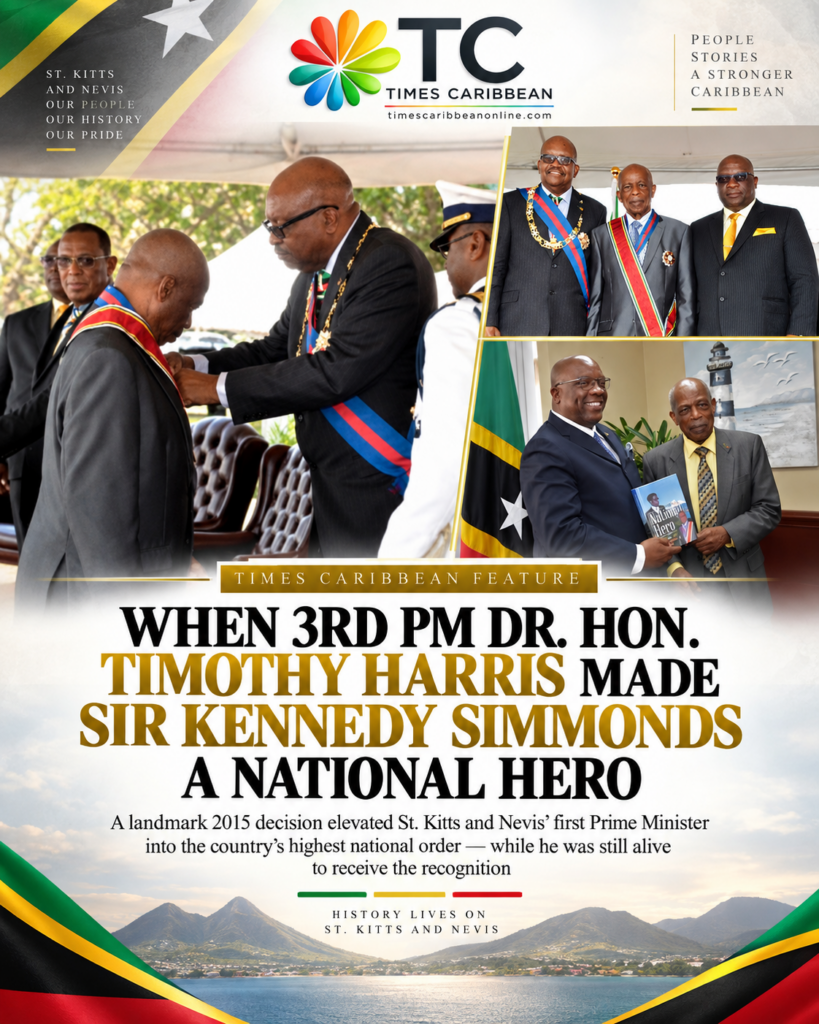
WHEN 3RD PM DR. HON. TIMOTHY HARRIS AND TEAM UNITY MADE SIR KENNEDY SIMMONDS A NATIONAL HERO
A landmark 2015 decision elevated St. Kitts and Nevis’ first Prime Minister into the country’s highest national order — while he was still alive to receive the recognition
BASSETERRE, ST. KITTS — TIMES CARIBBEAN FEATURE
There are moments in the political history of a country that eventually become larger than the government that initiated them.
The decision by the Dr. Timothy Harris-led Team Unity Government in 2015 to name Dr. the Right Honourable Sir Kennedy Alphonse Simmonds a National Hero of St. Kitts and Nevis was one such moment.
On September 19, 2015, during his first Independence Address as Prime Minister, Dr. the Honourable Timothy Harris announced that Sir Kennedy — the man who had led St. Kitts and Nevis into political independence 32 years earlier — would become the Federation’s fifth National Hero and its first living recipient of the distinction.
It was historically significant on several levels.
Sir Kennedy was not being honoured decades after his death. He was alive. He could hear the country acknowledge his contribution, respond personally to the honour, and later stand at Government House as the nation formally invested him with its highest distinction.
And the government making the decision was itself only seven months old.
HARRIS’ 2015 ANNOUNCEMENT
The February 16, 2015 general election had brought Team Unity to office under Harris, heading a coalition involving the People’s Labour Party, the People’s Action Movement and the Concerned Citizens Movement.
Seven months later came the Independence announcement.
Harris placed Sir Kennedy’s role directly within the history of nation-building.
He reminded the nation that Sir Kennedy had taken St. Kitts and Nevis into independence and had subsequently led the new state during its formative years.
In the Independence Address, Harris declared:
“Today we add yet another name to the Pantheon of National Heroes in the person of Dr the Right Excellent and Right Honourable Sir Kennedy Simmonds.”
The Prime Minister described Simmonds as the leader who had “ushered us into Nationhood” and overseen the Federation’s entry onto the international stage.
He concluded his tribute with a remarkably personal acknowledgement:
“Sir Kennedy you have done well for your country.”
Those words captured the essential argument behind the honour.
Whatever partisan disputes had surrounded Sir Kennedy during his active political career, the Harris administration was making the case that the historical assessment of a founding Prime Minister should ultimately be broader than party politics.
WHY SIR KENNEDY’S ROLE WAS HISTORIC
Sir Kennedy’s place in the Federation’s constitutional history is unambiguous.
He became Premier in 1980, leading the PAM-NRP coalition government, and remained Premier until St. Kitts and Nevis achieved independence from Britain on September 19, 1983. With independence, he became the country’s first Prime Minister, serving until 1995.
That placed him at the centre of one of the most consequential transitions in the country’s history — from Associated State status to full sovereignty.
He became responsible for leading the institutions of a newly independent microstate, establishing its international relationships, managing its early economic direction and navigating the continuing constitutional relationship between St. Kitts and Nevis.
Later official government accounts also credited Simmonds with helping to manage the difficult relationship between the two islands during a period when the possibility of separation was a live political issue. His own autobiography would later credit fellow National Hero Sir Simeon Daniel for helping secure the constitutional arrangement that enabled the Federation to move into independence together.
The Harris administration subsequently identified another part of Simmonds’ legacy: private-sector-led economic transformation during the 1980s. At the 2018 unveiling of statues honouring the five National Heroes, Harris specifically associated Sir Kennedy with “private sector-led growth and transformation in the 1980s.”
A BREAK WITH THE PREVIOUS PATTERN
Before Sir Kennedy, every person elevated to the Order of National Hero had received the recognition posthumously.
The preceding National Heroes were:
Sir Robert Llewellyn Bradshaw; Sir Caleb Azariah Paul Southwell; Sir Joseph Nathaniel France; and Sir Simeon Daniel.
Sir Kennedy’s designation therefore broke a significant precedent.
He became the first citizen to be given the nation’s highest honour while still living. Official government records continue to identify him as the Federation’s only living National Hero.
That distinction mattered deeply to Simmonds himself.
Speaking after the 2015 announcement, Sir Kennedy said he felt “deeply honoured” and was especially grateful that he remained alive to appreciate the recognition. He thanked the Government and people of St. Kitts and Nevis, as well as those who had supported him throughout his life and public service.
That response highlighted one of the broader philosophical questions raised by the Harris government’s decision: Should societies wait until national figures die before acknowledging their historic contributions?
Team Unity’s answer was clearly no.
THE FORMAL INVESTITURE CAME IN 2016
There is an important distinction between the 2015 announcement and what happened the following year.
Sir Kennedy was named National Hero in September 2015.
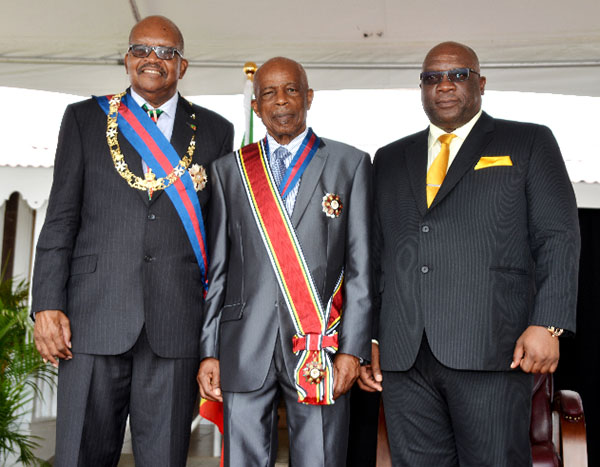
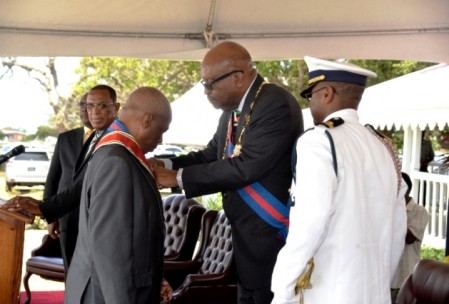
The formal investiture came on June 28, 2016, when Governor-General Sir S.W. Tapley Seaton formally conferred the Order of National Hero upon him at Government House.
At that ceremony, Harris broadened his assessment of Simmonds beyond domestic politics.
He described the former Prime Minister as a “towering standard-bearer” of the generation of Caribbean political leaders who guided their countries through the transition from colonial rule to independence.
It was an important framing.
Harris was effectively placing Simmonds not only in the national history of St. Kitts and Nevis, but in the wider Caribbean independence generation — alongside leaders who presided over the transformation of former British colonies and associated states into sovereign nations.
HARRIS LATER EXPANDED ON SIMMONDS’ ECONOMIC LEGACY
The designation was not treated by the Harris administration as a ceremonial one-off.
Over subsequent years, Harris repeatedly returned to Sir Kennedy’s contribution.
On Sir Kennedy’s 82nd birthday in 2018, Harris credited his “ingenuity and vision” with helping facilitate the Federation’s transition to independence and modernity. The Prime Minister also pointed to the establishment of the Citizenship by Investment Programme during Simmonds’ tenure as an example of policy innovation.
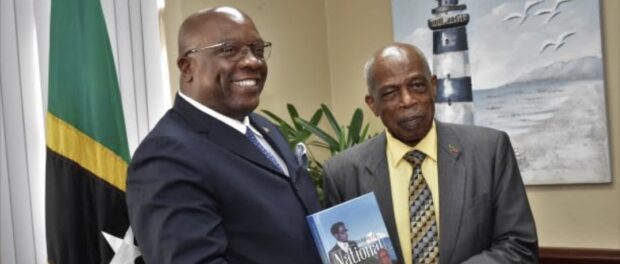
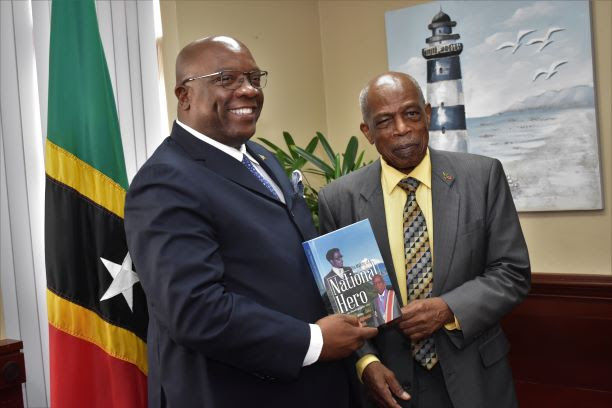
When Simmonds presented Harris with a copy of his autobiography in 2019, Harris again reflected on his economic record.
He pointed to periods of strong economic growth under the Simmonds administration and highlighted measures such as the abolition of personal income tax and reforms involving the National Provident Fund as policies that, in Harris’ assessment, helped expand economic freedom.
Whether every individual agrees with every policy adopted by the Simmonds governments is separate from the historical question the National Hero designation sought to answer.
The honour recognised the scale and duration of his contribution to the state.
TEAM UNITY ALSO CHANGED HOW NATIONAL HEROES WERE COMMEMORATED
The 2015 decision became part of a wider Team Unity approach to national commemoration.
On National Heroes Day in September 2015, Harris announced plans for a permanent National Heroes Park honouring all of the Federation’s National Heroes.
He later explained that the concept represented a different philosophy: rather than constructing recognition around individual political traditions, the country would create a national space incorporating every person elevated to its highest order.
By September 2016, Harris was explicit about the principle behind it.
“National heroes cannot be pigeon holed by party political interests.”
He argued that their contribution had to possess a broader, national and enduring character.
That principle became especially meaningful in a country whose recognised heroes emerged from differing political traditions.
Bradshaw, Southwell, France, Daniel and Simmonds did not occupy identical political camps.
Their political careers often intersected with fierce disagreement.
Yet the philosophy articulated under Harris was that a National Hero should ultimately belong to the country rather than to a party.
At the dedication of the National Heroes Park in 2016, Harris put the idea even more plainly, saying the honour stood “outside of and above party politics.”
COUNTRY ABOVE PARTY
That may be the most important dimension of the 2015 decision.
Sir Kennedy Simmonds was one of the founders of the People’s Action Movement and remained one of the defining figures in that party’s history.
The Team Unity coalition contained PAM, but Harris himself came from a different political journey, having served for many years in a Labour administration before eventually leading the People’s Labour Party and the Team Unity coalition.
Sir Kennedy’s designation therefore sat at the intersection of history, party politics, coalition politics and national identity.
Yet Harris repeatedly argued that national recognition had to transcend those boundaries.
During another national commemoration in 2017, he explained the philosophy this way: National Heroes do not belong exclusively to their families or political parties; they belong to the country.
That idea became a defining feature of the Team Unity-era treatment of national heroes.
THE SIGNIFICANCE OF HONOURING SOMEONE WHILE HE COULD STILL RECEIVE IT
There is another dimension that has become more apparent with time.
Countries frequently celebrate their most consequential citizens after death.
Buildings are renamed. Statues are commissioned. Roads are dedicated. National awards are announced.
But the recipient is no longer present to hear the applause.
The Harris-led government took another path with Sir Kennedy.
Simmonds was able to attend ceremonies as a National Hero. He addressed young people on National Heroes Day. He stood alongside the other heroes in the nation’s official historical narrative. He watched the National Heroes Park develop. And he participated personally in preserving the story of the independence generation.
In 2017, Sir Kennedy himself told the nation’s youth that the common thread connecting national heroes was service.
He also emphasised something fundamental: no political leader becomes a national figure independently of the people.
“I thank the Government and people of St. Kitts and Nevis for the signal honour given to me while I am yet alive,” he said.
That line perhaps best explains what was different about 2015.
The nation did not wait.
A DECISION THAT BECAME PART OF THE HISTORICAL RECORD
By 2019, Harris openly reflected on the significance of Team Unity having honoured Simmonds during his lifetime.
At that year’s National Heroes Day observance, he noted that Sir Kennedy remained the only living recipient of the distinction and linked the decision to what he described as Team Unity’s approach to national recognition.
Four years after the original designation, the government was therefore still presenting the decision as a statement about national gratitude — that major contributions need not be recognised only retrospectively.
History will continue to debate governments.
It will debate policies.
It will debate economic choices, political battles and ideological differences.
But certain constitutional facts stand outside those arguments.
Kennedy Alphonse Simmonds led St. Kitts and Nevis into independence on September 19, 1983.
He became its first Prime Minister.
And 32 years later, on September 19, 2015, the government led by Dr. Timothy Harris and Team Unity formally placed his name among the Federation’s National Heroes.
The formal insignia followed at Government House on June 28, 2016.
And for the first time in the history of St. Kitts and Nevis, a citizen was able to stand before his country as a living National Hero and hear, in his own lifetime, the nation’s official verdict that his service had earned its highest honour.
For Sir Kennedy Simmonds, it was recognition of a lifetime of public service.
For the Harris administration, it became one of its most enduring acts of national commemoration.
And for St. Kitts and Nevis, it established a precedent with a simple but profound message:
A nation does not always have to wait until its builders are gone before saying thank you.
TIMES CARIBBEAN FEATURE | HISTORY • LEADERSHIP • NATIONAL DEVELOPMENT
















Leave a comment
You must be logged in to post a comment.