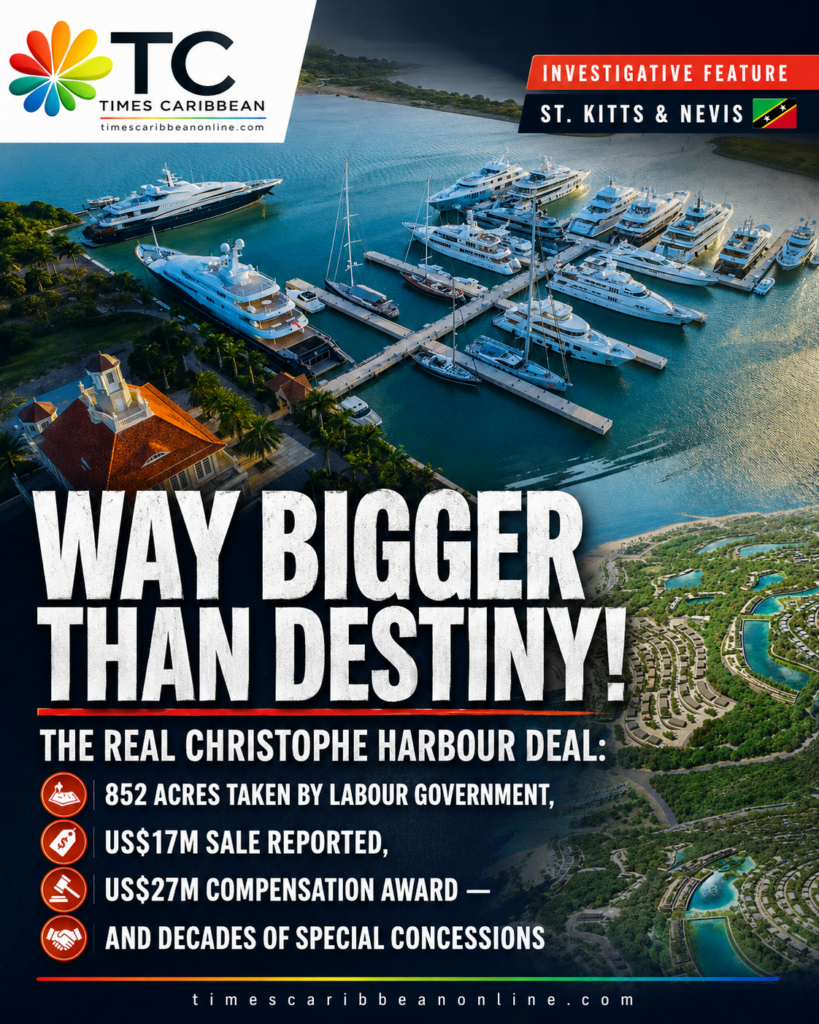
WAY BIGGER THAN DESTINY ! THE REAL CHRISTOPHE HARBOUR DEAL: 852 ACRES TAKEN BY LABOUR GOVERNMENT, US$17M SALE REPORTED, US$27M COMPENSATION AWARD — AND DECADES OF SPECIAL CONCESSIONS
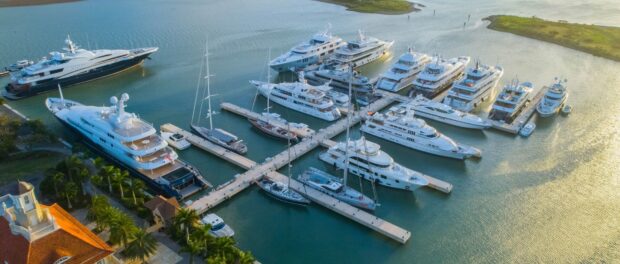
CHRISTOPHE HARBOUR VS. DEZTINY: THE LAND QUESTION CHANGES EVERYTHING
The comparison now being made between Christophe Harbour and the proposed Deztiny development requires an important distinction.
They are not the same kind of land transaction.
Based on the information presently available, land involved in the proposed Deztiny project is held by private owners. Those owners ultimately retain the choice to sell, negotiate or decline an offer.
Christophe Harbour presents a substantially different historical picture.
Court records reviewed by Times Caribbean confirm that in 2007 the Government of St. Kitts and Nevis compulsorily acquired approximately 852.355 acres at Major’s Bay. The land included acreage already caught up in a long-running private contractual dispute.
That point is critical.
The State was therefore not merely standing on the sidelines while private parties independently bought and sold land. Government exercised one of the strongest powers available to the State — compulsory acquisition — over hundreds of acres of property in an area subsequently incorporated into the wider Christophe Harbour development framework.
The 2007 Development Agreement itself confirms that Government and the Joint Venture entered into a separate purchase-and-sale arrangement under which public acquisition lands at Major’s Bay, Priddies Plateau and Black Coral/Little Salt Pond were to be transferred to the Joint Venture in fee simple title.
That is a vastly different public-policy proposition from a developer approaching individual private landowners and asking whether they wish to sell.
THE US$17 MILLION QUESTION
Contemporary reporting and later court material indicate that the approximately 850-acre Major’s Bay lands were transferred into the Christophe Harbour development for roughly US$17 million. A 2015 statement attributed to then-Attorney General Vincent Byron described the previous administration as having sold the approximately 850 acres to Christophe Harbour after Government acquisition.
Times Caribbean has previously reported the sale price as approximately US$17 million.
But the story did not end there.
And this is where the financial implications for taxpayers become significantly more serious.
The former owners pursued Government for compensation arising from the compulsory acquisition.
According to a 2026 Judicial Committee of the Privy Council judgment, on April 19, 2013, the High Court awarded the relevant former landowners US$27,392,721.04 in compensation, together with post-judgment interest, arising from Government’s compulsory acquisition of the Major’s Bay property.
That creates an extraordinary public-interest comparison:
The State reportedly sold the lands into the development for approximately US$17 million, while Government was subsequently ordered to compensate former owners by approximately US$27.39 million — before considering interest, legal expenses or any other associated public costs.
If those figures are placed side by side, the compensation judgment alone was approximately US$10.39 million higher than the reported US$17 million sale price.
That does not, by itself, establish that Government ultimately suffered a net US$10.39 million loss. A proper calculation would require the full acquisition accounts, amounts actually paid, outstanding balances, financing arrangements, related land transactions and any revenues or consideration received elsewhere.
But the numbers are serious enough to demand a complete public reconciliation.
THIS MAKES THE CHRISTOPHE HARBOUR COMPARISON FAR MORE CONSEQUENTIAL
Critics comparing Christophe Harbour with Deztiny should therefore be careful not to flatten two very different situations into the same argument.
With privately owned land, the fundamental starting point is voluntary negotiation.
An owner can say:
Yes.
No.
Or:
The price is not enough.
Compulsory acquisition changes that relationship entirely.
Government acquires land using statutory authority for an asserted public purpose, and constitutional safeguards concerning compensation become central.
That means citizens have every right to ask:
Why was compulsory acquisition necessary?
What public purpose justified acquiring the 852 acres?
What valuation did Government rely upon?
What exactly did Government pay the original owners?
What did Christophe Harbour ultimately pay Government?
Why did litigation eventually produce a US$27.39 million compensation award?
How much interest was subsequently payable?
And perhaps most importantly:
Who ultimately absorbed the difference?
Because Government does not possess money independently of the public.
Government liabilities ultimately sit on the public balance sheet.
THE DEVELOPMENT AGREEMENT MAKES THE LAND HISTORY EVEN MORE IMPORTANT
This land issue cannot be separated from the extraordinary concessions contained in the agreement.
Government was not merely transferring land.
The 2007 agreement also created a special Resort District, provided extensive tax exemptions, gave preferential treatment in several regulatory areas and committed Government to facilitating development approvals.
The agreement says that where provisions of ordinary law conflicted with the agreement or associated Key Documents, the contractual framework would prevail for the Joint Venture, Resort and Resort District.
It granted a tax-exemption regime that potentially continues until 20 years after the second hotel opens, subject to extensions.
It contemplated perpetual seabed leases, generally for nominal consideration of US$1 plus development obligations.
It facilitated preferential treatment for foreign purchasers.
It allowed extensive coastal works, reclamation, dredging and alteration of parts of the Southeast Peninsula, subject to the agreed environmental framework.
And against that backdrop sits the compulsory acquisition of approximately 852 acres at Major’s Bay.
That combination makes the Christophe Harbour transaction far more than a straightforward private development proposal.
It involved the power, finances and long-term obligations of the State.
THE REAL QUESTION IS NOT WHETHER DEVELOPMENT IS GOOD OR BAD
St. Kitts and Nevis needs investment.
It needs hotels.
It needs jobs.
It needs foreign exchange, infrastructure and serious private capital.
The proper debate is therefore not whether development should happen.
The question is on what terms.
A development agreement can still prove beneficial despite generous incentives.
A compulsory acquisition can still serve a legitimate public purpose.
A Government can legitimately decide that sacrificing short-term revenue will generate much larger economic gains over decades.
But once public land, compulsory acquisition, multimillion-dollar compensation liabilities, tax concessions and exceptional regulatory privileges are involved, citizens are entitled to see the final arithmetic.
And Christophe Harbour now presents a particularly important case study.
The project was originally projected to deliver more than US$17 billion in tax and economic benefits over approximately 20 years.
Almost two decades later, there should be no difficulty answering the obvious question:
Did St. Kitts and Nevis actually receive value commensurate with what it gave?
That calculation should include not only investment and jobs, but:
the 852 acres compulsorily acquired; the approximately US$17 million reported sale price; the US$27.39 million compensation judgment and interest; tax concessions; waived duties; alien landholding concessions; infrastructure commitments; Government services; CBI-related benefits granted to the development; and the long-term economic value of the land itself.
Until that accounting is produced, comparisons with newer developments will remain incomplete.
Because with Christophe Harbour, the public story is not simply that a developer bought land and developed it.
The documented history is substantially more complicated.
The State acquired major acreage compulsorily, transferred lands into a specially protected luxury-development framework, granted far-reaching concessions, and subsequently faced a multimillion-dollar compensation judgment arising from the acquisition.
That deserves scrutiny.
Not speculation.
Not political spin.
The numbers. The contracts. The valuations. The payments. And the final benefit to the citizens of St. Kitts and Nevis.
















Leave a comment
You must be logged in to post a comment.