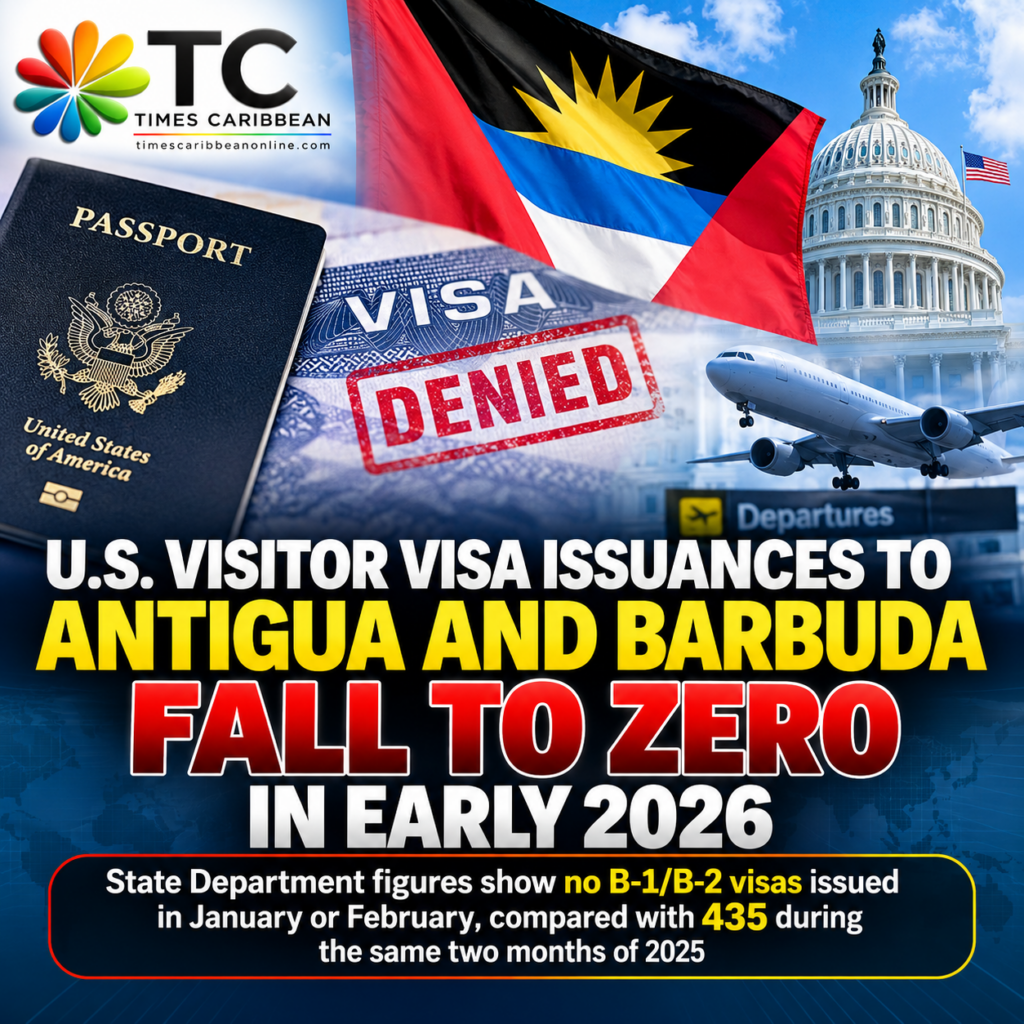
U.S. VISITOR VISA ISSUANCES TO ANTIGUA AND BARBUDA FALL TO ZERO IN EARLY 2026
State Department figures show no B-1/B-2 visas issued in January or February, compared with 435 during the same two months of 2025
TIMES CARIBBEAN | ST. JOHN’S, ANTIGUA — The number of new United States visitor visas issued to nationals of Antigua and Barbuda dropped to zero during the first two months of 2026, marking a dramatic shift from the hundreds issued during the corresponding period one year earlier.
Figures published through the U.S. Department of State’s monthly nonimmigrant visa statistics show that 249 B-1/B-2 business and visitor visas were issued to Antigua and Barbuda nationals in January 2025, followed by another 186 in February 2025.
That represents 435 B-1/B-2 visas across the two-month period.
In January and February 2026? None.
The sharp change comes against the backdrop of new U.S. visa restrictions that took effect on January 1, 2026, under Presidential Proclamation 10998. Antigua and Barbuda is among 19 countries subject to partial restrictions covering new B-1, B-2 and B-1/B-2 visitor visas, along with F, M and J student and exchange categories and most immigrant visas, subject to limited exceptions.
JUST ONE VISA RECORDED IN JANUARY
The decline extended beyond the traditional visitor category.
According to the published nationality data, only one nonimmigrant visa was recorded for an Antigua and Barbuda national in January 2026 — a K-1 visa, the category generally used by a foreign fiancé or fiancée of a U.S. citizen.
By comparison, a total of 260 visas across nonimmigrant categories were recorded in January 2025, according to figures reported from the State Department data.
That represents a year-on-year decline of approximately 99.6 per cent for January.
February showed only a modest increase.
Seven visas were recorded for Antigua and Barbuda nationals during that month: two G-1 visas, one G-4 visa and four P-1 visas.
G visas are generally associated with representatives of governments and international organisations, while P-1 visas are available for certain qualifying athletes and entertainment groups.
The February 2026 total of seven compares with 204 nonimmigrant visas issued during February 2025, a decline of approximately 96.6 per cent.
No B-1/B-2 visitor visas, F-1 student visas, M-1 vocational student visas or J-1 exchange visitor visas were listed for Antigua and Barbuda nationals during either January or February 2026.
NEW U.S. RESTRICTIONS
The timing closely corresponds with the implementation of Presidential Proclamation 10998.
The White House proclamation specifically states that the entry of Antigua and Barbuda nationals as immigrants and as nonimmigrants using B-1, B-2, B-1/B-2, F, M and J visas is suspended, subject to specified exceptions. It became effective at 12:01 a.m. Eastern Standard Time on January 1, 2026.
Importantly, the policy does not mean every Antigua and Barbuda national holding a U.S. visa suddenly lost that visa.
The State Department says the proclamation generally applies to affected foreign nationals who were outside the United States on January 1 and did not already possess a valid visa at the time the restrictions became effective.
Visas that were valid before the proclamation took effect were not revoked simply because of the new restrictions.
Applicants affected by the proclamation may also continue to submit visa applications and attend scheduled interviews, although they may ultimately be ineligible to receive a visa unless an exception applies. Certain national-interest and other exemptions can be considered on a case-by-case basis.
A STARK CHANGE IN THE NUMBERS
The difference is especially striking because visas were still being issued shortly before the restrictions took effect.
State Department figures reported for late 2025 show 74 B-1/B-2 visas issued to Antigua and Barbuda nationals in November and 73 in December.
Then came January.
Zero.
For Antigua and Barbuda residents seeking new U.S. visitor visas, the first published figures of 2026 therefore provide one of the clearest numerical indications yet of how substantially the new American visa policy has altered the issuance landscape.
The State Department continues to publish monthly visa issuance statistics by nationality and visa classification, meaning subsequent reports will provide a clearer picture of whether the near-total decline continues through the remainder of 2026.
TIMES CARIBBEAN will continue to follow developments affecting Caribbean nationals seeking travel, study and other visas to the United States.
















Leave a comment
You must be logged in to post a comment.