THE STEWART FAMILY SETTLEMENT: Why the Caribbean Can Finally Exhale as Sandals’ Four-Year Estate Battle Ends
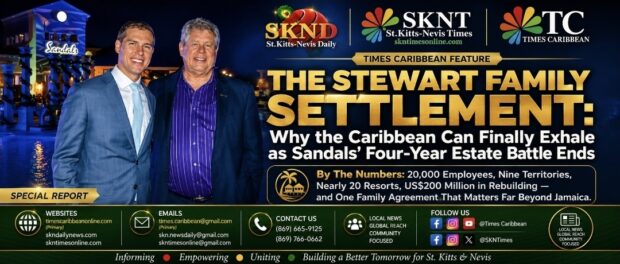
THE STEWART FAMILY SETTLEMENT: Why the Caribbean Can Finally Exhale as Sandals’ Four-Year Estate Battle Ends
By The Numbers: 20,000 Employees, Nine Territories, Nearly 20 Resorts, US$200 Million in Rebuilding — and One Family Agreement That Matters Far Beyond Jamaica
BASSETERRE, ST. KITTS, June 2026 — Four years after the passing of legendary Jamaican hotelier Gordon “Butch” Stewart, the family behind the Caribbean’s most powerful homegrown hospitality empire has announced that its differences have been resolved — bringing a long-running and closely watched estate dispute to a quiet but deeply consequential end.
For the Caribbean tourism sector, the statement is more than a family update. It is a regional economic development.
Sandals Resorts International and the wider Stewart business empire are not merely private companies. They are pillars of Caribbean tourism infrastructure. Across nine Caribbean territories, Sandals and Beaches represent employment, airlift confidence, foreign exchange earnings, hotel tax revenue, supplier contracts, agricultural linkages, construction activity, brand visibility, and destination credibility.
That is why the Stewart family’s public declaration of unity removes a cloud of uncertainty that had hovered over the Sandals and Beaches Group for more than four years.
The settlement terms have not been publicly disclosed. But the signal is unmistakable: the family is drawing a line under the dispute and turning attention back to the future of one of the Caribbean’s most valuable private-sector legacies.
The Numbers Tell the Story
By the numbers, the stakes were enormous.
Sandals Resorts International operates across nine Caribbean territories, employs more than 20,000 people, and manages nearly 20 properties under the Sandals and Beaches brands. The group is also in the middle of a major transformation agenda, including a US$200 million resort reimagining programme in Jamaica following damage from Hurricane Melissa.
Those numbers explain why the family dispute was never simply a private disagreement over inheritance, trusts, or corporate control.
It was a matter of regional economic significance.
For governments across the Caribbean, Sandals is a tourism anchor. For thousands of workers, it is a livelihood. For airlines, it is a demand generator. For taxi operators, farmers, fishers, entertainers, tour companies, contractors, and small suppliers, it is part of a wider economic ecosystem.
A prolonged leadership dispute at the top of such a group carried the risk of distraction, uncertainty, reputational pressure, and delayed strategic execution.
Now, with the family announcing that its differences have been resolved, the region can breathe easier.
A Dispute Rooted in Legacy, Trusts and Control
The dispute emerged after Butch Stewart’s death in January 2021.
At the centre were questions surrounding his estate, the role of two Bahamian trusts, the future control of major Stewart family assets, and claims connected to what was reportedly described as a late-stage instruction concerning the distribution of interests in key asset-holding companies.
According to public reporting, one of the most sensitive claims involved an alleged wish that would have given Stewart’s United States-based family — including Cheryl Hammersmith-Stewart and their children — a significant stake in key companies, along with influence over major business decisions.
Had such an arrangement been accepted in the manner reportedly advanced, it could have materially affected the position of Adam Stewart, who had long been seen as Butch Stewart’s chosen successor and who became Executive Chairman of Sandals Resorts International following his father’s death.
Adam Stewart and the Jamaican side of the family consistently rejected the claims against him and the trust structure. He maintained that the allegations were without foundation, that Sandals remained financially strong, and that his father had intended him to lead the company into its next chapter.
Over time, the dispute moved through courts in multiple jurisdictions, including The Bahamas and Jamaica. Several procedural outcomes favoured Adam Stewart’s position, including a Jamaican Supreme Court ruling striking out an attempt by estate executors to pursue what was described as a “red flag” audit of major Stewart-linked businesses.
Why the Region Was Watching
For the ordinary Caribbean observer, the dispute may have appeared to be another high-profile family disagreement following the passing of a wealthy patriarch.
But for regional tourism analysts, the matter was far more serious.
Sandals is one of the Caribbean’s rare global brands built from within the region. It is not an outside hotel chain merely operating in the islands. It is a Caribbean-born hospitality giant that helped reshape the global image of all-inclusive luxury, especially in Jamaica and the wider English-speaking Caribbean.
The company’s stability matters because the Sandals brand carries destination confidence.
When Sandals invests, airlines pay attention. When Sandals expands, governments promote it. When Sandals rebuilds, contractors, suppliers and workers feel the impact. When Sandals opens a Beaches resort, family tourism markets shift. When Sandals delays, entire local economies can feel the slowdown.
That is why prolonged uncertainty at the ownership and governance level had implications beyond the courtroom.
Even where individual court rulings did not threaten day-to-day hotel operations, the cumulative effect of multi-jurisdictional litigation created legitimate concern. Could strategic decisions slow down? Could investment timetables be affected? Could competitors exploit uncertainty? Could governments become cautious? Could employees and suppliers begin to wonder about long-term direction?
Those questions are now less pressing.
The family’s public statement of resolution sends a message of continuity, stability and renewed focus.
Adam Stewart’s Defining Test
For Adam Stewart, the end of the dispute marks a major personal and corporate moment.
He inherited not only a company, but a legacy. He also inherited the impossible burden of following one of the Caribbean’s most iconic business builders.
Butch Stewart was not simply a hotelier. He was a salesman, risk-taker, brand builder, media owner, investor, political influencer, and regional economic force. His name became synonymous with Jamaican entrepreneurship and Caribbean hospitality ambition.
Taking over after such a figure would have been difficult under normal circumstances. Adam Stewart had to do so while navigating legal challenges, family division, public scrutiny, pandemic recovery pressures, changing travel patterns, climate-related disruption, and the heavy emotional toll of personal loss, including the passing of his wife from cancer.
He also had to manage the operational aftermath of Hurricane Melissa, which damaged several major Jamaica properties and forced the company into a significant rebuilding and reimagining programme.
Through it all, Sandals continued to operate, rebuild, expand and promote its future vision.
That matters.
In business, leadership is not only tested when the sun is shining. It is tested when the inheritance is contested, the market is watching, the weather is unforgiving, the legal bills are mounting, and the workforce still expects direction.
By surviving this period and keeping the company moving, Adam Stewart has strengthened his claim not merely as successor by family line, but as steward by performance.
Sandals 2.0 and the Next Phase
The settlement comes as Sandals is already pushing what Adam Stewart has described as a future-focused transformation of the brand.
The company’s US$200 million investment to reimagine three iconic Jamaica resorts — Sandals Montego Bay, Sandals Royal Caribbean, and Sandals South Coast — is not simply a repair programme. It is being framed as part of a wider “Sandals 2.0” repositioning.
That phrase matters.
It suggests that the company is not merely restoring what existed before. It is preparing for a new tourism era defined by higher guest expectations, climate resilience, luxury reinvention, stronger digital engagement, expanded family travel, enhanced employee development, and more intense regional competition.
The Caribbean tourism market is changing quickly. Destinations are competing not only against each other but against Mexico, Dubai, Europe, cruise tourism, private villas, boutique luxury brands and emerging experiential travel markets.
In that environment, a distracted Sandals would have been bad for the region. A focused Sandals is a regional asset.
The family settlement therefore arrives at a pivotal moment.
It clears the way for leadership to focus on rebuilding, expansion, brand renewal, and the continued development of Beaches — a brand with enormous potential for family tourism across the Caribbean.
The Bahamas, Jamaica and the Trust Question
One of the more complex features of the dispute was its multi-jurisdictional nature.
The involvement of Bahamian trusts placed parts of the matter within The Bahamas’ legal framework, while business operations and related proceedings also brought Jamaica into the picture. That cross-border structure reflected the scale and sophistication of the Stewart business empire, but it also made the dispute more complicated.
High-net-worth Caribbean families increasingly use trusts, holding companies, offshore structures and multi-territory corporate arrangements to manage assets, succession planning and tax exposure. But the Stewart matter illustrates a hard truth: complex structures do not always prevent conflict. Sometimes they simply relocate the conflict into more technical legal arenas.
For Caribbean business families, the lesson is powerful.
Succession planning is not only about documents. It is about clarity, communication, enforceability, governance, family expectations and leadership legitimacy.
The Stewart dispute showed how even one of the region’s most successful business dynasties could face uncertainty when questions arise over final wishes, trust authority, estate administration, and control of operating companies.
The resolution may close this chapter, but it will likely be studied for years by lawyers, wealth managers, family businesses and corporate governance specialists across the Caribbean.
Family Unity as Economic Strategy
The joint family statement deliberately avoided the details of the settlement. That is not unusual. In high-value estate and trust disputes, parties often choose confidentiality over public explanation.
But the language of unity was important.
The family expressed excitement about the continued development and success of Butch Stewart’s legacy. That choice of wording matters because it shifts the public narrative away from conflict and toward preservation.
In the Caribbean, where family-owned businesses often dominate major sectors, unity can be more than sentimental. It can be strategic.
A divided family can unsettle employees, lenders, partners and governments. A united family can reassure markets, protect brand confidence and accelerate investment decisions.
For Sandals, unity is now part of the business message.
The troubled waters have calmed. The empire has not fractured. The brand remains standing. The future can now be discussed without every major announcement being viewed through the shadow of unresolved litigation.
The Caribbean Can Exhale — But the Lessons Remain
The end of the Stewart family dispute is good news for Sandals, Jamaica and the wider Caribbean.
But it should not be treated simply as a happy ending. It is also a warning.
Caribbean economies are heavily dependent on family-owned conglomerates, legacy businesses and founder-led institutions. Many of these enterprises are now approaching generational transition. Founders are ageing. Children are taking over. Family structures are becoming more complex. Assets are more global. Marriages, partnerships, offshore trusts, blended families and competing expectations are increasingly part of the succession landscape.
The Stewart case demonstrates how succession disputes can place even strong businesses under public pressure.
The lesson is clear: legacy must be planned, not assumed.
Butch Stewart built a tourism empire that changed the Caribbean. The family has now taken a major step toward protecting that legacy. For Adam Stewart, the settlement gives him the space to lead without the constant shadow of an unresolved estate conflict. For Sandals employees, it brings reassurance. For governments, it brings continuity. For the regional tourism sector, it brings stability at a time when stability is priceless.
Four years. Multiple jurisdictions. Two Bahamian trusts. A disputed legacy. A bruising legal chapter.
Now, finally, a declared peace.
And for the Caribbean’s most prominent homegrown hospitality brand, the message is simple: Sandals can get on with it.
















Leave a comment
You must be logged in to post a comment.