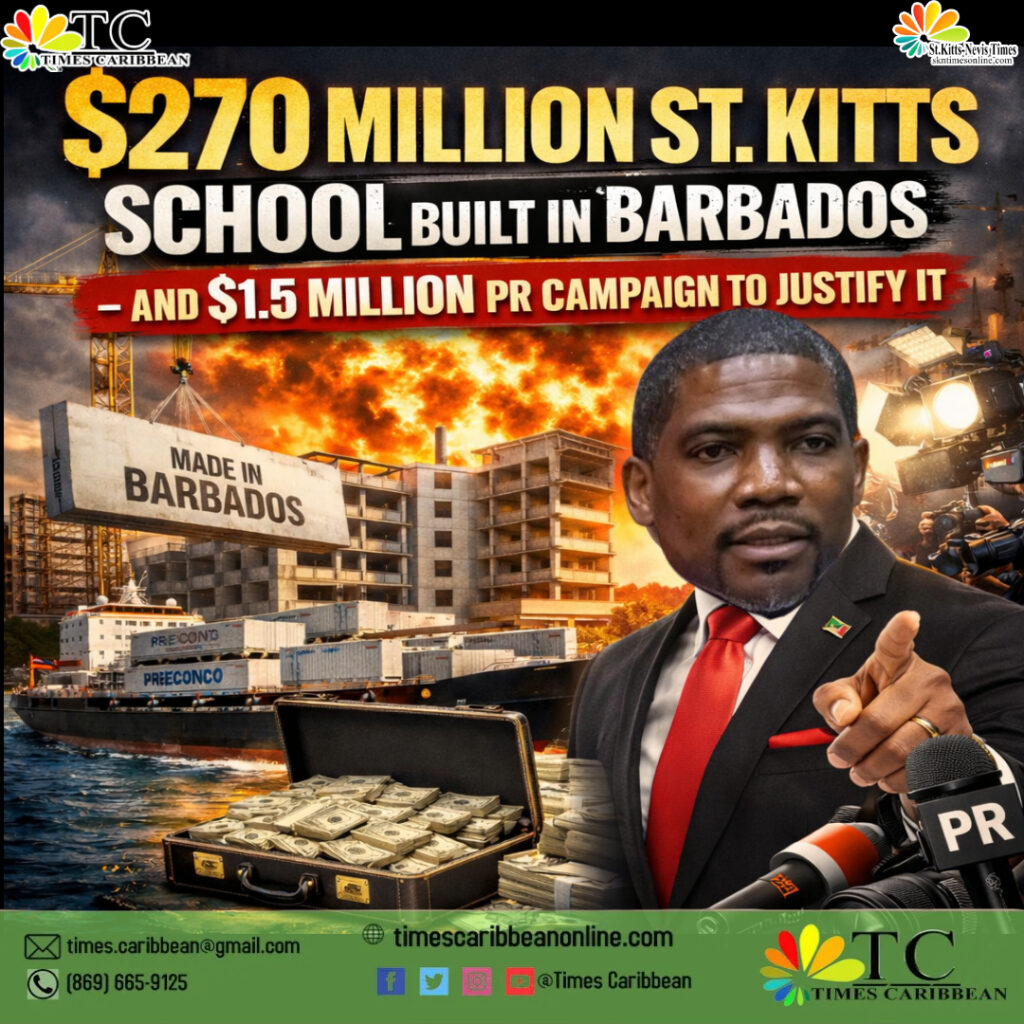
THE $270 MILLION ST.KITTS SCHOOL TO BE BUILT IN BARBADOS AND THE $1.5MILLION PR CAMPAIGN TO JUSTIFY IT

The administration of Prime Minister Dr. Terrance Drew is reportedly preparing to launch what observers describe as a major public relations campaign costing potentially millions of dollars to defend its controversial decision to construct the new Basseterre High School using precast structures manufactured in Barbados.
According to sources familiar with the communications strategy surrounding the project, a series of carefully crafted articles and technical features are expected to appear in Barbadian media outlets, particularly The Nation newspaper in Bridgetown, highlighting the role of Preconco Limited, the Barbados-based company manufacturing structural components for the school.
These articles are expected to present the project as a model of modern engineering: high-quality precast concrete produced in Barbados, shipped to St. Kitts, and assembled into a hurricane-resilient, state-of-the-art educational facility.
But critics say the emerging media campaign appears less about explaining the project and more about managing the growing public backlash surrounding what has become one of the most controversial public infrastructure decisions in the history of St. Kitts and Nevis.
The Technology Was Never the Issue
The anticipated public relations articles will likely devote significant attention to the advantages of precast concrete construction — factory precision, faster building timelines, reduced weather delays, and enhanced structural resilience.
None of those points are disputed.
Precast technology is widely used internationally and is considered a reliable and efficient construction method.
But the debate in St. Kitts and Nevis has never been about the engineering method itself.
The central questions remain far more fundamental:
Why was the decision taken to manufacture major structural components of a St. Kitts public school in another country — and how did the cost of the project balloon to nearly EC$271 million?
The Abandoned Project Few Want to Discuss
One issue that is unlikely to be addressed in the PR campaign is the earlier Basseterre High School redevelopment project at the Ponds Pasture site.
Before the Drew administration took office in 2022, that project had already advanced through years of planning and preparation. Engineering studies had been completed, architectural designs finalized, and millions of dollars invested in site preparation and project management.
Yet shortly after the change of government, the project was abruptly halted and the site effectively abandoned.
Years of work and significant taxpayer investment were written off with little public explanation.
For many observers, that decision marked the first turning point in what has now evolved into a much larger and more expensive undertaking.
The School Being Manufactured Overseas
The forthcoming PR articles are expected to emphasize that the entire school is not being constructed in Barbados, but rather that structural components are being manufactured there before being shipped to St. Kitts for assembly.
Technically, that distinction may be correct.
But critics argue that it does little to address the broader concern: that a large portion of the project’s value is now being exported outside the federation.
Wall panels, structural columns, floor slabs, and foundation components — essentially the structural backbone of the school — are being fabricated at Preconco’s facility at Lears Quarry in St. Michael, Barbados.
Industry observers estimate that well over half of the engineering and manufacturing value of the project could now be occurring in Barbados rather than St. Kitts and Nevis.
For a small island economy where major public works projects traditionally provide employment for local contractors, tradesmen, and labourers, the implications are significant.
The Cost That Keeps Climbing
Perhaps the most glaring omission from the expected public relations campaign will be the issue that has captured the greatest public attention: the extraordinary cost of the project.
Initial discussions about rebuilding Basseterre High School placed the project at roughly EC$100 million.
Today, estimates circulating publicly place the cost at approximately EC$270–271 million.
If confirmed, the project would rank among the most expensive secondary school construction initiatives ever attempted in the Caribbean.
Yet the expected PR narrative is unlikely to address the dramatic cost escalation.
Instead, it will focus largely on the technical advantages of precast construction — an argument that, while valid in engineering terms, does little to explain why the project budget appears to have nearly tripled.
The US$10 Million Question
Equally absent from the anticipated media campaign are reports that approximately US$10 million (EC$27 million) has already been paid to Preconco for the manufacture of structural components.
Government officials have indicated that the project is being financed through the Public Benefactor Option of the Citizenship-by-Investment Programme (CBI).
If that is the case, many observers argue that the public deserves clarity.
How exactly is the financing structured?
Why was such a significant payment required at this stage?
And if a public benefactor is financing the project, why was the payment not handled directly through that benefactor rather than through government channels?
These questions remain unanswered.
When Public Relations Becomes the Story
Perhaps the most revealing element of the entire episode is that the narrative defending the project appears to be emerging outside St. Kitts and Nevis itself.
Just like the construction process.
Instead of addressing concerns directly within the federation — where the school is meant to serve thousands of students — the communication effort appears to be unfolding largely in Barbados, where the contractor is based and where much of the economic benefit from the project will remain.
For critics, the optics are troubling.
A school for St. Kitts students is being manufactured in Barbados, and now the public relations campaign defending the project may also be centered there.
The School Students Are Still Waiting For
More than ten years after the closure of Basseterre High School, thousands of students have passed through temporary facilities while successive governments promised a modern campus.
The current project was supposed to finally deliver that promise.
Instead, it has become entangled in controversy: abandoned sites, overseas manufacturing, rising costs, and mounting questions about transparency.
Public relations campaigns may attempt to shape the narrative.
But they cannot erase the central reality.
After more than a decade of waiting and hundreds of millions of dollars in projected spending, the new Basseterre High School is being built by a Barbadian contractor — and a significant portion of the economic benefit from the project appears set to remain there.
Meanwhile, the students of St. Kitts and Nevis are still waiting for their school.
















Leave a comment
You must be logged in to post a comment.