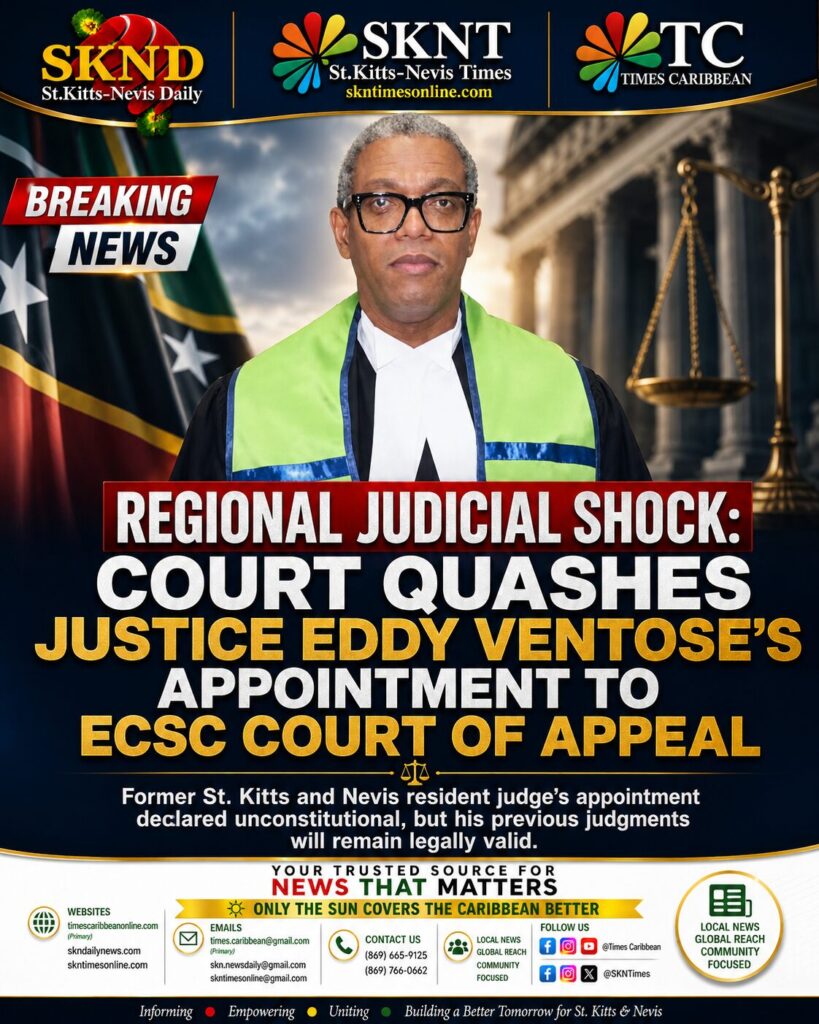
REGIONAL JUDICIAL SHOCK: COURT QUASHES JUSTICE EDDY VENTOSE’S APPOINTMENT TO ECSC COURT OF APPEAL

Former St. Kitts and Nevis resident judge’s appointment declared unconstitutional, but his previous judgments will remain legally valid
ST. GEORGE’S, Grenada, July 15, 2026 — In a landmark ruling with major implications for judicial appointments across the Eastern Caribbean, the High Court has quashed the appointment of Justice Eddy David Ventose as a Justice of Appeal of the Eastern Caribbean Supreme Court.
Justice Raulston L. A. Glasgow, in a written judgment delivered on July 7, declared the appointment “unconstitutional, null, void and of no effect,” after finding that the Judicial and Legal Services Commission failed to establish that Justice Ventose satisfied the mandatory qualifications contained in the West Indies Associated States Supreme Court Order 1967. Justice Ventose’s appointment to the appellate bench had taken effect on January 8, 2024.
The legal challenge was brought by prominent Grenadian attorney James A. L. Bristol KC, who argued that the JLSC acted outside its lawful authority when it appointed Justice Ventose.
Under the governing court order, a person appointed as a Justice of Appeal must have served for an aggregate period of at least five years as a judge of a court of unlimited jurisdiction or must have been qualified and practised as an advocate for at least 15 years.
The parties accepted that Justice Ventose had not completed the required five years of judicial service at the time of his elevation. The central dispute therefore focused on whether his extensive career as a legal academic, consultant, researcher and practitioner could satisfy the 15-year advocacy requirement.
Justice Glasgow accepted that modern advocacy extends beyond oral arguments inside a courtroom and may include preparing pleadings, witness statements and other litigation-related work. However, he concluded that purely academic work, legal scholarship and activities unconnected to the conduct of litigation could not automatically be treated as practising as an advocate.
The court ultimately found that the evidence did not establish that Justice Ventose had practised as an advocate for the required period. It therefore ruled that the JLSC acted beyond its constitutional authority in making the appointment.
Justice Ventose is well known throughout St. Kitts and Nevis, having served as the resident High Court judge assigned to the St. Kitts Circuit from 2018. Official ECSC records identified him as the Federation’s resident High Court judge during his tenure.
Despite the force of the ruling, Justice Glasgow emphasised that the proceedings raised no questions about Justice Ventose’s competence, extensive legal knowledge or widely recognised professional accomplishments. The court also found no evidence that he knew—or reasonably should have known—that his appointment was legally defective.
Importantly, the judge invoked the de facto officer doctrine, meaning that appeals heard and judgments delivered by Justice Ventose will not become invalid merely because of the defect in his appointment. The principle protects decisions made by an official who performed the duties of an office under the reasonable belief that the appointment was lawful.
Before joining the ECSC bench, Justice Ventose was also involved in a landmark Barbados voting-rights case. In 2018, the Caribbean Court of Justice ordered electoral authorities to register the Saint Lucian-born legal scholar as an elector, ruling that he satisfied the statutory requirements as a Commonwealth citizen lawfully residing in Barbados.
The ruling is expected to intensify regional discussion about the scrutiny applied to senior judicial appointments and the responsibility of the JLSC to verify that every nominee strictly satisfies the qualifications established by law.
















Leave a comment
You must be logged in to post a comment.