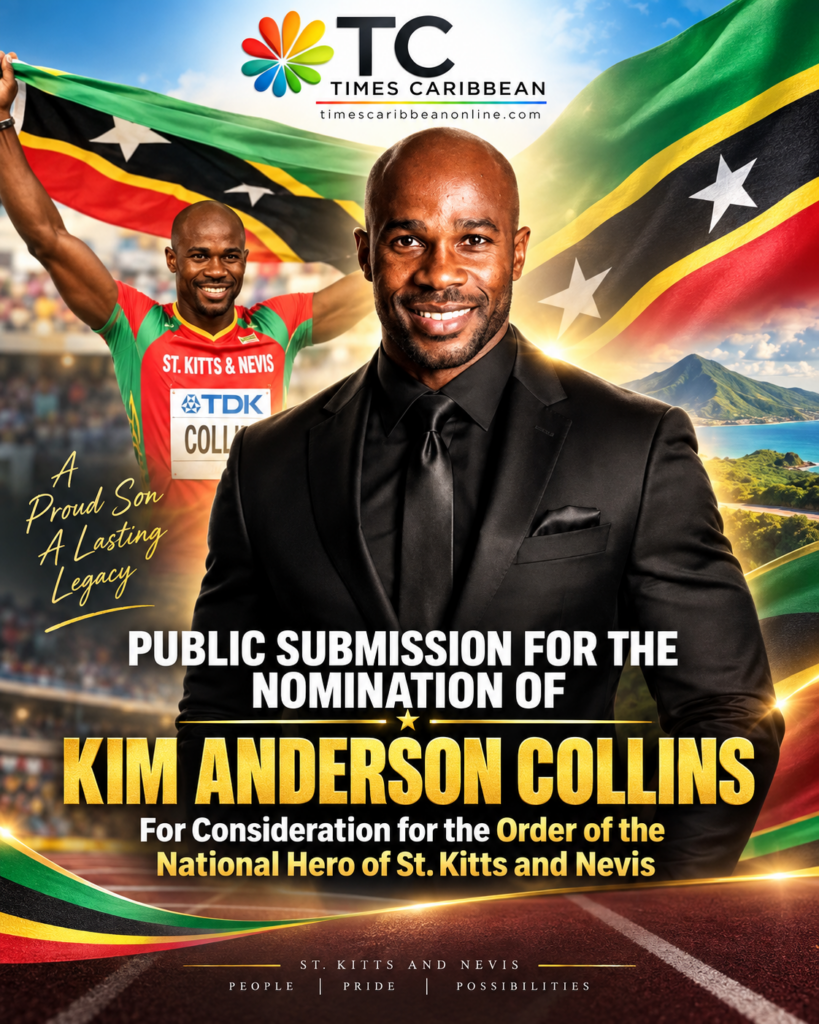
PUBLIC SUBMISSION FOR THE NOMINATION OF KIM ANDERSON COLLINS For Consideration for the Order of the National Hero of St. Kitts and Nevis
Public Submission to:
The Cabinet of the Government of St. Kitts and Nevis
The Independence Honours and Awards Committee
Subject: Consideration of Kim Anderson Collins for appointment to the Order of the National Hero of St. Kitts and Nevis
INTRODUCTION
This public submission respectfully places before the Cabinet of the Government of St. Kitts and Nevis and the Independence Honours and Awards Committee the documented record of Kim Anderson Collins, one of the Federation’s most internationally accomplished athletes, for consideration under the standards applicable to the Order of the National Hero.
The purpose of this submission is to provide a factual and analytical basis upon which the relevant authorities may assess his record. The ultimate determination of whether that record satisfies the legal, historical and national threshold for appointment to the Order properly rests with the institutions entrusted with that responsibility.
The central question is larger than sporting success alone. It is whether Collins’ achievements, longevity, pioneering accomplishments, international representation and symbolic contribution to the identity of St. Kitts and Nevis constitute service and national impact of the exceptional character contemplated by the country’s highest honour.
The evidence supporting consideration is substantial.
The Order of the National Hero forms part of the national honours framework. Government records describe it as the country’s greatest honour and record five persons as having received it: Sir Robert Llewellyn Bradshaw, Sir C. A. Paul Southwell, Sir Joseph N. France, Sir Simeon Daniel and Sir Kennedy A. Simmonds.
Kim Collins would represent a distinctly different field of national endeavour: sporting excellence and international athletic achievement.
1. KIM COLLINS AND THE MAKING OF SPORTING HISTORY
Kim Anderson Collins was born on 5 April 1976 in St. Kitts.
His international career ultimately placed the flag of St. Kitts and Nevis on some of the most prominent stages in world sport.
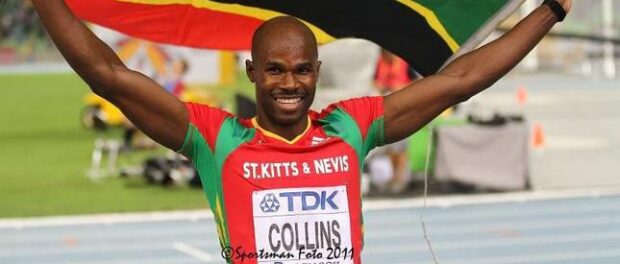
The defining moment came on 25 August 2003 at the World Championships in Paris, when Collins won the men’s 100 metres in 10.07 seconds.
World Athletics’ contemporary report recorded simply that the new world 100-metre champion hailed from St. Kitts and Nevis.
For a country with a population and sporting infrastructure vastly smaller than those of the major athletics powers, the significance extended beyond an individual medal.
It was a moment of national visibility.
World Athletics subsequently described Collins as the first Caribbean athlete to win the men’s 100 metres at the World Championships.
His victory meant that one of international sport’s most recognised titles—the men’s 100-metre world championship—belonged to an athlete competing under the flag of St. Kitts and Nevis.
That distinction remains central to any assessment of Collins’ national legacy.
2. HIS ACHIEVEMENT WAS NOT A SINGLE GREAT RACE
A proper evaluation of Collins should not reduce his career to Paris 2003.
His record demonstrates sustained international excellence.
Before becoming world champion, Collins won the 2002 Commonwealth Games 100 metres, recording 9.98 seconds. He also won medals at the World Championships, World Indoor Championships and other major competitions.
His World Championship record included individual medals across different stages of his career. He won bronze over 200 metres in 2001, the world 100-metre title in 2003, another 100-metre bronze in 2005 and a further 100-metre bronze in 2011. He also helped St. Kitts and Nevis secure a World Championship 4×100-metre relay bronze in 2011.
That longevity is important.
World-class sprinting is normally measured in fractions of seconds and careers can be comparatively short. Collins remained internationally competitive across generations of elite sprinters.
3. OLYMPIC REPRESENTATION
Collins also became one of the Federation’s most enduring representatives in Olympic competition.
World Athletics records him as the first athlete from St. Kitts and Nevis to reach an Olympic final. He finished seventh in the 100 metres at Sydney 2000 and sixth in the Athens 2004 final.
Official St. Kitts and Nevis reporting in 2026 records that he represented the Federation at five Olympic Games between 1996 and 2016.
For a small state, participation at that level has a diplomatic and cultural dimension as well as a sporting one.
Every appearance placed the country’s name, abbreviation and national colours before a global audience.
Collins therefore functioned not merely as an individual competitor but as an internationally visible representative of the Federation.
4. THE 9.93-SECOND ACHIEVEMENT AT AGE 40
One of the strongest indicators of Collins’ extraordinary longevity arrived late in his career.
In 2016, at age 40, Collins ran 9.93 seconds for the 100 metres.
Government reporting describes the performance as making him the oldest sprinter to break the 10-second barrier. The same 9.93 performance is recorded as his personal best.
This matters to the assessment of his legacy because it demonstrates something unusual even among world champions.
Collins did not simply reach the summit.
He remained internationally relevant across an exceptionally long period.
His career consequently became associated not only with speed but with longevity, persistence and adaptation.
5. INTERNATIONAL RECOGNITION BEYOND COMPETITION
Collins’ international standing eventually extended beyond performances on the track.
In 2017 he was elected to the then-IAAF Athletes’ Commission, receiving the highest vote total in the election according to the Government of St. Kitts and Nevis. His term was scheduled from January 2018 through December 2021.
That distinction is materially different from winning a race.
It represented recognition from within the international athletics community and gave a national of St. Kitts and Nevis a role within the governance structure of the sport.
His international significance therefore moved through several stages:
competitor → champion → veteran standard-bearer → representative within international athletics governance.
That progression is relevant when considering the breadth of his contribution.
6. A SMALL COUNTRY ON A VERY LARGE STAGE
Perhaps the most compelling national dimension of Collins’ career is the scale of the country he represented relative to the scale of his achievements.
St. Kitts and Nevis does not possess the population, athlete pool or financial resources of the world’s major sporting nations.
Yet Collins reached the summit of one of sport’s most competitive disciplines.
When he became world champion in 2003, St. Kitts and Nevis did not possess the type of athletics infrastructure routinely available to competitors from major sporting countries. Collins himself later reflected publicly on becoming world champion despite the limitations of the facilities available at home.
His success therefore had significance far beyond his personal biography.
It demonstrated that the Federation could produce an athlete capable of competing successfully against the world’s strongest sprinting nations.
7. NATIONAL RECOGNITION HAS ALREADY BEEN EXTENSIVE
Another relevant factor for the Committee is the extent to which the State has already formally memorialised Collins’ contribution.
August 25 has been observed as Kim Collins Day, marking the anniversary of his 2003 World Championship victory. Government reporting in 2016 described the occasion as a celebration of his historic accomplishments.
The country’s principal athletics facility was renamed the Kim Collins Athletics Stadium on 5 April 2015 during the CARIFTA Games.
The Kim Collins Highway also bears his name, and contemporary reporting records other forms of national recognition following his international achievements.
These recognitions are important evidence.
They demonstrate that successive public authorities have already treated Collins’ achievements as possessing national—not merely personal or sporting—importance.
8. PREVIOUS GOVERNMENT ACKNOWLEDGEMENT OF HIS PLACE IN NATION-BUILDING
There is also an important historical precedent directly relevant to this submission.
During the 2019 National Heroes Day observance, then Prime Minister Timothy Harris spoke about individuals whose contributions deserved continued national recognition and specifically included Kim Collins among persons whose contributions to nation-building should be further immortalised.
This does not determine whether Collins satisfies the threshold for the Order of the National Hero.
It does establish, however, that consideration of his place within the broader national honours conversation is not a new proposition.
Government officials have previously characterised his career in terms extending beyond athletics.
In 2017, the Government described him as an international standard-bearer for excellence and perseverance and highlighted what it regarded as his capacity to create a sense of national unity through sporting achievement.
9. NATIONAL HEROISM NEED NOT BE CONFINED TO POLITICAL LEADERSHIP
The existing National Heroes emerged principally from political leadership, labour advocacy, state-building and public service.
That historical reality does not itself establish that national heroism must permanently be confined to those fields.
Indeed, official remarks surrounding the development of the National Heroes framework have recognised the importance of diversity in profession when considering national distinction. In 2016, government reporting referred to the development of criteria intended to ensure diversity including in profession.
That raises a legitimate national question:
Can extraordinary cultural, sporting or international achievement constitute nation-building at a level comparable in national significance—though different in character—to political or governmental service?
Kim Collins presents an important case through which that question can be examined.
His contribution was not the drafting of legislation, construction of constitutional institutions or leadership of government.
His contribution was different.
Through sport, he carried the Federation’s identity into arenas where hundreds of millions around the world encounter nations—Olympic Games, World Championships, Commonwealth Games and global athletics.
Any assessment should recognise both the distinction and the difference.
10. A PIONEER FOR KITTITIAN AND NEVISIAN ATHLETES
Before Collins’ rise, there was no domestic precedent demonstrating that an athlete representing St. Kitts and Nevis could become men’s 100-metre world champion.
After Paris 2003, there was.
That psychological dimension cannot readily be quantified.
Records can be measured.
Medals can be counted.
But pioneering achievement also changes what succeeding generations consider possible.
The national athletics association itself described Collins on his retirement as a beacon for athletics and an inspiration to the people of St. Kitts and Nevis, emphasising the role he played in putting the Federation on the international sporting map.
The Committee may therefore consider not simply what Collins won, but what his achievements represented to athletes who followed him.
11. HIS LEGACY HAS OUTLIVED HIS COMPETITIVE CAREER
An important consideration in national honours is durability.
Temporary celebrity is not equivalent to lasting national contribution.
Collins’ defining world title occurred in 2003. More than two decades later, the Federation continues publicly to recognise his contribution.
As recently as March 2026, St. Kitts and Nevis officially highlighted Collins at an Organization of American States exhibition recognising outstanding athletes of African descent. The Federation’s diplomatic representation again presented his career and achievements internationally.
The continued use of his name on the national athletics stadium and highway further embeds his legacy within the country’s physical landscape.
That persistence strengthens the argument that his significance has moved beyond the temporary acclaim normally associated with sporting victory.
12. MATTERS THE COMMITTEE SHOULD ASSESS
A rigorous national honours process should apply the same institutional standards to every proposed recipient.
Accordingly, Collins’ candidature can be assessed against several neutral questions:
- National impact: Did his career materially advance the international visibility and reputation of St. Kitts and Nevis?
- Historical significance: Were his accomplishments unprecedented or transformational for the Federation?
- Sustained excellence: Does the record demonstrate distinction over a sufficiently long period rather than a single achievement?
- National representation: Did he consistently represent the Federation at the highest international level?
- Legacy: Has his contribution endured beyond his competitive career?
- Nation-building: Can sporting achievement of this magnitude constitute a nationally significant contribution under the applicable honours framework?
- Exemplary influence: Has his career materially expanded aspirations and opportunities for succeeding generations?
- Comparative institutional threshold: Does the nature and magnitude of the contribution meet the statutory and established standards associated with the Federation’s highest honour?
These questions allow the Committee to consider the nomination on evidence rather than sentiment.
13. A NATIONAL LEGACY ALREADY WRITTEN INTO THE LANDSCAPE
There is unusual symbolism in the geography of St. Kitts itself.
There is a Kim Collins Highway.
There is a Kim Collins Athletics Stadium.
There is Kim Collins Day.
And there is an internationally documented sporting record in which the name St. Kitts and Nevis appears beside World Championship gold.
Those recognitions arose because Collins achieved something that fundamentally altered the Federation’s place in international athletics.
His legacy is therefore simultaneously statistical, historical, institutional and symbolic.
CONCLUSION
The documented record presents Kim Anderson Collins as an exceptional figure in the sporting history of St. Kitts and Nevis.
He became 100-metre World Champion in 2003. He won the Commonwealth 100-metre title. He accumulated medals across multiple World Championships. He became the Federation’s first Olympic athletics finalist, represented the country across five Olympic Games, contributed to an historic World Championship relay medal, ran 9.93 seconds at age 40 and subsequently represented athletes within the international governance of his sport.
His country has already commemorated him through a national stadium, a highway and Kim Collins Day. Government leaders across different periods have publicly recognised the national significance of his achievements.
The question for the Cabinet of the Government of St. Kitts and Nevis and the Independence Honours and Awards Committee is therefore whether this exceptional sporting record, together with its sustained contribution to national identity, international recognition, youth aspiration and nation-building, satisfies the standards prescribed for appointment to the Order of the National Hero of St. Kitts and Nevis.
That determination should be made through the established honours process and against the same rigorous standards applicable to all candidates.
What the historical record establishes clearly is that Kim Anderson Collins’ contribution is substantial, internationally documented and deeply embedded in the modern sporting history of St. Kitts and Nevis.
PUBLIC SUBMISSION
For consideration by:
The Cabinet of the Government of St. Kitts and Nevis
The Independence Honours and Awards Committee
Nominee: Kim Anderson Collins
Field of National Contribution: Athletics, Sport, International Representation and Nation-Building
Honour for Consideration: Order of the National Hero of St. Kitts and Nevis
Date: National Heroes Day — 16 September 2026
















Leave a comment
You must be logged in to post a comment.