CBI CLASH! NEVIS PREMIER MARK BRANTLEY PUBLICLY DISAGREES WITH PM DR. TERRANCE DREW’S DECISION TO WIND DOWN ST. KITTS AND NEVIS’ BILLION-DOLLAR CITIZENSHIP PROGRAMME!
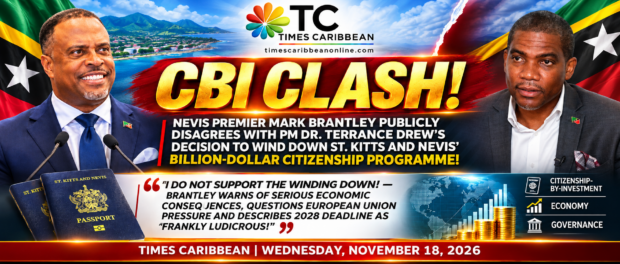
“I DO NOT SUPPORT THE WINDING DOWN!” — BRANTLEY WARNS OF SERIOUS ECONOMIC CONSEQUENCES, QUESTIONS EUROPEAN UNION PRESSURE AND DESCRIBES 2028 DEADLINE AS “FRANKLY LUDICROUS!”
TIMES CARIBBEAN | WEDNESDAY, NOVEMBER 18, 2026
BASSETERRE, ST. KITTS AND NEVIS — A significant political and economic disagreement has emerged at the highest levels of leadership in St. Kitts and Nevis, as Nevis Premier and Federal Opposition Leader Hon. Mark Brantley has publicly rejected the decision by Prime Minister Dr. Terrance Drew to wind down the Federation’s historic Citizenship by Investment (CBI) Programme.
The disagreement places two of the Federation’s most prominent political leaders on opposite sides of a decision that could fundamentally reshape the country’s economy for generations.
And the stakes could hardly be higher.
In comments reported by the internationally respected British newspaper The Guardian on Tuesday, November 17, Premier Brantley made clear that although he understood the intense pressure being applied by the European Union, he did not support abandoning a programme that has generated billions of dollars and helped finance critical public services.
Brantley acknowledged that the country had been given very little choice. Nevertheless, his opposition to the proposed closure was unmistakable.
BRANTLEY QUESTIONS THE EU: WHERE IS THE ECONOMIC SUPPORT?
At the centre of Brantley’s concerns is the potentially devastating financial impact of ending a programme that has supported government expenditure, economic development and essential services throughout the Federation.
The Premier questioned why the European Union was pressing small Caribbean economies to discontinue a major source of national revenue without presenting adequate financial assistance or a clearly defined transition package.
He stressed that CBI revenues have contributed substantially to national development, supporting access to clean water, education, healthcare and other services upon which ordinary citizens depend.
For Brantley, the issue extends far beyond international travel privileges or diplomatic negotiations.
It is about the economic security of families, workers, businesses and vulnerable citizens whose livelihoods could be affected by a dramatic reduction in government income.
He also described the European Union’s proposed June 1, 2028 deadline as “frankly ludicrous.”
His comments raise a fundamental question: How can small island economies replace decades of substantial CBI revenue within such a limited transition period?
PM DREW DEFENDS WIND-DOWN AS NECESSARY TO PROTECT THE FEDERATION
Prime Minister Drew, however, has presented a sharply different assessment.
During his November 13 national address, Drew announced that his administration had formally communicated its decision to the European Union to wind down the CBI Programme, with the final timetable still subject to negotiations.
The Prime Minister argued that continuing the programme could expose St. Kitts and Nevis to serious international financial and diplomatic consequences, including the possible suspension of visa-free access to Europe’s Schengen area.
He also warned of risks to international banking relationships, remittances and cross-border financial transactions.
According to Drew, the potential consequences of losing essential banking connections could affect businesses, tourism operators and ordinary citizens.
The Prime Minister has additionally attributed some of the international concerns surrounding CBI to practices under previous administrations, citing controversial investment arrangements, insufficient financial safeguards and pricing practices.
His administration maintains that extensive reforms have already strengthened the programme but that the latest international pressures require a broader economic transition.
Drew has identified tourism, yachting, digital industries, creative enterprises and geothermal energy development as potential pillars of a more diversified economy.
He has also pledged that raising taxes is not part of his government’s economic transition plan.
TWO LEADERS. TWO DIFFERENT APPROACHES. ONE UNCERTAIN ECONOMIC FUTURE.
The emerging disagreement is particularly significant because Brantley is not merely an opposition politician criticising a federal government policy.
As Premier of Nevis, he leads an island administration whose financial stability and development prospects are closely connected to the Federation’s wider economic performance.
His intervention therefore places an important constitutional and economic dimension on the debate.
While Drew argues that ending CBI is necessary to safeguard international banking relationships and preserve travel privileges, Brantley questions whether the economic consequences of that decision have been adequately addressed.
There is also a wider regional dimension.
The five Eastern Caribbean countries operating CBI programmes have not adopted identical responses to European Union pressure.
Antigua and Barbuda has sought a longer transition period, while Grenada has expressed interest in maintaining its programme beyond the proposed 2028 deadline.
Dominica and Saint Lucia have also been engaging European authorities without publicly committing to the same wind-down approach announced by St. Kitts and Nevis.
These differing positions raise legitimate questions about the negotiating options available to Caribbean governments and the balance between protecting international relationships and preserving vital national revenue.
THE BILLION-DOLLAR QUESTION: WHAT REPLACES CBI?
For more than four decades, St. Kitts and Nevis has been internationally recognised as the birthplace of the modern Citizenship by Investment industry.
The programme has helped generate significant national revenue, financed development initiatives and supported public expenditure.
Its planned termination represents one of the most consequential economic policy shifts in the Federation’s modern history.
But the programme has not yet closed. Applications will continue to be processed during the transition, and the final application deadline remains subject to negotiations with the European Union.
For the public, the central questions are becoming increasingly urgent.
How much revenue will the Federation lose? Which economic sectors can realistically replace it? How quickly can those sectors deliver comparable returns? And what safeguards will protect healthcare, education, infrastructure and social assistance programmes during the transition?
Brantley’s public disagreement with Drew has brought those questions into sharper focus.
One leader believes the wind-down is necessary to protect the country from potentially greater international financial consequences.
The other recognises the external pressure but does not support surrendering such a significant national revenue source without adequate economic alternatives and international assistance.
For the people of St. Kitts and Nevis, the issue is no longer simply whether the CBI Programme should end.
It is whether the Federation can afford the economic consequences of ending it — and whether a sufficiently credible, funded and achievable replacement strategy is in place.
TIMES CARIBBEAN — REGIONAL NEWS | POLITICS | ECONOMY | ACCOUNTABILITY
















Leave a comment
You must be logged in to post a comment.