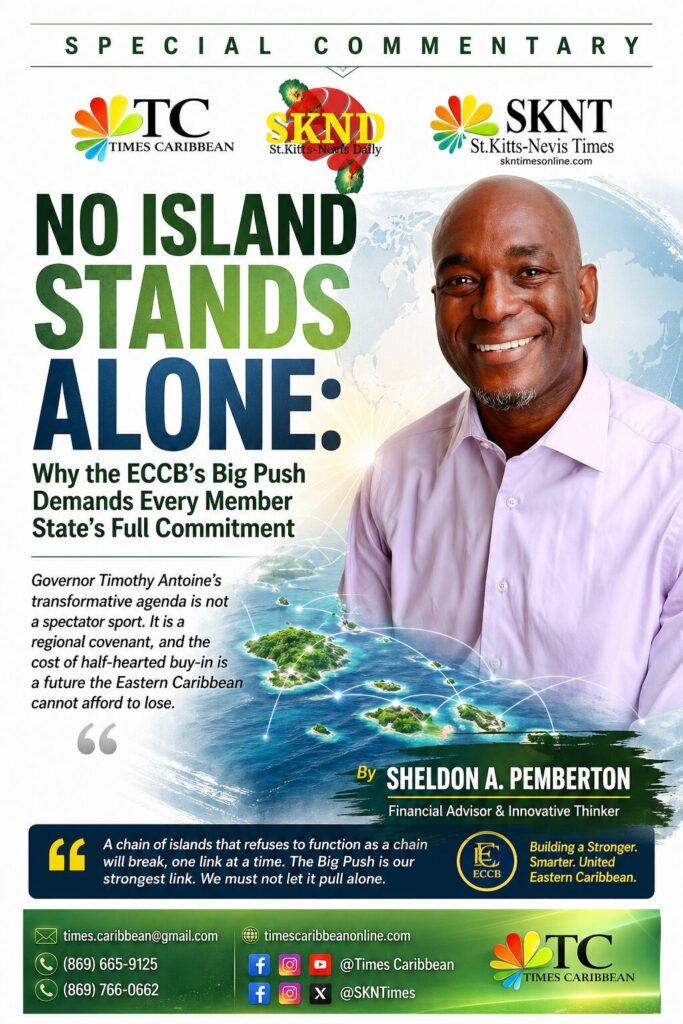
No Island Stands Alone: Why the ECCB’s Big Push Demands Every Member State’s Full Commitment

S P E C I A L C O M M E N T A R Y
No Island Stands Alone: Why the ECCB’s Big Push Demands Every Member State’s Full Commitment
Governor Timothy Antoine’s transformative agenda is not a spectator sport. It is a regional covenant, and the cost of half-hearted buy-in is a future the Eastern Caribbean cannot afford to lose.
By Sheldon A. Pemberton · Financial Advisor & Innovative Thinker
There are moments in the life of a region when history does not whisper. It shouts.
We are living inside one of those moments right now.
Eastern Caribbean Central Bank Governor Timothy Antoine has placed before us a vision of transformative proportions: the Big Push agenda, an ambitious, multidimensional framework designed to reposition our member states not merely as surviving economies, but as competitive, resilient, and dynamic actors in an increasingly unforgiving global landscape.
My conviction in this vision is total. My support is unwavering.
But conviction without collaboration is simply noise, and noise, no matter how eloquent, builds nothing.
The plain and urgent truth is this: Governor Antoine cannot push alone. No central bank, however visionary its leadership and however sound its monetary architecture, can compel economic transformation in isolation.
The Big Push is not a mandate issued from Basseterre. It is an open invitation to a shared destiny.
The member states of the Eastern Caribbean Currency Union must answer that invitation not with polite applause from a comfortable distance, but with the full and serious weight of their governmental authority, their fiscal resources, and their unyielding political will.
“A chain of islands that refuses to function as a chain will break, one link at a time. The Big Push is our strongest link. We must not let it pull alone.”
I. The Architecture of Urgency
We are not being asked to prepare for a distant future.
The future powered by artificial intelligence and generative technologies has already arrived. It is restructuring labour markets, redirecting capital flows, and rewriting the rules of competitive advantage in economies far larger and far better resourced than ours.
The question hanging over every finance ministry, every cabinet table, and every boardroom across Antigua and Barbuda, Dominica, Grenada, Montserrat, Saint Kitts and Nevis, Saint Lucia, and Saint Vincent and the Grenadines is not whether AI will reshape our economic realities.
It is whether we will be positioned to benefit from that reshaping — or buried beneath it.
Governor Antoine’s Big Push agenda understands this existential calculus with remarkable clarity.
At its core, the agenda recognises that small island developing states carry an inherent structural disadvantage: limited land mass, shallow domestic markets, narrow export bases, and acute vulnerability to external shocks including hurricanes and global recessions.
These are not new challenges.
What is new is that the arrival of transformative technology creates a rare and narrow window — perhaps the first in a generation — where smallness need not be a permanent sentence to marginality.
Artificial intelligence, applied intelligently and intentionally, can dramatically compress the gap between the capacity of small economies and the demands of global competitiveness.
But only if we move with urgency.
And only if we move together.
II. Collaboration Is Not Courtesy. It Is Architecture.
I have observed, over many years of advising governments and institutions across this region, a persistent and dangerous tendency: the tendency to treat regional cooperation as a diplomatic nicety rather than an economic necessity.
We attend summits.
We sign memoranda of understanding.
We express solidarity in the language of brotherhood.
And then we return to our individual islands and govern as though the ocean between us is a wall rather than a corridor.
This approach was always costly.
In the era of generative AI, it is catastrophic.
The competitive advantage that AI offers to small economies is not found in any single island adopting it in isolation.
It is found in the network effect — in the aggregation of talent, data, digital infrastructure, regulatory frameworks, and institutional capacity across the entire currency union.
A unified regional AI readiness strategy, undergirded by the fiscal and policy commitments of every member state government, is worth exponentially more than seven separate, underfunded, and inconsistent national experiments.
K E Y I M P E R A T I V E S F O R M E M B E R S T A T E S
- Make the Big Push National Policy
Each member state government must formally designate the Big Push as a centrepiece of its national economic agenda.
It cannot be a footnote in a budget speech.
It must be a structuring principle of each island’s development strategy.
- Fund the Future
Finance ministries must allocate meaningful, ring-fenced resources toward digital infrastructure, AI literacy, data governance, and innovation capacity.
This commitment must hold even under conditions of fiscal constraint.
- Empower Regional Leadership
Heads of government must create the political space for ECCB leadership to coordinate and to lead where necessary.
They must resist the temptation to subordinate regional strategy to short-term domestic political considerations.
- Mobilise the Private Sector
Public-private partnerships must be urgently constructed to draw in the private capital, technical expertise, and entrepreneurial energy that governments alone cannot supply.
- Create Common AI Standards
A common regional framework for AI adoption — covering standards, ethics, data sovereignty, and workforce transition — must be developed collaboratively and implemented consistently across all member states.
III. The Price of Passive Observation
I am not a pessimist by nature.
But I am a realist by discipline.
And the reality that any honest reading of global economic trends forces us to confront is that the penalty for hesitation in this technological moment will be severe, swift, and possibly irreversible.
Economies that fail to build the foundational infrastructure — including broadband, digital governance systems, an educated workforce, and innovation-friendly regulation — will not simply lag behind.
They will be excluded from the new architecture of global value creation altogether.
For our islands, exclusion is not a manageable inconvenience.
It is an existential threat.
Our tourism sectors, already fragile and climate-threatened, will face AI-powered competition from destinations with deeper pockets.
Our financial services sectors, still navigating correspondent banking pressures, will face automation-driven disruption without the institutional depth to absorb it.
Our young people — our most precious and most restless resource — will continue to depart for economies that offer digital opportunities their home islands failed to build.
“The member states that treat the Big Push as someone else’s priority will discover, far too late, that they have forfeited their own future in the process.”
IV. A Call to Serious Statesmanship
What Governor Antoine is asking of member states is not small.
He is asking for a quality of political commitment that transcends election cycles.
That withstands the pressure of competing domestic priorities.
That requires governments to make difficult choices about how they allocate limited resources.
He is asking for serious, sustained, strategic engagement that produces real transformation — rather than the kind that produces well-attended press conferences and glossy policy documents that gather dust on ministerial shelves.
That is precisely why I believe in this agenda so deeply.
Easy agendas produce easy outcomes.
And easy outcomes are not what our people need.
They need leaders willing to be accountable to a future larger than the next election cycle.
They need governments that understand the most patriotic thing a small island state can do right now is to govern not just for its own citizens in the present, but for the collective regional prosperity of the next generation.
The Big Push demands that quality of statesmanship.
It deserves it.
Final Word
The wave of technological transformation does not care about our geography, our history, or our smallness.
It will crest and break regardless of whether we are prepared for it.
Governor Timothy Antoine has shown us the path to preparation.
The member states of the ECCU must now demonstrate — through their budgets, legislation, bilateral cooperation, and daily conduct of governance — that they understand the magnitude of the moment they are living in.
The Big Push is not Governor Antoine’s agenda.
It is ours.
All of ours.
And it will only become what it must become — a genuine engine of regional transformation — if every island in this union decides, deliberately, seriously, and without further delay, to push.
A B O U T T H E A U T H O R
Sheldon A. Pemberton
Financial Advisor and Innovative Thinker, Eastern Caribbean Region.
The views expressed in this commentary are solely those of the author and do not represent the official position of any institution, government, or organisation.
















Leave a comment
You must be logged in to post a comment.