MAJOR SECURITY BREAKTHROUGH: ST. KITTS AND NEVIS EMBASSY HOSTS HISTORIC CARICOM–U.S. BIOMETRIC DATA-SHARING AGREEMENT
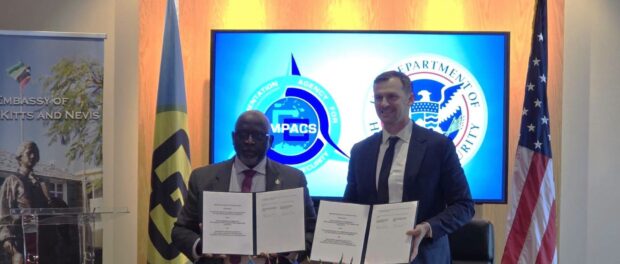
New partnership between CARICOM IMPACS and the U.S. Department of Homeland Security aims to strengthen border security, immigration screening and the integrity of Citizenship by Investment programmes
WASHINGTON, D.C., USA, July 14, 2026 — The Embassy of St. Kitts and Nevis in Washington has taken centre stage in a major new chapter of Caribbean–United States security cooperation, hosting the signing of a Memorandum of Cooperation between the Caribbean Community Implementation Agency for Crime and Security, CARICOM IMPACS, and the United States Department of Homeland Security.
Her Excellency Jacinth Henry-Martin, St. Kitts and Nevis’ Ambassador to the United States, hosted Monday’s signing ceremony, which formally enables the establishment of a Biometric Data Sharing Partnership between the two organisations.
The agreement represents a significant milestone in regional security cooperation and is expected to enhance the Caribbean’s ability to screen individuals, verify identities, strengthen immigration controls and support investigations involving possible security risks.
Representatives from Antigua and Barbuda, Dominica, Grenada, St. Kitts and Nevis, Saint Lucia, St. Vincent and the Grenadines and the Eastern Caribbean Central Bank attended the high-level ceremony.
Officials from the United States Homeland Security Council and the U.S. Department of State were also present.
According to the Embassy of St. Kitts and Nevis, the memorandum establishes a framework for secure information sharing, biometric identity verification and collaborative risk assessments across CARICOM Member States and Associate Members.
The partnership is intended to strengthen border security, support law enforcement agencies and improve regional efforts to address transnational criminal activity.
The agreement will also introduce enhanced security capabilities aimed at supporting the integrity of Citizenship by Investment programmes operated by participating Organisation of Eastern Caribbean States member countries, including St. Kitts and Nevis.
It is further expected to support the future work of the Eastern Caribbean Citizenship by Investment Regulatory Authority, known as ECCIRA.
In a separate statement, U.S. Department of Homeland Security Under Secretary Rob Law described the agreement as the department’s first multilateral biometric information-sharing arrangement.
“This will strengthen cooperation between DHS and CARICOM IMPACS on border security and immigration vetting. DHS welcomes this new partnership to strengthen security across the region,” Law stated.
The Memorandum of Cooperation creates a mechanism for automated queries and controlled exchanges of information to assist with the screening, vetting and investigation of individuals who may present security or immigration concerns to the United States or participating CARICOM jurisdictions.
The agreement also directly addresses concerns surrounding Citizenship by Investment programmes in the Eastern Caribbean.
United States Presidential Proclamation 10998 reportedly identifies the potential misuse of purchased citizenship to bypass travel restrictions or obscure identities and assets. The proclamation imposes certain visa restrictions affecting some Citizenship by Investment nationals.
Information exchanged through the new Biometric Data Sharing Partnership is expected to strengthen due-diligence and vetting practices while responding to some of the concerns outlined by the United States.
However, U.S. authorities made it clear that the agreement does not alter existing visa powers or authorities under Section 212(f) of the Immigration and Nationality Act.
The signing comes as Eastern Caribbean governments face increasing international pressure to demonstrate that their Citizenship by Investment programmes meet strengthened global standards relating to transparency, identity verification, financial accountability and national security.
For St. Kitts and Nevis, the ceremony places its Washington Embassy at the centre of a potentially transformative regional security partnership involving CARICOM IMPACS, the United States Government and the Eastern Caribbean’s financial and investment-migration institutions.
DHS and CARICOM IMPACS are aiming to make the Biometric Data Sharing Partnership fully operational before the end of the 2026 calendar year.
The initiative is expected to become a critical component of wider efforts to protect the region’s borders, improve immigration vetting and reinforce international confidence in the Caribbean’s security and Citizenship by Investment frameworks.
















Leave a comment
You must be logged in to post a comment.