LEGAL SOLUTIONS REDEFINED: MEDIATION EMERGES AS POWERFUL ALTERNATIVE AS RON DUBLIN-COLLINS EXPANDS PROFESSIONAL SERVICES

TIMES CARIBBEAN | SKN TIMES | ST. KITTS-NEVIS DAILY
Basseterre, St. Kitts-Nevis — In a legal climate increasingly burdened by delays, mounting costs, and procedural bottlenecks, a quiet but powerful shift is taking shape across the Caribbean justice system: mediation is rising as the preferred pathway to resolution.
At the center of this evolution is Ron Dublin-Collins, LLB (Hons) — a seasoned public servant, trained legal professional, and accredited mediator — who is now positioning himself at the forefront of this transformation with a renewed push to expand professional mediation services across St. Kitts and Nevis and the wider region.
A SYSTEM UNDER PRESSURE — AND A SOLUTION EMERGING
Across the Eastern Caribbean, court systems continue to grapple with case backlogs, prolonged litigation timelines, and accessibility challenges. Legal experts have long argued that traditional litigation, while necessary, is not always the most efficient or humane route to resolving disputes — particularly in civil, commercial, and family matters.
Mediation, by contrast, offers:
- Faster resolution timelines
- Reduced legal costs
- Confidential, non-adversarial processes
- Mutually beneficial outcomes rather than imposed judgments
Dublin-Collins’ latest service announcement signals a strategic alignment with global best practices, where mediation is increasingly integrated into mainstream dispute resolution frameworks.
CREDENTIALS BACKED BY EXPERIENCE
What distinguishes Dublin-Collins is not just certification — but depth of institutional experience and regional legal exposure.
His portfolio includes:
- IMI Qualified Mediator & YCM Accredited Mediator
- Formal mediation training from UWI, YCM India, and the University of London
- Active role as a Court-Connected Mediator & Mediation Training Coach within the Eastern Caribbean Supreme Court system
- Membership in the prestigious Honourable Society of the Middle Temple (UK)
- Current Barrister Training at BPP University, London
- Former Permanent Secretary in the Government of St. Kitts and Nevis
This blend of public administration, legal training, and mediation practice positions him uniquely at the intersection of policy, law, and conflict resolution.
WHY THIS MATTERS NOW
The timing of this expanded mediation push is critical.
With governments across the Caribbean emphasizing judicial reform, efficiency, and citizen-centered services, mediation is no longer a niche offering — it is becoming a policy priority.
Legal observers note that:
- The Eastern Caribbean Supreme Court has already integrated mediation into its processes
- Businesses are increasingly seeking alternative dispute resolution (ADR) to avoid costly litigation
- Family and community disputes benefit from less confrontational, relationship-preserving approaches
Dublin-Collins’ services therefore align with a broader regional pivot toward modernization of justice systems.
“TRY MEDIATION” — A CALL TO ACTION
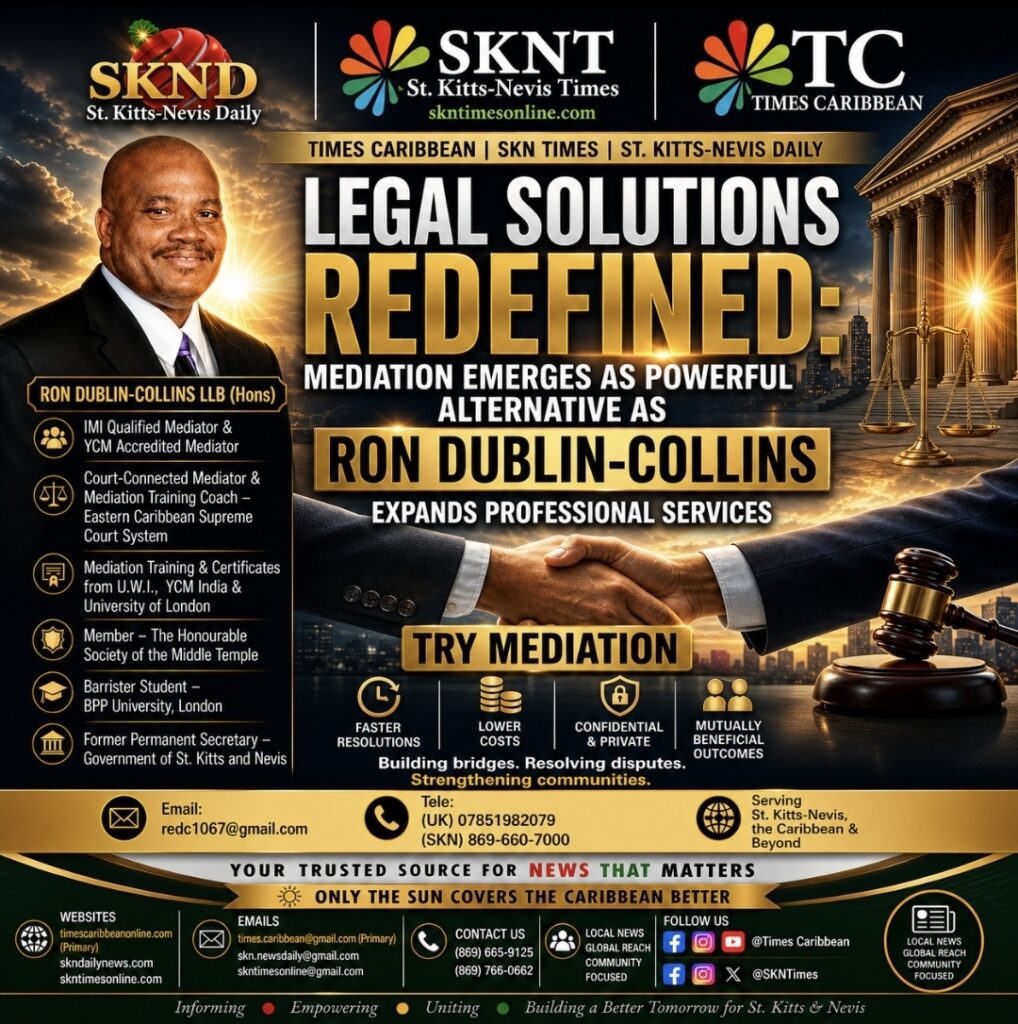
In a striking visual campaign centered around a firm handshake — symbolizing agreement over conflict — Dublin-Collins is urging individuals, businesses, and institutions to “Try Mediation” before resorting to court battles.
His outreach emphasizes accessibility, offering direct contact for consultations both locally and internationally:
- St. Kitts-Nevis: (869) 660-7000
- United Kingdom: 0785-198-2079
- Email: redc1067@gmail.com
🌍 A REGIONAL IMPACT IN THE MAKING
Beyond individual cases, the implications of this initiative could be far-reaching.
If widely adopted, mediation could:
- Ease pressure on national court systems
- Improve investor confidence by ensuring faster dispute resolution
- Strengthen social cohesion by reducing adversarial conflict
- Empower citizens with more control over outcomes
📰 THE BOTTOM LINE
As St. Kitts and Nevis continues to navigate the demands of a modern legal environment, professionals like Ron Dublin-Collins are helping to reshape the conversation — from confrontation to collaboration.
In a region where time, cost, and fairness remain central concerns in justice delivery, mediation may well prove to be not just an alternative — but the future of dispute resolution.
— END —
















Leave a comment
You must be logged in to post a comment.