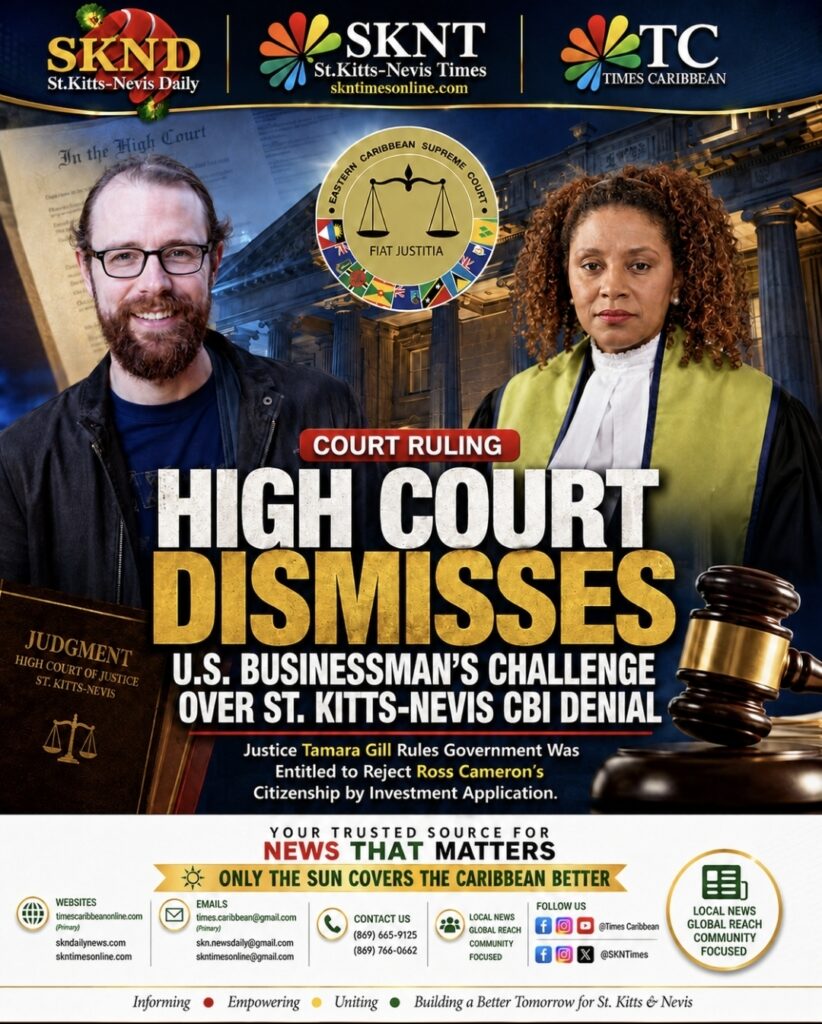
HIGH COURT DISMISSES U.S. BUSINESSMAN’S CHALLENGE OVER ST. KITTS-NEVIS CBI DENIAL

Justice Tamara Gill Rules Government Was Entitled to Reject Ross Cameron’s Citizenship by Investment Application Over False Information on Application Form
BASSETERRE, ST. KITTS — The High Court of Justice has dismissed a major legal challenge brought by United States businessman Ross Cameron, a successful entrepreneur associated with the online financial education company Warrior Trading, who sought to overturn the decision of St. Kitts and Nevis authorities to deny his application for citizenship under the Federation’s Citizenship by Investment Programme.
In a judgment delivered by High Court Judge Justice Tamara Gill, the court ruled that Cameron failed to establish that the Government, the Citizenship by Investment Unit, or the relevant decision-makers acted unlawfully, irrationally, or procedurally improperly when his application was refused.
Claimant
and
HON. DR. TERRANCE DREW
(in his capacity as Minister of National Security)
1
st Defendant
MICHAEL MARTIN
(in his capacity as head of the Citizenship by Investment Unit)
2
nd Defendant
TECHNICAL COMMITTEE
(established pursuant to Section 9 of the Citizenship by
Investment Regulations)
3
rd DefendantDownload
The case, filed under claim number SKBHCV2024/0134, named Hon. Dr. Terrance Drew, in his capacity as Minister of National Security, Michael Martin, in his capacity as Head of the Citizenship by Investment Unit, and the Technical Committee established under the Citizenship by Investment Regulations as defendants.
Cameron, a United States citizen, had applied for citizenship of St. Kitts and Nevis under the Citizenship by Investment Programme. His application included his wife and two children and was submitted through Dover Corporate Services Ltd., his CBI agent.
While the case focused on the legal treatment of his application, court records also presented Cameron as an established business figure with a record in financial education and entrepreneurship. Through Warrior Trading, Cameron has been associated with a business that has continued operating and serving its market. The judgment referenced submissions indicating that the company had engaged outside compliance consultants and law firms, including Paul Hastings, to strengthen its compliance practices.
The court record also noted that Warrior Trading had continued to operate after the United States Federal Trade Commission matter and that, according to information submitted on Cameron’s behalf, the business took compliance obligations seriously while continuing to seek improvement. Further, the judgment referenced a Business Insider review of best day-trading courses in July 2024, in which Warrior Trading Inc. was listed as runner-up — a detail advanced by Cameron’s side as part of the wider picture of the company’s business standing.
At the heart of the legal dispute was Cameron’s response to a key question on the CBI application form. The form asked whether he had ever been under investigation by any law enforcement agency or tax authority in any country. Cameron answered “No.”
However, the court found that the evidence before the decision-makers showed that Cameron had been the subject of proceedings involving the United States Federal Trade Commission, which had filed a civil complaint against him and related companies. The matter resulted in a stipulated order involving a permanent injunction, monetary judgment, and other relief, including a US$3 million payment.
Cameron’s legal team argued that he did not provide false information. They contended that he understood the question to refer to criminal investigations, not civil regulatory or enforcement proceedings. They also highlighted that a copy of the FTC order had been submitted with the application package through his CBI agent.
The court noted that the FTC order itself stated that Cameron and the other defendants neither admitted nor denied the allegations in the complaint, except for facts necessary to establish the court’s jurisdiction. Cameron’s representatives also submitted that settling the matter avoided the cost and business disruption of litigation and that the settlement was reached without admissions or judicial findings of wrongdoing.
Despite those submissions, Justice Gill found that the wording of the application form was not limited to criminal investigations. The court held that the FTC was a law enforcement authority in the relevant context, even though the matter was civil and not criminal. The judge concluded that Cameron’s answer of “No” was objectively false.
The court further noted that although the FTC order was included in the supporting documents submitted with the application, it was not referenced on the application form itself. Justice Gill stated that the correct information had to be placed on the application form, and that a cover letter was not the form.
The judgment emphasized that the CBI regulations make denial mandatory where an applicant provides false information on the application form. Once the Minister determined that this fact existed, there was no discretion to approve the application.
Cameron had asked the court to quash the recommendation and decision denying his application. He argued that the defendants failed to properly explain the basis of the decision and did not provide a full account of how the decision was reached. The court acknowledged that the defendants did not provide a comprehensive explanation of their decision-making process, raising issues connected to the duty of candour in judicial review proceedings.
However, Justice Gill found that any such omission was not fatal to the Government’s case. The court held that the issue was straightforward: Cameron answered “No” when the evidence showed he had been investigated by the FTC, a law enforcement agency in the relevant sense.
The defendants had initially also relied on the ground that Cameron was involved in activity likely to cause disrepute to St. Kitts and Nevis. However, during the proceedings, counsel for the defendants indicated that this ground would no longer be defended. The case therefore proceeded primarily on whether Cameron had provided false information on the application form.
Justice Gill ruled that even without the disrepute ground, the denial of the application remained valid because the CBI regulations allow refusal on any one of the listed grounds. The finding of false information was sufficient to uphold the decision.
In the end, the court dismissed Cameron’s fixed date claim and made no order as to costs, noting that neither side had acted unreasonably in the circumstances.
The ruling is likely to be closely watched within the regional investment migration industry, as it reinforces the importance of full and precise disclosure in Citizenship by Investment applications. It also shows that civil enforcement matters, regulatory complaints, and consent orders may carry major implications for applicants, even where there are no criminal findings or admissions of wrongdoing.
For St. Kitts and Nevis, the judgment represents a significant legal affirmation of the Government’s authority to uphold strict due diligence standards in the Citizenship by Investment Programme.
For Cameron, the ruling is a legal setback in his bid for St. Kitts and Nevis citizenship, but the court record also reflects a businessman who has built a recognized financial education brand, continued operating in a highly scrutinized sector, and presented evidence of compliance improvements and business recognition as part of his wider profile.
















Leave a comment
You must be logged in to post a comment.