FOUR YEARS OF PRAISING ST. KITTS-NEVIS’ HEALTHCARE SYSTEM — BUT WHEN THE PRIME MINISTER NEEDED HEALTHCARE, HE WAS FLOWN OVERSEAS. WHAT DOES THAT SAY ABOUT THE SYSTEM HE LEADS?
Worked for 9s
TIMES CARIBBEAN | SPECIAL COMMENTARY & ANALYSIS
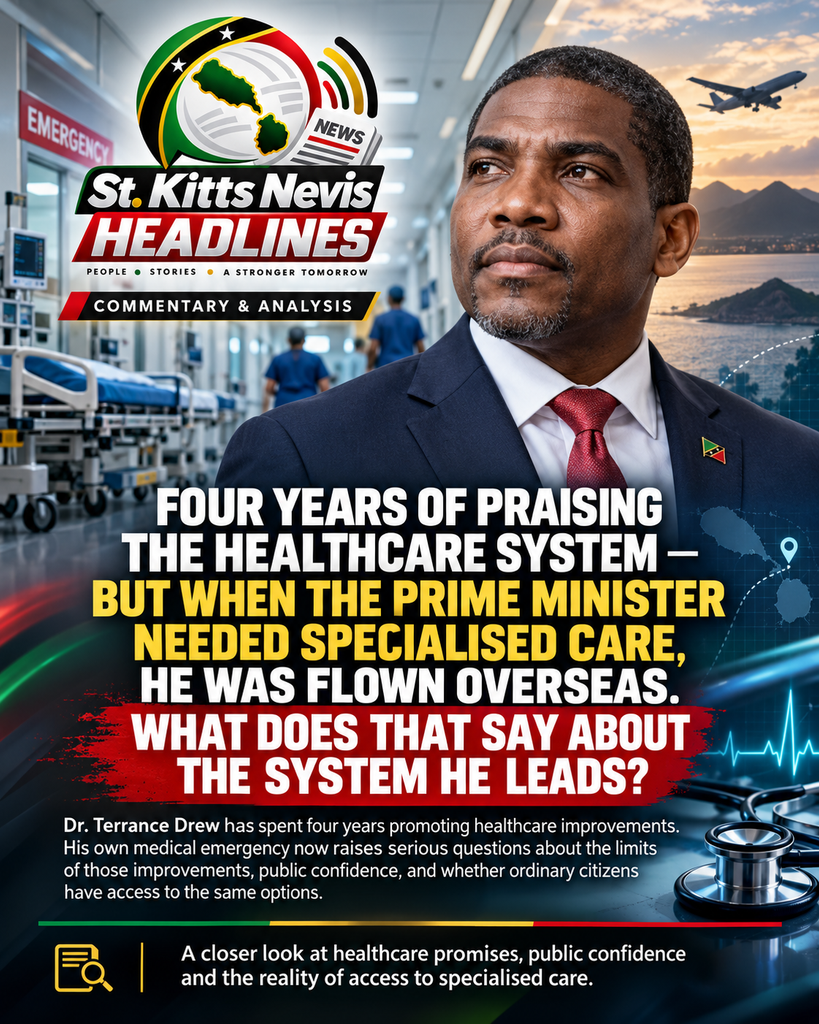
FOUR YEARS OF PRAISING ST. KITTS-NEVIS’ HEALTHCARE SYSTEM — BUT WHEN THE PRIME MINISTER NEEDED SPECIALISED CARE, HE WAS FLOWN OVERSEAS. WHAT DOES THAT SAY ABOUT THE SYSTEM HE LEADS?
DR. TERRANCE DREW HAS SPENT FOUR YEARS PROMOTING HEALTHCARE IMPROVEMENTS. HIS OWN MEDICAL EMERGENCY NOW RAISES DIFFICULT QUESTIONS ABOUT THE LIMITS OF THOSE IMPROVEMENTS, PUBLIC CONFIDENCE AND WHETHER ORDINARY CITIZENS HAVE ACCESS TO THE SAME OPTIONS.
For four years, Prime Minister and Minister of Health Dr. Terrance Drew has presented healthcare as one of the defining achievements of his administration.
The message has been persistent. The hospital is improving. Medical services are expanding. More specialists are available. Equipment has been upgraded. Healthcare in St. Kitts and Nevis, the government insists, is being transformed.
In April 2025, an official government publication went so far as to describe the administration’s healthcare achievements as among the most transformative in the Federation’s modern history.
Then came August 30, 2026.
The Prime Minister experienced a medical emergency and was admitted to the Joseph N. France General Hospital. After assessment by the local medical team, his doctors recommended that he be transported overseas for specialised care.
He was subsequently airlifted to Martinique and later transferred to Miami.
And that development raises a question the government’s healthcare publicity cannot simply brush aside.
If the nation’s healthcare system has improved as dramatically as the administration maintains, what important services were unavailable locally when its own Minister of Health required specialised medical attention?
That is not an accusation. It is a legitimate question about national healthcare capacity.
No reasonable person should criticise Dr. Drew for seeking appropriate medical care. His doctors had every responsibility to recommend the treatment and facilities they considered necessary. Indeed, the government confirmed that overseas transfer was advised by the medical professionals who had been treating him at JNF.
But the Prime Minister is not merely another patient. He is the Minister directly responsible for the public healthcare system.
And that creates an unavoidable question of accountability.
What happens when an ordinary Kittitian or Nevisian experiences a medical emergency requiring precisely the kind of specialist intervention that cannot be provided locally?
Can that person access an overseas medical transfer just as promptly?
Who makes the decision? Who pays? What criteria determine eligibility? And how many families have faced serious financial and logistical difficulties trying to secure specialised treatment abroad?
Those questions deserve clear answers.
The government can point to tangible investments, including a CT scanner, expanded specialist services, additional dialysis equipment, hospital renovations and improvements to emergency transportation. These are developments worth acknowledging.
But improved infrastructure does not automatically mean comprehensive medical capability.
A refurbished hospital is not necessarily a hospital equipped to manage every serious medical emergency. More equipment does not eliminate every specialist shortage. And celebrating progress is not a substitute for identifying the gaps that remain.
There is another distinction that matters.
The Prime Minister’s overseas transfer does not establish that he personally distrusted JNF. In fact, he initially received care there, and the decision to transfer him was made on medical advice. Nevertheless, the episode provides an opportunity to examine the distance between the government’s public messaging and the actual limitations of the national healthcare system.
For the ordinary citizen, that distance can have enormous consequences.
Prime Minister Drew has repeatedly highlighted improvements at JNF. In July 2025, he cited falling in-hospital deaths as evidence of progress, and in July 2026, he again outlined healthcare investments among his government’s achievements.
Those claims should be assessed against independently verifiable outcomes, not simply repeated as political achievements.
The public deserves published information on emergency response times, specialist coverage, patient transfers, treatment delays, staffing levels, clinical outcomes and the accessibility of overseas referrals.
Because healthcare is not measured only by what ministers announce at press conferences.
It is measured by what happens when an ambulance arrives.
When a worried family enters the emergency department.
When a physician needs an urgent diagnostic test.
And when a patient requires a level of care that the country cannot currently provide.
The Prime Minister’s experience also illustrates why there must be a serious national discussion about medical evacuation arrangements.
Should every medically eligible citizen have access to a clearly defined, transparent process for obtaining specialist care abroad? What government assistance is available? And are those arrangements adequately funded?
These are policy questions, not personal attacks.
Dr. Drew’s recovery is welcome news. His experience should also motivate an open assessment of what JNF can provide today, what it cannot provide, and how the government intends to close those gaps.
After four years in office, the Minister of Health has every right to highlight genuine progress. But the public has an equal right to scrutinise the results.
It is not enough to say healthcare has been transformed.
Show the measurable improvements. Identify the remaining weaknesses. Explain the overseas referral system. And demonstrate that access to necessary medical care is determined by clinical need rather than financial means or public office.
Ultimately, this debate should not be about whether the Prime Minister deserved the best medical attention available. Of course he did.
The more important question is whether an ordinary citizen facing a comparable medical emergency can count on timely access to the care that person needs.
That is the standard against which the government’s healthcare promises deserve to be measured.
And it is a question the people of St. Kitts and Nevis are entitled to ask.
TIMES CARIBBEAN — Commentary & Analysis
















Leave a comment
You must be logged in to post a comment.