THE CHRISTENA ECHO: MV BARIMA CAPSIZING REOPENS A 56-YEAR CARIBBEAN MARITIME WOUND
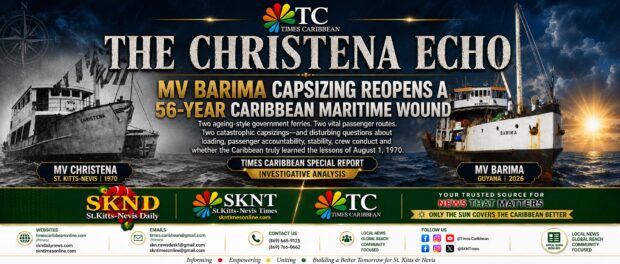
Two ageing-style government ferries. Two vital passenger routes. Two catastrophic capsizings—and disturbing questions about loading, passenger accountability, stability, crew conduct and whether the Caribbean truly learned the lessons of August 1, 1970.
TIMES CARIBBEAN INVESTIGATIVE ANALYSIS
By Times Caribbean Investigative Desk | July 20, 2026
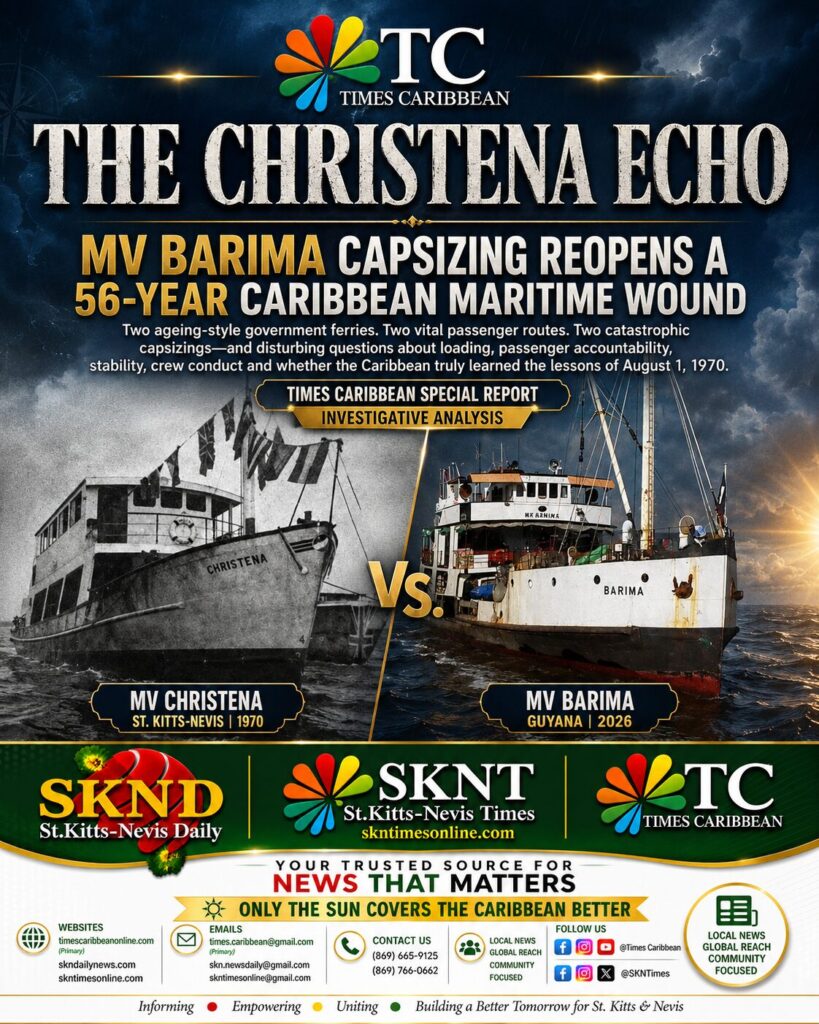
Two photographs, separated by more than half a century, are enough to stop any Caribbean observer in their tracks.
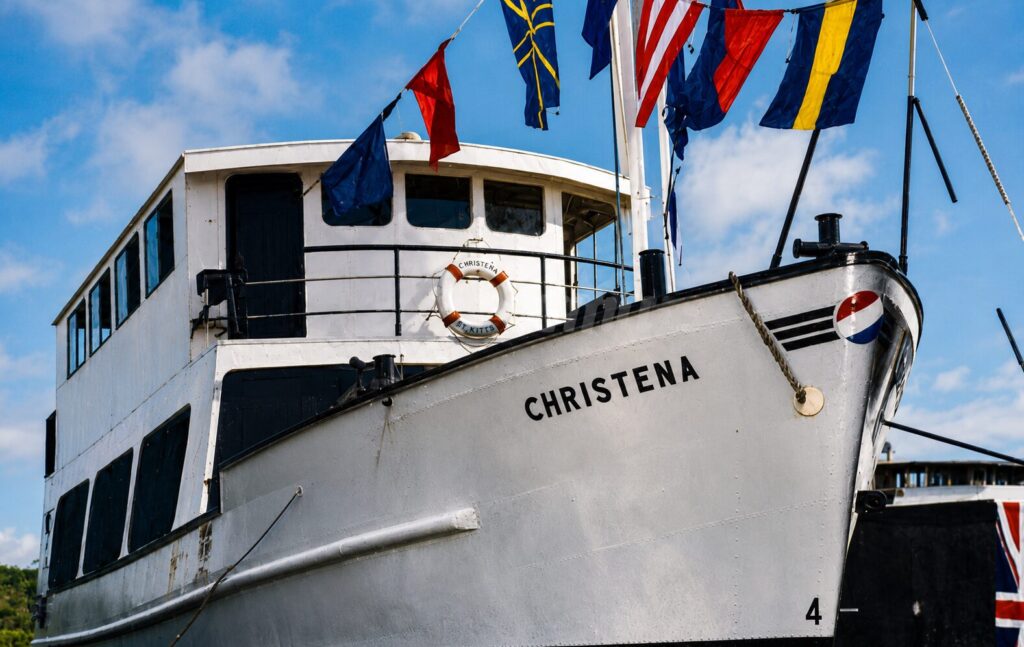
One shows the MV Christena, the government ferry that disappeared beneath the waters of The Narrows between St. Kitts and Nevis on August 1, 1970, taking 233 lives and leaving only 91 survivors.
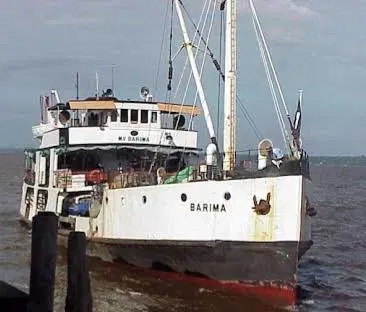
The other shows the weathered white hull of Guyana’s MV Barima, which capsized off the Essequibo coast on Saturday night while travelling from Georgetown to Port Kaituma.
Placed side by side, the visual resemblance is eerie: elevated wheelhouses, stacked passenger decks, broad utilitarian hulls and the unmistakable profile of an earlier generation of government-operated passenger and cargo vessels.
The resemblance deserves scrutiny—but it must not be mistaken for proof that the vessels were identical, sister ships or victims of the same technical defect.
FIRST, A CRITICAL CORRECTION
Claims circulating that both vessels were built in Guyana are not entirely accurate.
The MV Christena was designed and constructed by Sprostons Limited in Georgetown, British Guiana, and completed in May 1959 for the Government of St. Christopher, Nevis and Anguilla.
The MV Barima, however, was built in Port Glasgow, Scotland, by Ferguson Brothers. It was completed in 1939 as one of three related passenger-cargo vessels—Pomeroon, Lady Northcote and Barima—ordered for the Transport and Harbours Department of British Guiana.
Therefore, both vessels are deeply connected to Guyana’s maritime history, but only Christena was actually built there.
They were also far from identical in size. Christena measured approximately 66 feet long with a 16-foot beam, while Barima was approximately 125 feet 9 inches long and 29 feet wide—almost twice Christena’s length and roughly 80 per cent wider.
Yet their similar workhorse appearance is not accidental. Both belonged to an era when governments required practical vessels capable of moving people, agricultural produce, commercial goods and supplies between communities that depended heavily on water transportation.
CHRISTENA: THE DISASTER THAT BROKE A NATION’S HEART
The Christena was only about 11 years old when it left Basseterre on its final Emancipation holiday voyage.
According to the official 1970 Commission of Inquiry, the steel-hulled, two-deck vessel was designed to carry approximately 150 passengers, along with crew and limited cargo. On the afternoon of August 1, however, more than 300 men, women and children crowded aboard.
Passengers occupied benches, passageways, railings, open decks and almost every available standing space. Many were concentrated toward the stern and upper deck.
Contrary to decades of speculation about dangerous weather, the inquiry recorded generally calm seas, moderate-to-light winds and good visibility. It concluded that overcrowding, passenger distribution, limited counterbalancing cargo and the vessel’s physical characteristics combined to undermine stability. A steering malfunction may also have contributed, but the Commission found that it could not, by itself, explain the disaster.
The inquiry’s description of Christena was revealing: the vessel drew less than four feet of water but carried a superstructure more than 13 feet high. The Commissioner found that with an overcrowded upper deck, relatively little cargo below and passengers concentrated toward the stern, the ferry became dangerously vulnerable to rolling.
Water repeatedly washed over the stern before Christena rolled sharply to starboard, overturned and sank within minutes. Lifejackets were aboard, but the speed of the capsize left passengers with little opportunity to reach or use them. Buoyant seats intended as safety equipment reportedly floated upward and obstructed passageways and exits.
The official death toll was 233, making the Christena disaster the single greatest catastrophe in the recorded history of St. Kitts and Nevis. Ninety-one people survived.
BARIMA: A NIGHT VOYAGE THAT TURNED INTO A NATIONAL EMERGENCY
Fifty-six years later, the MV Barima left Georgetown at approximately 3:15 p.m. on Saturday, July 18, bound for Port Kaituma.
At about 11 p.m., authorities received a distress signal. The ferry subsequently capsized approximately seven miles offshore near the Pomeroon River.
The official manifest initially recorded 116 passengers, 17 crew members and approximately 268 tonnes of cargo, against a stated cargo capacity of 284 tonnes. Guyanese officials said the vessel was licensed to carry more than 300 passengers.
As of Monday, 67 people—including 15 children—had been rescued and two bodies recovered. However, the true number aboard remained uncertain because numerous survivors were not listed on the official manifest. The Associated Press reported that at least 35 of the 67 rescued persons were absent from that document.
Authorities also confirmed that the captain and first engineer tested positive for cannabis following their rescue. That result is now part of the investigation, but a positive test alone does not establish when cannabis was consumed, whether either individual was impaired during the voyage or whether it contributed to the capsize. Those matters require forensic and investigative determination.
The Government of Guyana has ordered a multi-agency investigation into the manifest, passenger and cargo loading, compliance with safety requirements and the conduct of the captain, crew and shore-based personnel. The management team responsible for loading and dispatching the vessel has been suspended, while police have obtained surveillance footage from the Kingston Goods Wharf.
THE MOST DISTURBING PARALLEL: WHO WAS REALLY ON BOARD?
The strongest connection between Christena and Barima may not be their appearance. It may be the failure of passenger-accountability systems.
The Christena Commission found that tickets were sold during voyages and that there was no effective independent system for physically counting passengers before departure. Written concerns about overcrowding had reportedly reached government officials years before the disaster, yet the Commission concluded that effective corrective action was not taken.
The Commissioner declared that it was “beyond question” that Christena had repeatedly carried more passengers than it should have.
In Guyana, the Barima investigation has already exposed what officials describe as serious manifest discrepancies. People were rescued who did not officially exist on the voyage records. That failure did more than breach administrative procedure—it left search teams uncertain about how many people they were trying to locate.
The parallel is chilling: in both cases, the paperwork allegedly failed to represent the human reality aboard the vessel.
However, an important distinction remains. Christena’s extreme overcrowding was firmly established by the Commission of Inquiry. With Barima, suspected overloading remains under investigation. Its official cargo figure was below the stated limit, and the unreliable passenger manifest presently makes any final calculation impossible.
THE STABILITY QUESTION THAT CANNOT BE IGNORED
Christena’s capsize was fundamentally associated with stability: too many people, too much weight concentrated above and toward the stern, insufficient counterbalancing weight below and a shallow-draught vessel with a comparatively high superstructure.
Barima’s cause has not yet been determined.
Some survivors reportedly claimed that water had been entering the cargo area before the ferry overturned. Officials have also discussed sea and tide conditions. These accounts must be tested against the wreck, weather data, cargo arrangements, compartment integrity, distress communications and the vessel’s stability calculations.
Investigators must establish whether Barima’s cargo was properly secured and evenly distributed; whether water entered any compartment; whether watertight doors, hatches and pumping systems functioned; whether passengers moved suddenly after an alarm; and whether the vessel’s actual loading condition matched its approved stability limits.
Until those questions are answered, it would be irresponsible to declare that Barima suffered the same stability failure as Christena. Nevertheless, Christena demonstrates precisely why those questions must be asked immediately.
RECENT DRY-DOCKING DID NOT SAVE CHRISTENA—WHAT ABOUT BARIMA?
Another uncomfortable similarity is that both vessels had documented maintenance histories shortly before disaster struck.
Christena underwent extensive docking and repairs in Barbados between February and May 1970, returning to service less than three months before it sank. The Commission recorded that the ferry had been docked annually and that repairs were conducted, yet operational and administrative weaknesses still produced catastrophic consequences.
Guyana’s Public Works Minister Juan Edghill has stated that Barima was seaworthy, had been dry-docked in 2024, was operating with new engines and remained within its scheduled docking cycle. He rejected claims that the ferry had previously been declared unsafe.
However, the government had announced in March that approximately G$124.5 million in docking and overhaul work was planned for Barima. Officials maintain that this represented routine scheduled maintenance rather than evidence that the vessel was unfit for service.
Both positions can be true: a vessel can remain legally certified while still being scheduled for substantial work. The investigation must therefore publish the 2024 dry-dock report, inspection findings, outstanding repair recommendations and the complete scope of the planned 2026 overhaul.
A maintenance certificate should be evidence—not the end of questioning.
AN 87-YEAR-OLD VESSEL VERSUS AN 11-YEAR-OLD FERRY
Age creates one of the largest differences between the vessels.
Barima was built in 1939, making it approximately 87 years old at the time of its capsize. Christena was approximately 11 years old when it sank.
That contrast is important because Christena proves that relative youth does not guarantee safety. Barima’s advanced age, meanwhile, does not automatically prove that it was unseaworthy. Older vessels can continue operating safely when their hulls, machinery, stability documentation, lifesaving equipment and operating procedures are rigorously maintained and independently inspected.
The real question is not simply, “How old was the boat?”
It is: What was its verified condition when it left the wharf?
LIFEJACKETS, RAFTS AND ACCESSIBILITY
Officials said Barima carried 250 lifejackets, six inflatable life rafts and two rigid life rafts, despite being licensed to carry more than 300 passengers. That numerical difference requires official clarification, including whether additional approved flotation devices were counted separately and what complement was legally required for the voyage. It should not, without supporting regulatory evidence, be presented as proof of a violation.
Christena also carried lifesaving equipment. The Commission found, however, that rapid capsizing, passenger congestion and obstructed exits rendered much of it inaccessible or unusable.
The lesson is decisive: safety equipment only saves lives when it is sufficient, accessible, maintained and capable of being deployed during the actual emergency.
FISHERFOLK AGAIN BECOME THE FIRST LINE OF SURVIVAL
In 1970, small fishing boats and private vessels raced toward the overturned Christena, pulling survivors from the water with limited equipment and little official coordination.
In 2026, local Guyanese fisherfolk and private vessels again joined Coast Guard and government teams across an expanding search area. Aircraft, divers, scanners, sonar-equipped vessels and shoreline searches were later deployed.
Across both disasters, ordinary mariners became indispensable.
That courage deserves recognition—but governments cannot build national marine-safety systems around the expectation that nearby fishermen will always be available to compensate for failures elsewhere.
THE RESEMBLANCE SHOULD TRIGGER QUESTIONS—NOT VERDICTS
Christena and Barima were not sister ships. They were constructed in different countries, two decades apart, at dramatically different sizes and for different transport environments.
No evidence currently establishes a common design defect.
Yet their shared appearance reflects something historically significant: both were government transportation workhorses from a period when shallow-water access, mixed passenger-cargo operations and affordability often shaped vessel design.
The deeper similarities are institutional:
Passenger numbers that could not be confidently verified. Questions about loading and weight distribution. Public dependence on a single vital transport link. Questions about crew readiness and supervision. Safety equipment whose availability must be measured against its practical accessibility. And rescue operations complicated by uncertainty over how many people were aboard.
GUYANA MUST GO FURTHER THAN A CLOSED-DOOR INVESTIGATION
The Barima inquiry must produce more than arrests, suspensions or political assurances.
The Caribbean public deserves a technically independent report addressing the vessel’s stability calculations, cargo plan, hull and compartment condition, maintenance history, passenger records, crew certifications, toxicology findings, distress communications, weather conditions, emergency response and the accuracy of all information supplied by the Transport and Harbours Department.
The surveillance footage, ticket records and survivor accounts must be used to reconstruct the true number aboard.
Most importantly, the findings must be published.
The 1970 Christena Commission warned that disasters are seldom caused by one dramatic event. They emerge when technical vulnerabilities, weak administration, poor enforcement and ignored warning signs converge.
Fifty-six years later, the MV Barima has delivered the Caribbean another painful warning.
The two ferries may not have shared the same builder or blueprint—but unless the region confronts every failure honestly, they may yet share the same enduring lesson:
The sea may expose the final weakness, but the conditions for catastrophe are often created long before a vessel leaves the wharf.
This remains a developing story. Rescue totals, casualty figures and investigative findings may change as Guyanese authorities verify the number of people who were aboard.
Would you like an alert when Guyanese authorities release verified passenger totals or preliminary investigation findings?
















Leave a comment
You must be logged in to post a comment.