FEATURED ANALYSIS | THE U.S. VISA WAKE-UP CALL: WHY CARIBBEAN ARTISTES AND PROMOTERS CAN NO LONGER TREAT A B1/B2 AS A PERFORMANCE PASS
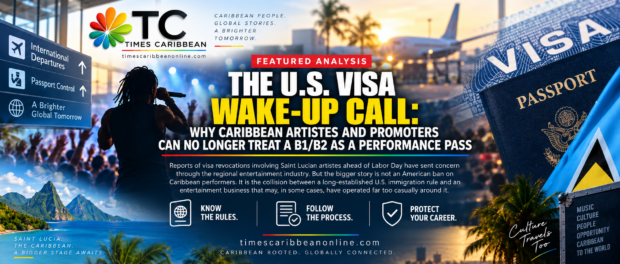
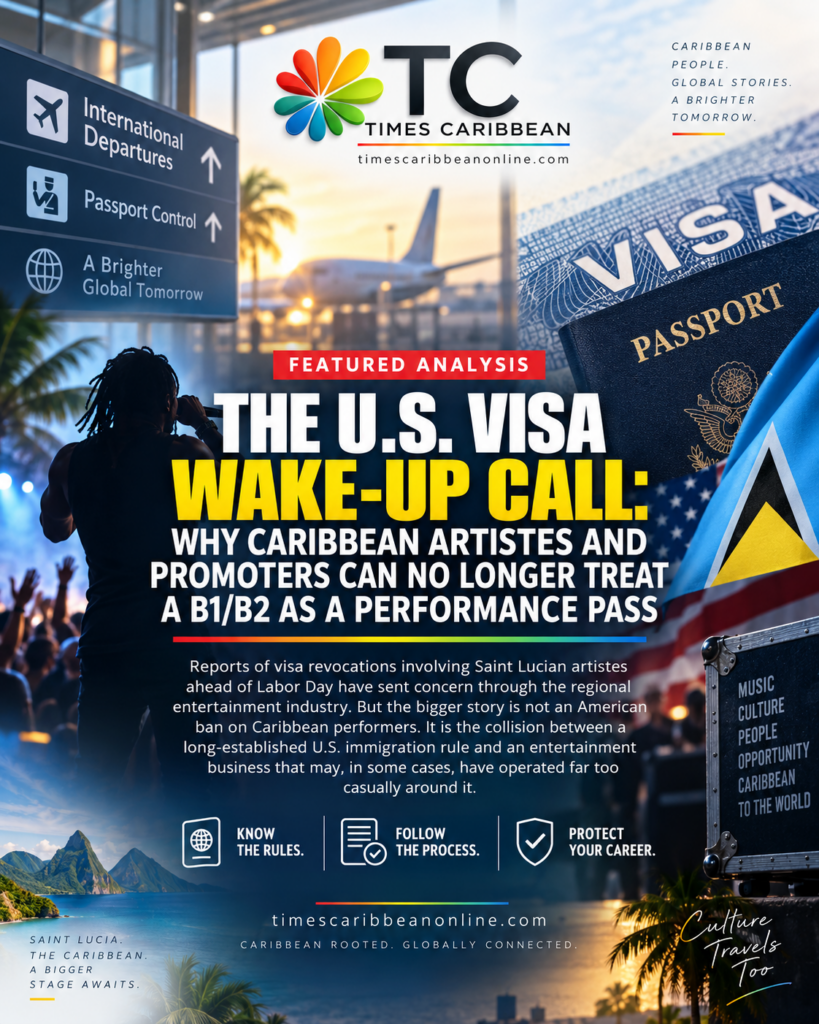
Reports of visa revocations involving Saint Lucian artistes ahead of Labor Day have sent concern through the regional entertainment industry. But the bigger story is not an American “ban” on Caribbean performers. It is the collision between a long-established U.S. immigration rule and an entertainment business that may, in some cases, have operated far too casually around it.
TIMES CARIBBEAN | September 7, 2026
The message coming out of this Labor Day weekend should be heard well beyond Saint Lucia.
Caribbean artistes, managers, booking agents and promoters who conduct business in the United States may need to fundamentally rethink how international engagements are arranged.
Reports published in Saint Lucia indicate that at least three Saint Lucian artistes had their U.S. visas revoked ahead of Labor Day engagements, disrupting plans to perform during one of the most commercially important Caribbean cultural weekends in the United States.
St. Lucia Times reported on September 5 that the artistes were among regional performers experiencing difficulties as U.S. authorities applied greater scrutiny to B1/B2 visa use. Prime Minister Philip J. Pierre also publicly addressed the issue, saying artistes who had previously performed in the United States on B visas were now being “sanctioned” and would need to follow the required process for employment-related engagements.
That is significant.
But it requires careful analysis.
Times Caribbean has found no public announcement from the United States establishing a new policy specifically targeting Saint Lucian or Caribbean entertainers. Nor should the reported revocation of an individual artiste’s visa automatically be interpreted as proof that the person deliberately violated U.S. immigration law.
The precise circumstances surrounding the reported Saint Lucian cases have not been publicly established. U.S. visa records are generally confidential under Section 222(f) of the Immigration and Nationality Act, meaning governments and the media frequently do not have access to the complete facts behind individual visa decisions.
That distinction matters.
What is clear is that the underlying American rule is much stronger — and much older — than many people in the regional entertainment industry may realise.
THE BIG MISUNDERSTANDING: B1/B2 DOES NOT MEAN “BUSINESS WORK”
A B1/B2 visa sounds broad.
The “B1” component covers certain temporary business activities. That wording can understandably cause confusion.
But conducting permissible business activity and performing paid work are not the same thing under U.S. immigration law.
The U.S. Department of State says B1 visitors may undertake activities such as consulting business associates, attending professional conventions and negotiating contracts.
Employment is another matter.
Its current guidance specifically lists employment, paid performances and professional performances before a paying audience among activities that cannot ordinarily be undertaken on a visitor visa. It separately states that a B1/B2 holder is not permitted to accept employment or work in the United States.
And the rules for professional entertainers go even further.
The State Department’s Foreign Affairs Manual says that, outside limited exceptions, B status is not appropriate for a professional entertainer entering the United States to perform services.
The guidance says performers should generally use another appropriate classification — “in most cases” a P classification — regardless of the amount or source of compensation, whether the artiste will make a public appearance, or even whether a performance is for charity or a U.S.-based ethnic organisation.
Read that again.
Simply saying “I am not being paid in America” may not settle the issue for a professional performer.
Neither does calling the trip “promotion.”
Neither does receiving payment back home.
Neither does performing for a diaspora organisation automatically transform a professional engagement into visitor activity.
There are narrow exceptions, including certain government-sponsored cultural programmes, some competitions and specific recording activity without public performances. But those exceptions have conditions. They should never be assumed.
THIS APPEARS TO BE AN ENFORCEMENT STORY — NOT A BRAND-NEW LAW
This is where much of the Caribbean conversation needs correction.
Some recent reporting has characterised the situation as a “change” in America’s B1/B2 rules.
The underlying restriction on professional performance is not new.
What may be changing is the level of enforcement, scrutiny, information-sharing or willingness to overlook practices that might previously have passed without difficulty.
That is an important difference.
An artiste who entered the United States several times before and performed without encountering a problem cannot reasonably conclude that those previous trips created a legal entitlement to continue doing so.
Immigration compliance does not operate on precedent established by an individual’s travel history.
“I did it last year” is not a visa category.
And a visa itself does not guarantee entry.
The Department of State explicitly explains that a visa allows someone to travel to a U.S. port of entry and seek admission. U.S. Customs and Border Protection ultimately determines whether the traveller will be admitted and whether the proposed activity is consistent with his or her status.
That makes the consequences potentially much larger than simply missing one show.
AMERICA’S OVERALL VISA ENVIRONMENT HAS BECOME TOUGHER
There is also a wider context that the Caribbean entertainment industry cannot ignore.
The U.S. State Department announced in August that more than 175,000 visas had been revoked under the current Trump administration for a broad range of stated visa-compliance, legal and security-related reasons. Reuters independently reported that announcement.
There is no public evidence establishing that the reported Saint Lucian artiste cases formed part of that wider initiative.
But the number illustrates something important.
The U.S. immigration environment in 2026 is one in which visa compliance is receiving intense attention.
The entertainment industry would be unwise to behave as though nothing has changed operationally simply because the statutes governing professional performances have existed for years.
The safest assumption now is straightforward:
Expect the rules to be examined.
SO WHAT VISA DOES AN ARTISTE ACTUALLY NEED?
There is no single universal “entertainer work permit.”
That phrase may be convenient in everyday conversation, but U.S. immigration law is considerably more specific.
The appropriate classification depends on the artiste, the group, the nature of the engagement and the supporting organisation.
The Department of State identifies several relevant categories. The O category can apply to individuals with extraordinary ability or achievement in fields including the arts. P-1 can cover recognised entertainment groups. P-2 relates to artistes or entertainers participating through qualifying reciprocal exchange programmes. P-3 can cover artistes coming to perform, teach or coach under culturally unique or traditional programmes.
That last category should be particularly interesting to Caribbean cultural stakeholders because U.S. guidance expressly refers to traditional ethnic, folk, cultural, musical, theatrical or artistic performance programmes.
But eligibility cannot simply be assumed because an artiste performs soca, calypso, reggae, bouyon, dancehall or another Caribbean genre.
The facts and documentation matter.
For many petition-based classifications, the process begins before the artiste ever reaches a U.S. consulate.
USCIS instructions allow qualifying U.S. employers or agents to petition for certain entertainers through Form I-129. Where an agent represents performers working for multiple employers, supporting documentation can include detailed itineraries identifying engagements, dates, employers and venues.
That changes the entire booking model.
PROMOTERS CANNOT LEAVE IMMIGRATION TO THE ARTISTE
For years, Caribbean entertainment bookings have sometimes moved at extraordinary speed.
A fete is announced.
The artiste is confirmed.
A flyer goes online.
Flights are purchased.
Deposits move.
The promoter assumes the artiste already “has a U.S. visa.”
That assumption is no longer good enough.
The relevant question is not merely:
“Do you have an American visa?”
It is:
“Do you have the immigration classification and authorization appropriate for what we are hiring you to do?”
That question should come before the poster.
Before the airline ticket.
Before the hotel booking.
And certainly before thousands of dollars are spent advertising a headline act whose immigration documentation has not been properly assessed.
Promoters who make immigration compliance an afterthought expose themselves to cancelled appearances, refund demands, replacement costs, damaged relationships with venues and sponsors, and loss of public confidence.
Artistes face even greater risks because their ability to enter one of the world’s most important entertainment markets can affect years of career planning.
A PARTICULARLY BIG ISSUE FOR THE CARIBBEAN
New York’s Labor Day period is not an ordinary weekend for Caribbean entertainment.
It is part performance circuit, part cultural gathering, part diaspora reunion and part commercial marketplace.
For artistes from smaller islands, one New York appearance can create bookings in Boston, Miami, Toronto, London and across the Caribbean diaspora.
Saint Lucia has itself historically supported artistes travelling into the U.S. market. A 2017 government release, for example, documented official support for Saint Lucian soca performers undertaking a multi-city U.S. tour beginning around Labor Day activities.
So tighter immigration scrutiny is not merely an inconvenience for singers.
It is an economic-development issue.
Caribbean music exports increasingly depend on international touring. Promoters, DJs, dancers, musicians, sound engineers, managers, producers, videographers and other workers earn revenue around those appearances.
One immigration problem can therefore ripple through an entire event.
THE REGION NEEDS A PROFESSIONAL RESPONSE
The wrong response would be outrage built around the claim that “America is banning Caribbean artistes.”
There is presently insufficient evidence for such a conclusion.
The smarter response is institutional.
Caribbean governments, cultural ministries, artistes’ associations, carnival organisations, management companies and major promoters should consider establishing proper immigration-compliance protocols for international performances.
At minimum, the industry should now be doing four things: obtaining qualified U.S. immigration advice well before engagements; determining the correct visa classification before advertising a performance; building immigration responsibilities and cancellation provisions into contracts; and maintaining proper documentation of promoters, agents, venues, itineraries, remuneration and the purpose of travel.
Professionalisation costs money.
But cancelled tours cost more.
AND ARTISTES SHOULD BE CAREFUL WHAT THEY SAY AT THE BORDER
There is another lesson here.
Accuracy matters.
A traveller should never attempt to disguise the true purpose of a trip or provide materially inaccurate information to obtain a visa or admission.
The Department of State warns that willful misrepresentation of a material fact or fraud in attempting to obtain a visa can result in serious immigration consequences.
That does not mean every performer questioned by immigration has done anything improper.
It means professional artistes should understand precisely what status they hold, what it permits and what documentation supports their trip.
Management has to become professional enough to protect the talent.
THE REAL WAKE-UP CALL
The reported experiences of the Saint Lucian artistes should therefore become something bigger than another weekend entertainment controversy.
They should force an industry-wide conversation.
Caribbean music is global now.
Its business systems must become global too.
An artiste who commands thousands of dollars for an international performance, employs a management team, headlines major festivals and travels repeatedly between markets is running an international creative enterprise.
Immigration compliance must be treated with the same seriousness as contracts, publishing rights, royalties, taxation, security, insurance and production.
And promoters must understand that a photograph of a valid B1/B2 visa is not proof that an entertainer is authorised to perform professionally in the United States.
That distinction could now determine whether the show goes ahead at all.
The United States may indeed be scrutinising these matters much more closely.
But the deeper warning is not that America suddenly changed the rules overnight.
It is that practices which may once have escaped serious scrutiny should never have been mistaken for the rules themselves.
For Caribbean artistes, the message after Labor Day 2026 is simple:
Know your status. Get proper advice. Complete the correct process. Protect the career you worked years to build.
Because in immigration law, “we’ve always done it this way” is not authorization.
Times Caribbean note: This analysis is based on publicly available reporting and official U.S. government immigration guidance. The specific legal grounds for individual reported visa revocations have not been independently established, and this article should not be treated as individual legal advice.
















Leave a comment
You must be logged in to post a comment.