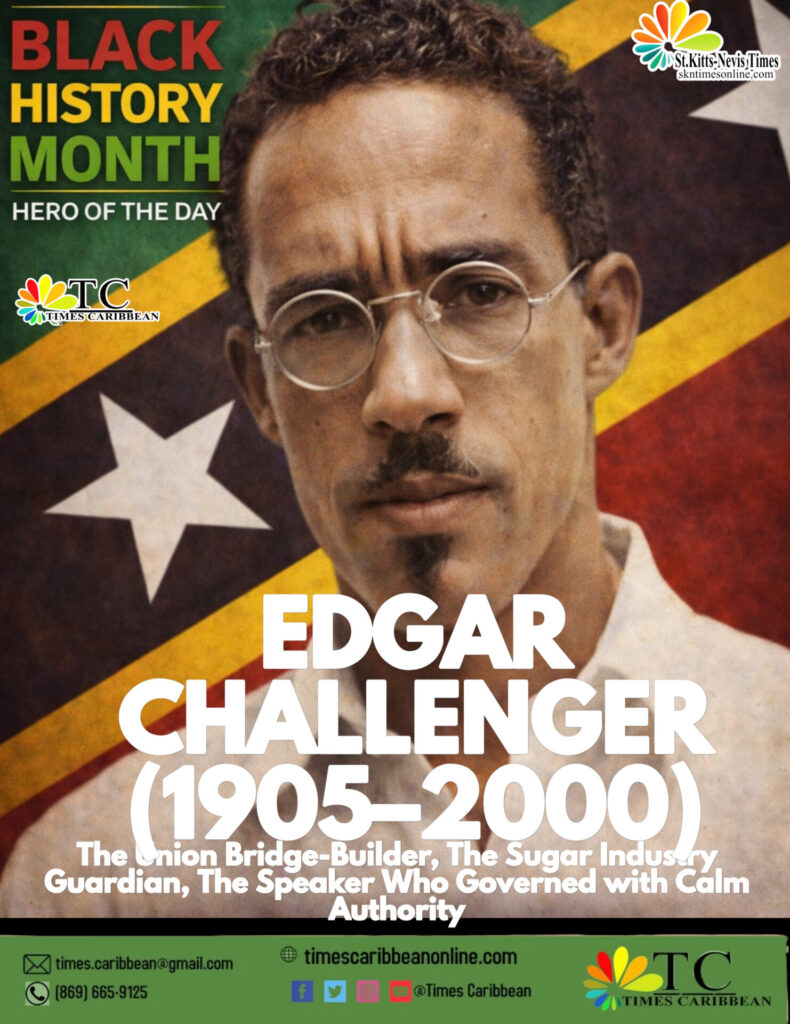
EDGAR CHALLENGER (1905–2000): The Scholar-Unionist, The Reluctant Revolutionary, The Keeper of Kittitian Memory
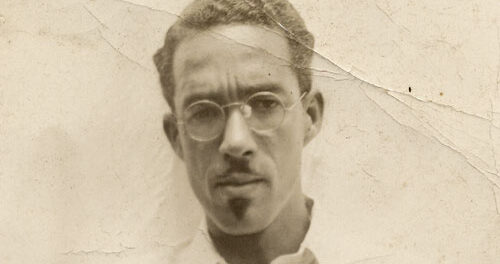
SKN TIMES | BLACK HISTORY MONTH – HERO OF THE DAY
There are men who dominate history through spectacle — and there are men who shape it through substance. Edgar Challenger belonged to the latter, yet his imprint on St. Kitts and Nevis remains indelible.
Born on November 29, 1905, Challenger emerged from modest beginnings to become one of the foundational architects of organized labour and an early guardian of Kittitian historical consciousness.
The Intellectual Who Refused Erasure
After early education in St. Kitts and at Lodge School in Barbados, Challenger pursued studies abroad in Canada and at City College, New York. It was there that a defining moment occurred: when he sought a course in Caribbean history and discovered none existed, he refused intellectual invisibility.
Rather than accept colonial silence, he began researching Caribbean history independently — an act of quiet rebellion long before “decolonization” became an academic movement.
This refusal to let West Indian history be sidelined would define the second half of his life.
Founding Father of Labour Organization
In 1937, during the first elections held in sixty years, Challenger won a seat in the Legislative Council as a Workers’ League candidate. By 1939, he became the first President of the St. Kitts-Nevis Trades and Labour Union.
The sugar strike of 1940 tested his leadership. For seven tense weeks, he negotiated on behalf of factory workers while providing food supplies from his own business to sustain strikers. His decisions were not driven by theatrics but by strategy and survival.
When faced with government-backed factory resistance and Defense Force mobilization, Challenger chose calculated retreat over reckless escalation — preserving the Union for future battles.
He believed in disciplined organization, not chaos.
Philosopher of Responsible Labour
In 1942, Challenger articulated a principle ahead of its time — the interdependence of capital and labour. He advocated moderation during World War II, persuading the Union to adopt a “no strike” resolution in recognition of global instability.
But leadership strains emerged following the death of Thomas Manchester in 1942. By April 1943, Challenger requested leave from Union leadership and did not resume his position.
He withdrew from frontline politics — but not from national service.
The Archivist Without a Title
The latter decades of Edgar Challenger’s life were devoted to research, genealogy, and historical inquiry. Long before formal archives were fully organized, he became a trusted reference point for scholars, researchers, and families tracing their lineage.
He preserved stories that might otherwise have disappeared.
He clarified records.
He answered queries from across the region and the diaspora.
He became a living archive — safeguarding the memory of a people.
A Life That Spanned a Century
Edgar Challenger died in November 2000, closing a life that spanned nearly a century of transformation — from colonial rule and sugar dominance to independence and regional integration.
He had witnessed labour unrest, political realignment, constitutional change, and the emergence of a modern Caribbean identity.
Through it all, he remained steady — principled, analytical, and deeply committed to his homeland.
Historical Significance
Edgar Challenger’s legacy is layered:
- First President of the Trades and Labour Union
- Workers’ League Vice-President and Legislator
- Negotiator during the pivotal 1940 strike
- Advocate for responsible labour action
- Independent historian and genealogical resource
He demonstrated that nation-building is not only about power — it is about preservation.
Today, SKN Times Honors Edgar Challenger
The unionist who fed the strikers.
The scholar who refused historical silence.
The patriot who preserved Kittitian memory.
In Black History Month, we salute not only the loud revolutionaries —
but the intellectual architects whose quiet work fortified the nation.
Edgar Challenger was one of those architects.
And history remembers.
















Leave a comment
You must be logged in to post a comment.