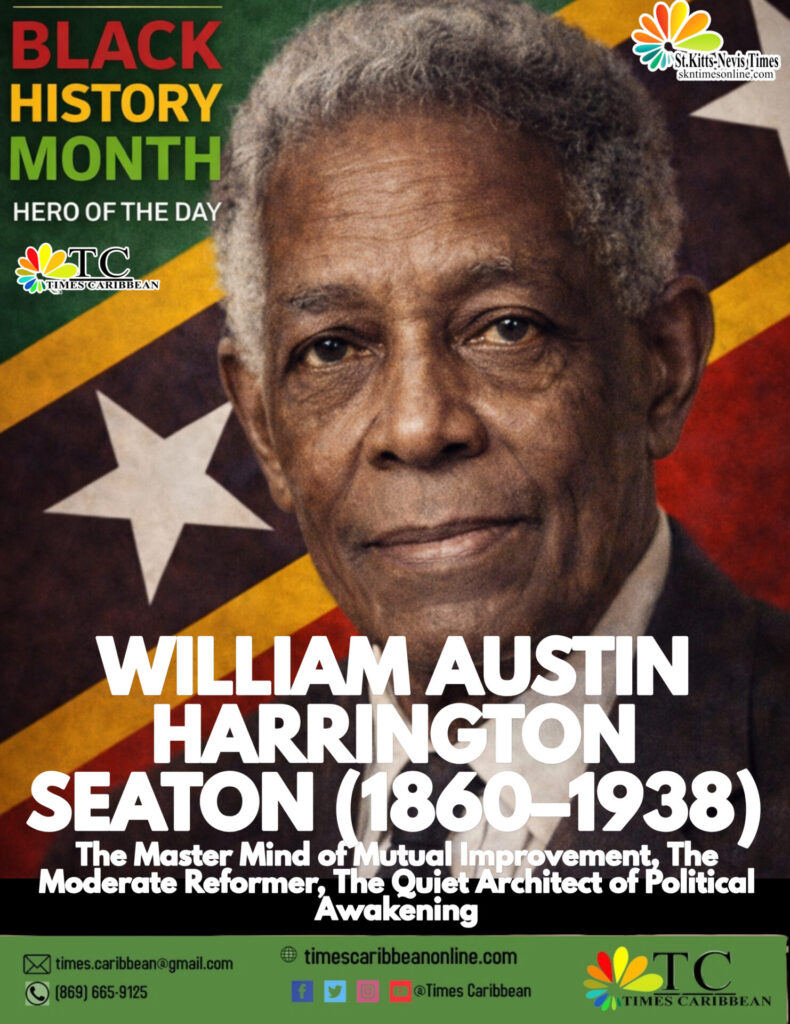
WILLIAM AUSTIN HARRINGTON SEATON (1860–1938): The Master Mind of Mutual Improvement, The Moderate Reformer, The Quiet Architect of Political Awakening
SKN TIMES | BLACK HISTORY MONTH – HERO OF THE DAY
Before the strikes.
Before the League.
Before constitutional agitation took organized form —
There was William Austin Harrington Seaton.
In this Black History Month tribute, SKN Times honors a man whose steady intellect and disciplined moderation helped lay the philosophical groundwork for modern political consciousness in St. Kitts and Nevis.
Born of Teachers, Raised in Discipline
William Austin Harrington Seaton was born on 6 December 1860 in Sandy Point to two trained primary school teachers. Education was not an aspiration in his home — it was a foundation.
By age nineteen, he was entrusted with the leadership of St. Augustine’s Infant School. Yet his interests stretched beyond the classroom. He explored blacksmithing with hopes of mechanical engineering but, discouraged by delicate health, redirected his ambition into tailoring and shoemaking — excelling particularly in the latter.
Even in trade, he sought excellence.
From Sandy Point to the Virgin Islands
In 1883, Seaton left for St. Thomas, initially intending to travel onward to Panama during the canal’s construction. The health dangers in the Canal Zone altered those plans.
Instead, he established himself in the Virgin Islands, becoming:
- A chorister and Sunday School teacher
- A clerk at the British Consulate
- A licensed lay reader in the Diocese of Antigua
- A headmaster and registrar of births and deaths
His administrative versatility was remarkable. He moved fluidly between education, church, and civil record-keeping — developing the organizational skills that would later define his public life.
Return to St. Kitts: Service Over Ambition
In 1893, Seaton returned to St. Kitts to care for his ailing mother. It was a turning point.
He married Priscilla Lavinia Greene-Cleghorn and resumed educational and ecclesiastical service under Archdeacon Dodsworth. Eventually, he entered the commercial world, working for multiple firms and rising to managing director by 1928 — until the Great Depression halted that trajectory.
His career reflects the precariousness of colonial economies — even the capable were vulnerable to global collapse.
The Mutual Improvement Society: Intellectual Nation-Building
If Seaton’s commercial career was practical, his intellectual contribution was profound.
In 1901, he co-founded the Mutual Improvement Society (MIS) — an organization dedicated to intellectual discourse, civic responsibility, and self-advancement among Black Kittitians.
By 1911, he was editor of The Reporter, the Society’s publication. For over twenty years, he sustained it largely through personal sacrifice — writing, editing, correcting proofs often until dawn.
Edward Margetson later described him as the “Master Mind” of the MIS:
“It gave a sense of safety to have his finely balanced judgment presiding over our deliberations.”
Seaton was not fiery — he was stabilizing.
He believed that before agitation must come education. Before protest, preparation.
Political Engagement Without Recklessness
In 1917, he helped organize a trade union, motivated by a desire to “better the condition of the labouring classes.” Police reports described him as:
“A man of very considerable intelligence and moderate in conduct and views.”
That description captures him perfectly.
He was no radical incendiary — yet neither was he indifferent to injustice.
When hostility from the colonial administration escalated, and internal reservations arose about tactics, Seaton withdrew. His moderation was principled, not timid.
Representative Government & Workers’ League
In 1918, Seaton served as Honorary Secretary of the Representative Government Association. Later, he became active in the Taxpayers’ Association, advocating accountability and administrative reform.
In 1932, he joined the Workers’ League and traveled with Thomas Manchester to the West Indies Conference in Dominica.
He served as Vice President and Secretary of the League until his death in 1938.
While others captured headlines, Seaton provided structure.
He was the careful drafter.
The reasoned voice.
The man who ensured that ideas were coherent before they were shouted.
Analytical Significance
William Seaton’s legacy reveals a vital truth about political evolution in St. Kitts and Nevis:
Radical transformation requires moderate architects.
He connected:
- Intellectual uplift through MIS
- Early labour advocacy
- Constitutional agitation
- Emerging nationalist consciousness
Without men like Seaton — disciplined, literate, administratively competent — the fiery activism of the 1930s may have lacked durable structure.
He was the bridge between Victorian restraint and 20th-century mobilization.
A Life of Measured Influence
William Austin Harrington Seaton died in 1938.
He did not live to see the full flowering of labour politics or eventual independence. But the intellectual and civic frameworks he nurtured shaped those movements profoundly.
His evenings bent over correspondence and editorials.
His patience in meetings.
His careful words in debate.
These were not glamorous acts.
They were foundational.
Today, SKN Times Salutes William A. H. Seaton
The Master Mind of Mutual Improvement.
The moderate reformer with unwavering principles.
The quiet architect of political awakening in St. Kitts and Nevis.
In Black History Month, we honor not only the revolutionaries —
but the disciplined thinkers who prepared the ground.
William Austin Harrington Seaton prepared that ground.
And the nation rose upon it.
















Leave a comment
You must be logged in to post a comment.