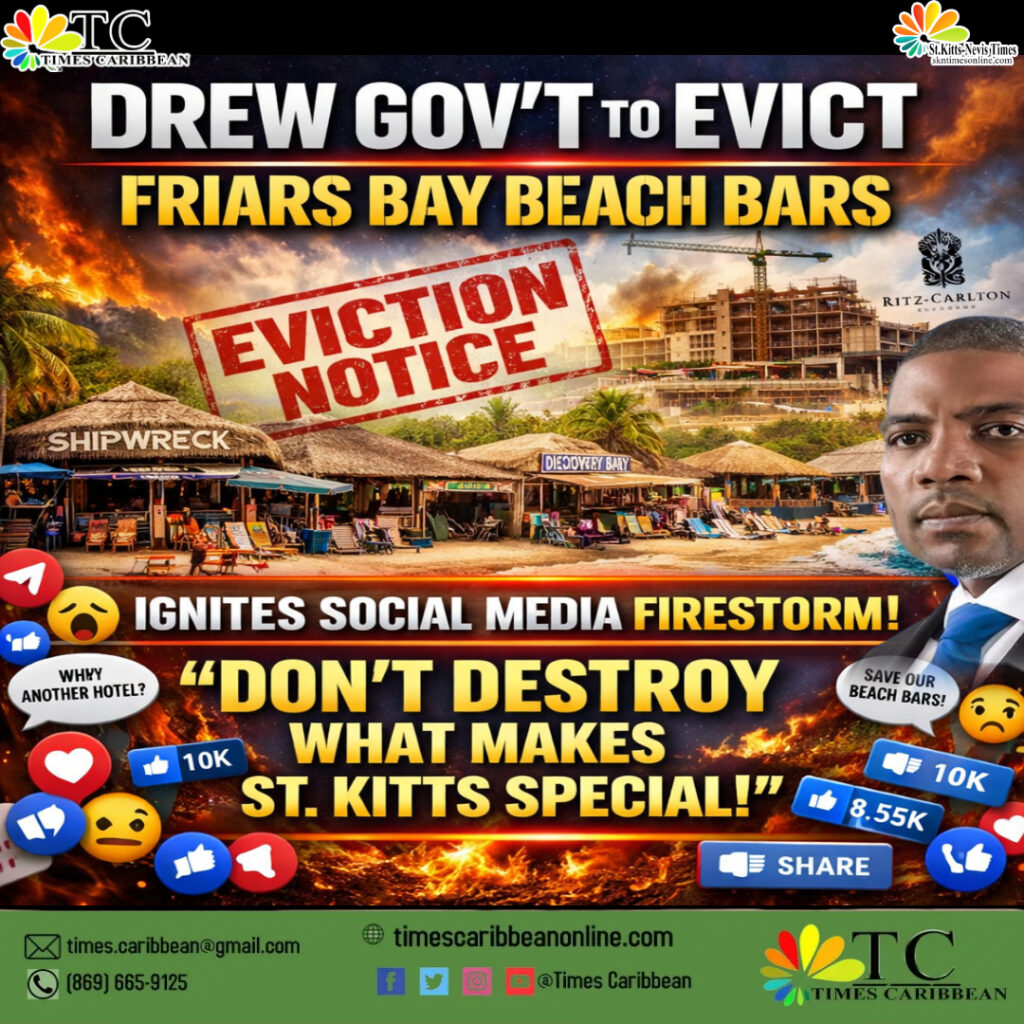
DREW GOV’T MOVE TO EVICT FRIARS BAY BEACH BARS IGNITES SOCIAL MEDIA FIRESTORM — CITIZENS WARN: “DON’T DESTROY WHAT MAKES ST. KITTS SPECIAL”

Commentary
The decision by the administration of Prime Minister Terrance Drew to move toward the eviction of long-standing beach bars at Friars Bay has unleashed a wave of bitter public condemnation — and nowhere is the backlash more visible than on social media.
Within hours of the news circulating, citizens, residents, diaspora members, and repeat visitors flooded Facebook threads with sharp criticism, concern, and in some cases outright disbelief at what they see as the potential dismantling of one of St. Kitts’ most authentic tourism spaces.
The anger is not simply about three beach bars. It is about the future direction of tourism development in the federation — and whether the government is sacrificing local culture and entrepreneurship to make room for another luxury resort.
“Why Another Hotel?”
One of the most repeated questions across social media was simple but piercing:
“Why does St. Kitts need yet another hotel that is going to be empty?”
Commenters pointed out that the island already has multiple luxury properties and questioned whether the demand truly exists to justify another large high-end development.
Some critics warned that the country could be repeating a pattern seen elsewhere in the Caribbean — ambitious hotel announcements that never fully materialize.
“Are all the hotels in St. Kitts at capacity? Are they actually going to finish construction or is it going to go the way of so many other promised hotels on island?”
That skepticism reflects a growing fatigue among citizens who have watched several high-profile development announcements stall or disappear over the years.
“They Were Paying Rent”
Another theme dominating the public discussion is the perception that the beach bar operators are being unfairly portrayed.
One commenter pushed back strongly against the narrative that the businesses were occupying land without legitimacy:
“They weren’t squatting. They were paying rent. But big money is more important than a beach that gives St. Kitts aesthetic value.”
For many citizens, that statement captures the core fear surrounding the controversy — that small local businesses are being displaced to clear the path for powerful international investors.
Tourists Speak Out
Perhaps the most striking voices in the debate are those of international visitors who say the beach bars are exactly what brings them back to St. Kitts year after year.
One long-time visitor wrote:
“As a visitor to your wonderful island, the thing that brings us back rather than to other islands are these bars. We don’t want to be in a big resort — we want to be out in these bars soaking up the atmosphere.”
Another former resident who lived on the island for three years echoed the same sentiment:
“One of the best things about St. Kitts was the mix of high-end hotels AND the beach bars that were wonderfully Caribbean. That mix is what made the island different from other overdeveloped places.”
These comments highlight a reality often overlooked in development debates: authenticity is itself a tourism asset.
Development vs. Identity
Not all commenters opposed development outright.
Some acknowledged the importance of tourism investment but urged government to find a balance between growth and preservation.
“I love that St. Kitts is developing, but we need to think about the impact on the local community. These fancy resorts are pushing up prices for everything. It’s not sustainable.”
Others suggested creative solutions — such as integrating the beach bars into the development rather than removing them.
“Rather than a Ritz-Carlton, make a place that is a little more affordable and still keep these beach bars there. That’s why people go to St. Kitts.”
The Jamaica Warning
One particularly thoughtful comment referenced Jamaica as a cautionary example of what can happen when tourism becomes dominated by large international resorts.
The commenter argued that economies built primarily around foreign-owned hotels can become fragile — especially when those corporations cut jobs during downturns.
“An economy is far healthier when locals start their own businesses to build generational wealth. That’s better long-term for an economy.”
The same commenter pointed out that government theoretically has the option to purchase land and protect local enterprise if it chooses.
Skepticism and Unanswered Questions
Beyond anger and nostalgia, many citizens simply want clarity.
Key questions remain unanswered:
• Who exactly owns the land?
• Are the businesses being offered relocation options?
• Will the development actually proceed?
• How will the government protect local entrepreneurship in tourism zones?
One commenter summed up the uncertainty bluntly:
“Another year, same topic. The beach bars ain’t moving. Next year this topic will rise again.”
A National Conversation
The Friars Bay controversy has now evolved into something larger than a zoning or lease dispute.
It has become a national conversation about identity, ownership, and the future of tourism in St. Kitts and Nevis.
For decades, the island’s tourism brand has rested on a unique blend: luxury resorts alongside laid-back beach bars, polished hospitality alongside authentic Caribbean culture.
Many citizens now fear that balance may be slipping.
If the beach bars of Friars Bay disappear, the government may gain another resort.
But the country could lose something far more valuable — a piece of the island’s soul.
















Leave a comment
You must be logged in to post a comment.