DR. HARRIS BLASTS STEP MASS LAYOFFS: “MAKE IT MAKE SENSE!”
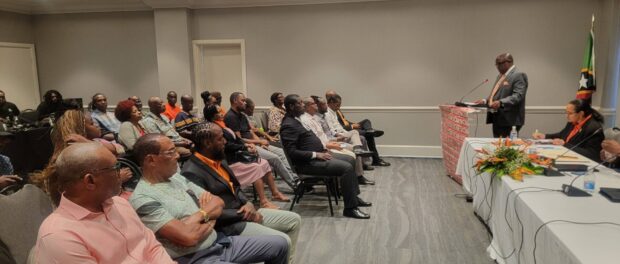
Former PM Warns New Cost-Sharing Policy Could Trigger Mass Layoffs Across St. Kitts and Nevis
Basseterre, St. Kitts and Nevis — The national debate over the Government’s revised Skills Training and Empowerment Programme (STEP) policy has taken a dramatic turn, after the Federation’s third Prime Minister and Leader of the People’s Labour Party, Dr. Hon. Timothy Harris, launched a blistering critique of the administration’s decision to shift 50% of STEP wage costs onto private sector employers.
In remarks that have sent shockwaves through the business community, Dr. Harris warned that the new cost-sharing arrangement could result in thousands losing their jobs, particularly within the already fragile small business sector.
“The Timing Is Very Bad and Very Off”
Dr. Harris did not mince words.
“In relation to the new policy of the government to require private entities to pay, I gather, about 50% of the wages, plus social security and that — this is going to have a damaging effect on the program. The truth is, the timing is very bad and very off.”
Under the revised arrangement, businesses participating in STEP will now be required to absorb approximately $250 per week per participant, in addition to statutory deductions including Social Security and other payroll obligations.
For small enterprises operating on tight margins — from corner shops to construction firms, restaurants, and service providers — the additional financial load could be crippling.
A Policy at Odds With Economic Reality?
Dr. Harris framed the issue as one of economic logic — or the absence thereof.
“Few small businesses can take on that additional burden of $250 weekly, plus all the other statutory deductions. So it means the government will be forcing small businesses, who need the support at this time when they are vulnerable.”
The former Prime Minister’s remarks strike at the heart of a widening concern: that the Government’s attempt to ensure STEP’s “sustainability” may paradoxically undermine its core objective — employment support.
Economic observers note that small and medium-sized enterprises (SMEs) represent the backbone of the Federation’s economy. Many are still recovering from global supply chain disruptions, inflationary pressures, rising utility costs, and increased minimum wage obligations.
Adding another recurring payroll expense, critics argue, could force employers to make hard decisions — including releasing STEP participants altogether.
The $27 Million Question
Perhaps the most politically explosive moment in Dr. Harris’ comments came when he juxtaposed the Government’s reported financial support to a major hotel entity with the new demands placed on small businesses.
“Imagine the government gave the largest hotel $27 million. $27 million. And now come to ask small businesses to pay $250 per week. Make that make sense to us.”
The comparison has ignited fresh scrutiny over public spending priorities and whether fiscal tightening is being disproportionately transferred onto local entrepreneurs rather than large-scale corporate beneficiaries.
Critics argue that while strategic investments in tourism infrastructure are important, the optics of multimillion-dollar assistance to large establishments — contrasted with cost burdens on small, local operators — create a perception of imbalance.
Thousands at Risk?
If even a fraction of participating businesses withdraw from STEP due to the added financial responsibility, analysts warn the ripple effects could be severe:
- Immediate job losses among STEP participants
- Reduced household income for vulnerable families
- Increased unemployment claims
- Slower domestic spending and consumer activity
- Heightened social strain
For many STEP participants, the program represents more than a paycheck — it is a pathway to experience, skills acquisition, and upward mobility.
If employers opt out en masse, the very individuals the programme was designed to empower could find themselves displaced.
Political Fault Lines Deepen
Dr. Harris’ intervention signals that STEP is poised to become a defining political battleground.
As the architect of earlier employment stabilization measures during his tenure, the PLP leader appears intent on framing the revised policy as economically reckless and socially destabilizing.
The Government, for its part, maintains that cost-sharing is necessary to ensure the programme’s long-term viability amid rising labour costs.
Yet the fundamental question lingers: Will sustainability come at the cost of jobs?
A Nation Watching
As March implementation approaches, business owners are reportedly reviewing their payroll projections and participation agreements. Some privately express concern that they simply cannot absorb the added weekly expenditure.
If withdrawals begin, the numbers could escalate rapidly.
For now, one thing is certain: the STEP policy shift has transformed from an administrative adjustment into a national economic flashpoint.
And as Dr. Harris bluntly challenged:
“Make that make sense to us.”
















Leave a comment
You must be logged in to post a comment.