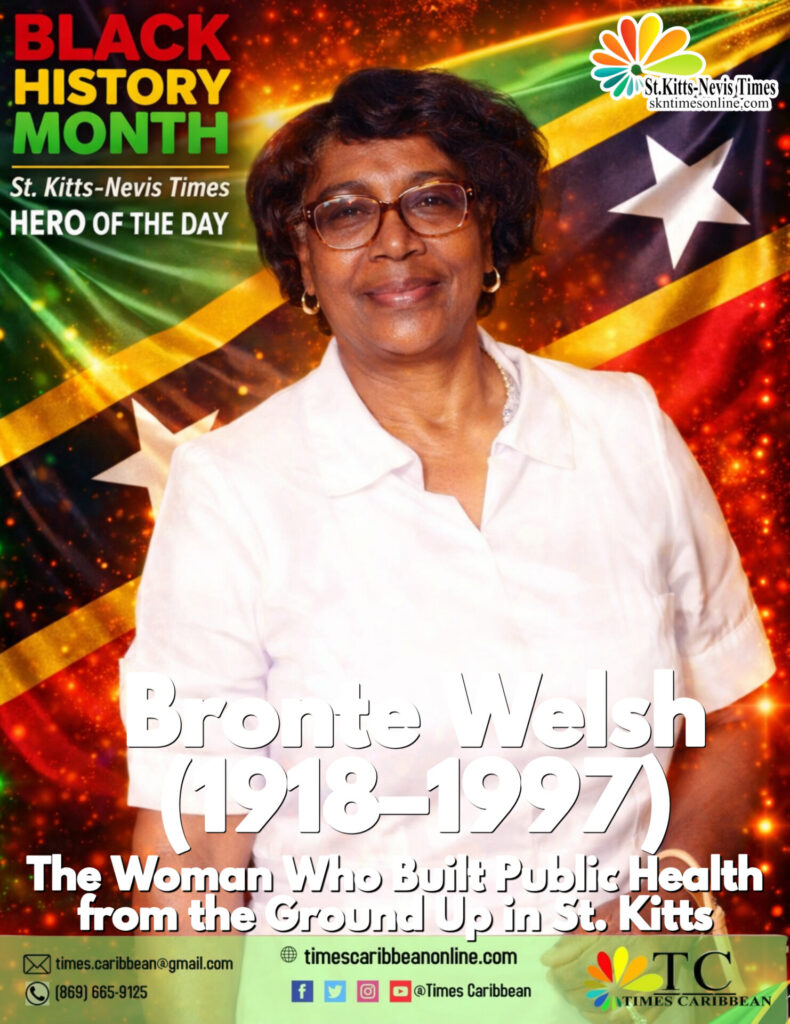
Bronte Welsh (1918–1997): The Woman Who Built Public Health from the Ground Up in St. Kitts

SKNTimes Black History Month History-Maker
As Black History Month honours pioneers whose service reshaped national life, SKN Times recognises Bronte Welsh—a trailblazing public health activist and the first Public Health Nurse to be formally recognised in St. Kitts, whose career transformed preventive medicine, community care, and nursing leadership across the Federation.
Born December 31, 1918, in Challengers Village, Bronte Agatha Welsh was the first daughter of Evan and Annie Welsh and second of six children. Her early education began at a private school before she entered Basseterre Girls’ School, completing Seventh Standard by age twelve. She later attended Girls’ High School, but the daily commute from Challengers proved taxing. At sixteen, she left school before sitting the Cambridge examination—an early setback that did not deter her vocation.
After several years of private teaching, Welsh answered a deeper calling: nursing. She entered the profession at nineteen, trained as a midwife, and briefly worked in a pharmacy—experience that later strengthened her clinical judgment. In 1942, she returned to Cunningham Hospital, qualifying as a staff nurse after three years. Crucially, she then pivoted to Public Health (Preventive) Nursing, becoming the first recognised Public Health Nurse in St. Kitts—a milestone in a society grappling with infectious disease and limited access to modern care.
Welsh’s impact widened through advanced training abroad. In 1949, she studied Social Disease control in Trinidad; in 1950, she specialised in tuberculosis eradication in Jamaica. On her return, she single-handedly tested children across all schools in the Presidency and vaccinated those in need—work undertaken amid widespread superstition and resistance to modern medicine. Her persistence helped normalise immunisation and evidence-based care.
Awarded a British Commonwealth Scholarship in 1954 (funded by the British Red Cross), Welsh trained in Home Nursing Care and Supervision at the Royal College of Nursing’s Westminster and Chelsea District. Back home, she rose swiftly: Supervisor of Public Health Nursing, then in 1957, the first local nurse appointed Superintendent of Public Health Nursing. Further study in Public Health Administration in London (1963) consolidated her role as an institutional architect of preventive health.
After retiring from government service in 1971, Welsh migrated to the U.S. Virgin Islands, re-credentialed, and served at the East Health Centre in St. Thomas, later leading a new federally initiated project—proof that her expertise travelled as effectively as her compassion.
Tragedy struck in 1979 when a fall severely injured her spine. Confined to a wheelchair after unsuccessful surgery, Welsh refused withdrawal. She remained publicly present—attending worship, ceremonies at Warner Park, and community events—demonstrating that disability was not a barrier to civic life. Ever reflective, she authored Nursing — A Calling or a Career, donating proceeds to the Red Cross to help purchase a transport van for the physically challenged.
Her legacy was honoured on May 28, 1992, when the Boyds Village Primary School was renamed Bronte Welsh Primary School. Long before clinics were commonplace, she had opened her home as a community clinic, embodying care where it was most needed.
Bronte Welsh died in August 1997, leaving behind a health system stronger for her courage, a profession elevated by her leadership, and a nation reminded that prevention, education, and dignity are pillars of public health.
This Black History Month, SKN Times salutes Bronte Welsh—nurse, innovator, and indomitable servant—whose life proves that one determined professional can change how a country cares for its people.
















Leave a comment
You must be logged in to post a comment.