Belize is Not Behind God’s Back: Notes from a Bajan’s Mainland Home
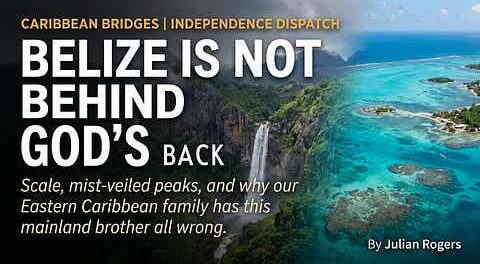
As Belize celebrates its Independence Day, here is what my Eastern Caribbean family gets wrong about the sheer scale, mountains, and majestic waters of our mainland brother.
Sep 20, 2026
Every time I travel across our region, someone invariably asks me the same question: “Julian, how does Belize compare to all those other places where you have lived, worked, and still call home?”
My immediate answer is always that comparison is a fool’s errand. Each country, each community across our region possesses its own distinct rhythm and soul. But let me clear up one enduring myth once and for all: Belize is not behind God’s back. Far from it. Belize is simply another magnificent corner of God’s paradise.
Yet, for my audience in the rest of the Caribbean, size matters, so let us put it into sharp perspective.
I cut my teeth in media across a vivid regional tapestry. I lived in tiny Montserrat back when it was an intact 39 square miles, learning to appreciate it as my very own miniature United Nations. I went on to Antigua and Barbuda, covering its 108 square miles, and I know every curve and parish of my native Barbados at 166 square miles. Later, my journey took me to Trinidad and Tobago, spanning nearly 2,000 square miles, and eventually to Jamaica, larger still.
None of that prepares an islander for the sheer territorial magnitude of Belize. We are talking about nearly 9,000 square miles of territory. To put that in terms my Bajan brothers and sisters can grasp, you could comfortably drop the entire island of Barbados inside Belize fifty times over, and you would still have room left over to tuck in Antigua, Barbuda, and Montserrat without touching the borders. It shares mainland company within CARICOM only with Guyana, but that comparison ends quickly once you look offshore. Belize possesses hundreds of cayes, with Ambergris Caye alone stretching nearly as long as Antigua.
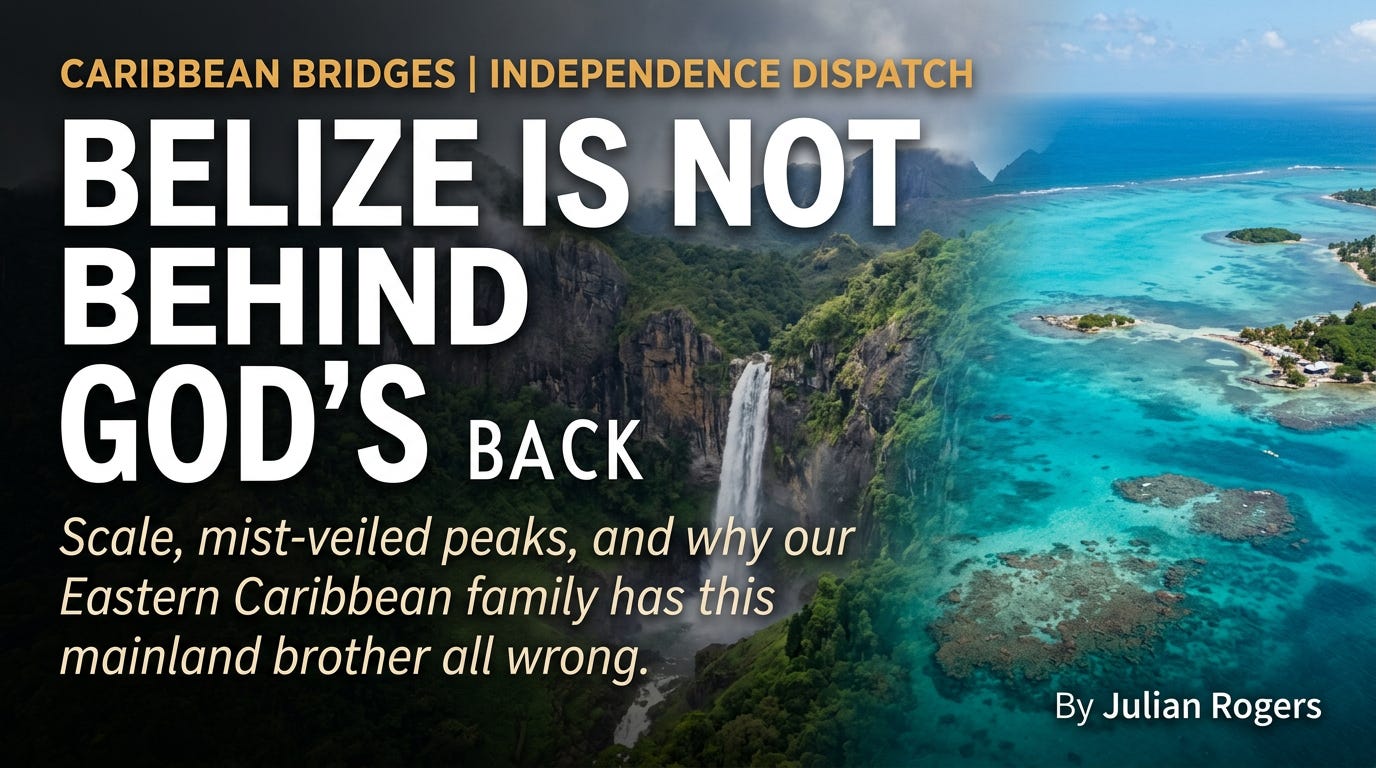
“You could comfortably drop the entire island of Barbados inside Belize fifty times over, and you would still have room left over to tuck in Antigua, Barbuda, and Montserrat.”
Nor is this vast expanse merely flat coastal plain or mangrove swamp. For those who think of the Caribbean only in terms of low-lying beaches and coral shelves, the interior of Belize is an astonishing revelation. The country rises majestically into the Maya Mountains and the rugged granite highlands of the Mountain Pine Ridge. Here, the humid Caribbean heat gives way to brisk mountain air, towering pine forests, and roaring rivers carving through limestone gorges. Hidden within these heights are spectacles that dwarf anything seen in our smaller islands, including waterfalls that plunge hundreds, even a thousand feet over sheer jungle cliffs into crystal pools below.
Across this vast landscape live roughly 400,000 people. You will find generational families alongside an influx of international retirees and adventurous young people drawn to the laid-back rhythm of island life. That modest population spread across such expansive geography means you have space, clean air, and unmatched agricultural potential.
Consider our endless regional talk about food security. We spend hundreds of millions importing frozen beef from Australia and New Zealand, yet Belize has enough cattle per square mile on its lush savannahs, plains, and valleys to supply the tables of CARICOM and anchor our collective self-reliance.
Geographically, Belize sits uniquely poised with one foot planted firmly in the Caribbean Sea and the other anchored in Central America. Bordered by Mexico and Guatemala, it literally straddles two distinct geopolitical spheres. You can pack your bags into a car here and drive straight through Mexico into the United States. That proximity explains why, while island folk naturally migrate to New York, Boston, and Miami, you find vibrant Belizean diasporas in Houston, Los Angeles, and across California.
Step onto Belizean soil, and you are greeted by an extraordinary cultural mosaic. Here you walk among the Garifuna, descendants of Afro-Indigenous ancestors exiled from St Vincent by the British, who settled along the Caribbean coast from Belize down to Nicaragua. You encounter the deepest concentration of ancient Mayan ruins anywhere on the planet, towering stone temples hidden beneath canopy forests, standing alongside their living descendants. You meet Mestizo communities, alongside families who fled regional conflicts in Guatemala and El Salvador decades ago.
Walk through any town, and your ear catches standard English, vibrant Kriol, melodious Spanish, and the resonant cadence of Garifuna, often within the span of a single block.
“Belize is not flat coastline and swamp. It rises into the cool elevations of the Mountain Pine Ridge and Maya Mountains, where thousand-foot waterfalls cascade through mist-shrouded rainforests.”
Then, of course, there is the food. Last year, while anchoring the Carifesta XV broadcasts on CBC television back in Barbados, I mentioned offhand to the television audience that an authentic breakfast in Belize can set you back just 2.50 US dollars, describing the hearty warmth of a fresh breakfast burrito. A lady in the audience was in sheer disbelief. But that burrito is merely an entry point to Belizean street food. Stewed beans are an undisputed national pillar, accompanying virtually everything. Meats arrive fresh from the rolling inland ranches, while red snapper, conch, and spiny lobster arrive straight from the Caribbean barrier reef, the second largest in the world.
Beyond the cuisine lies an unmatched natural heritage. Belize boasts an astonishing array of protected wildlife. You will not stumble across a jaguar wandering down the main street, though you can visit one at the Belize Zoo, but if you venture into the river valleys or dense jungle reserves, you will regularly cross paths with howler monkeys, tapirs, and toucans.
The relationship between land and community here inspired a phrase I find myself repeating often: Belize protects. Through an alliance of indigenous communities, dedicated conservationists, regional institutions, and international partners, vast swathes of pristine forest, roaring watersheds, and marine reserves remain fiercely safeguarded.
No, I do not hold a brief for the Belize Tourism Board. I write this simply as a Caribbean man who has built a life in yet another Caribbean home, eager to share its truth with my brothers and sisters across the waters.
In every territory where I have laid my hat, it is the people who ultimately define the country. Belize is no different. The people here are exceptionally generous, unfailingly courteous, and fiercely hardworking. They navigate the high cost of living that challenges our entire region, but they counter it with strong family bonds, lively Sunday tables, and deep national pride. What more could anyone ask for?
Belize 45th independence theme is “Look At Me: I Am Belize at 45”. I hope that my look at Belize makes you curious enough to learn more and come and experience this member of our CARICOM family.
Happy Independence Day, September 21st, Belize. May you continue to prosper, grow, and show the rest of our Caribbean family the true potential of our shared regional space.
Caribbean Bridges by Julian Rogers julian@caribbeanbridges.com
#Belize #BelizeIndependence #CARICOM #CaribbeanBridges #CaribbeanCulture #RegionalIntegration #TravelCaribbean #BelizeProtects
















Leave a comment
You must be logged in to post a comment.