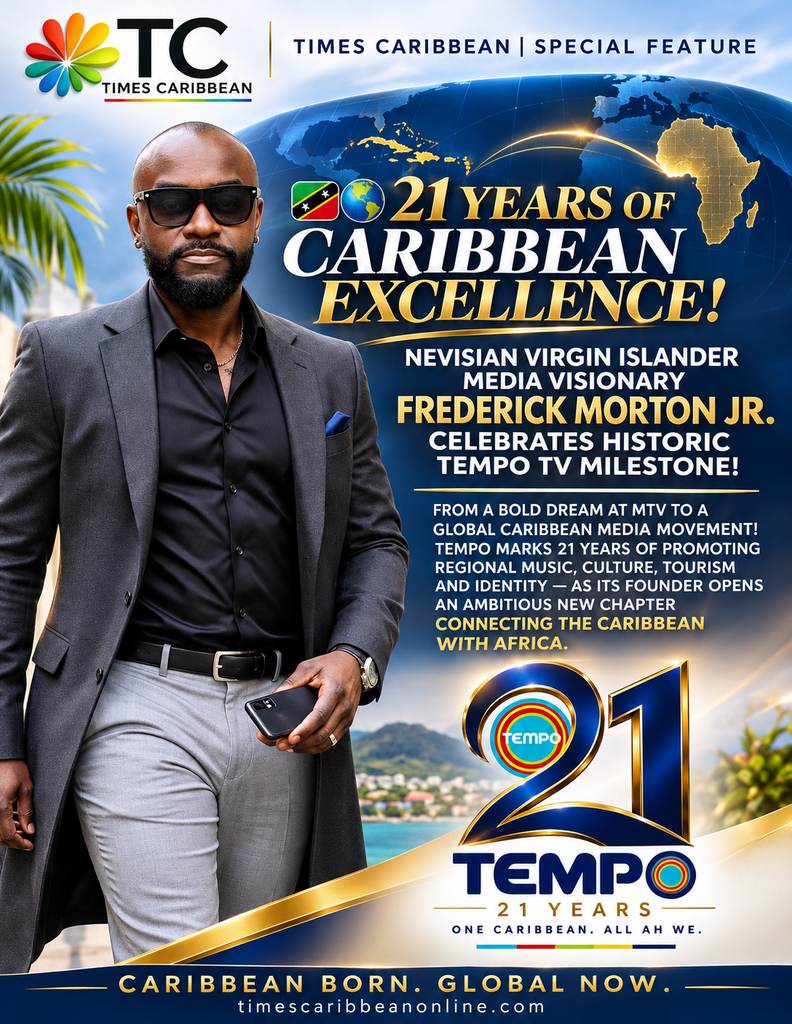
🇰🇳🌎 21 YEARS OF CARIBBEAN EXCELLENCE! NEVISIAN-ROOTED MEDIA VISIONARY FREDERICK MORTON JR. CELEBRATES HISTORIC TEMPO TV MILESTONE!FROM A BOLD DREAM AT MTV TO A GLOBAL CARIBBEAN MEDIA MOVEMENT!
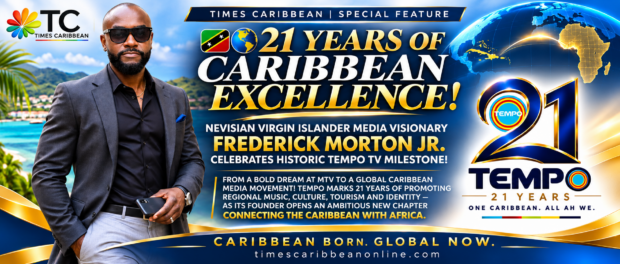
TEMPO MARKS 21 YEARS OF PROMOTING REGIONAL MUSIC, CULTURE, TOURISM AND IDENTITY — AS ITS FOUNDER OPENS AN AMBITIOUS NEW CHAPTER CONNECTING THE CARIBBEAN WITH AFRICA.TIMES CARIBBEAN | CULTURE, BUSI
BASSETERRE, ST. KITTS AND NEVIS — NOVEMBER 21, 2026
Twenty-one years ago, a Caribbean media revolution began with a simple but powerful conviction: the Caribbean deserved its own international television platform, its own cultural voice and the opportunity to tell its own stories to the world.
Today, that conviction has become a remarkable 21-year journey.
On Saturday, November 21, 2026, TEMPO Networks, the pioneering Caribbean music, entertainment and lifestyle television brand founded by Frederick A. Morton Jr., celebrates 21 years since its official broadcast debut on November 21, 2005.
For St. Kitts and Nevis, the anniversary carries special significance.
Morton, widely known as Mr. TEMPO, was born and raised in St. Croix, United States Virgin Islands, to Nevisian parents. His family roots in Nevis form an important part of his Caribbean identity and the vision that would eventually lead him from the corridors of corporate America to the forefront of regional media entrepreneurship.
And what a journey it has been.
From its beginnings within MTV Networks to its emergence as an independently owned Caribbean media company, TEMPO has developed into a platform connecting artists, filmmakers, musicians, tourism professionals, entrepreneurs and Caribbean communities throughout the region and its worldwide diaspora.
Its unmistakable message remains as relevant today as it was at its inception:
“ONE CARIBBEAN. ALL AH WE.”
THE DREAM THAT CHALLENGED INTERNATIONAL TELEVISION
To appreciate TEMPO’s significance, one must revisit the Caribbean media landscape of the early 2000s.
International television brands, particularly American music and entertainment channels, dominated much of the programming available to Caribbean viewers.
Reggae, dancehall, soca, calypso and other regional musical traditions were internationally influential, yet Caribbean artists did not have the same consistent access to major television distribution as their North American counterparts.
Caribbean culture travelled the world. But the region lacked a comparable international television institution dedicated to presenting that culture as its central product.
Morton recognized the opportunity.
An accomplished attorney and senior executive at MTV Networks, he understood both the cultural value of Caribbean entertainment and the corporate structures necessary to transform that value into a commercially viable media business.
His professional background was exceptional.
He earned undergraduate and law qualifications from Rutgers University and a master’s degree in public administration from Columbia University. His career included positions at the prestigious law firm Simpson Thacher & Bartlett, Johnson & Johnson, Viacom and MTV Networks.
By 2003, Morton had developed a proposal for a television network focused specifically on Caribbean culture.
He presented the concept to MTV executive Tom Freston. After approximately two years of advocacy and development, the project received the necessary corporate approval.
In May 2005, TEMPO was publicly announced during Caribbean Week in New York at a South Street Seaport celebration featuring Caribbean and international performers.
Among the artists associated with that launch were Wyclef Jean, Machel Montano, Rupee, Kevin Lyttle and other prominent entertainers.
Then came the defining moment.
On November 21, 2005, at 8 p.m., TEMPO began broadcasting.
The Caribbean finally had a dedicated channel within the MTV Networks family that placed its music, lifestyle and cultural experiences at the centre of the screen.
NEVIS WAS PART OF THE HISTORIC BEGINNING
For Nevisians, TEMPO’s history is especially meaningful because the island played a visible role in the channel’s historic Caribbean launch celebrations.
On October 30, 2005, a major TEMPO launch event was staged at the Mount Nevis Hotel in Newcastle, featuring internationally recognized entertainers and marking the culmination of a series of regional promotional events.
The celebration brought music-industry personalities, entertainment executives and media attention to the island.
This was more than an entertainment showcase.
It demonstrated that a small Caribbean island could participate meaningfully in the presentation of a major international media brand.
And the symbolism was powerful.
A media executive with Nevisian family roots was helping introduce the Caribbean to a television audience through a venture backed by one of the world’s most recognizable entertainment corporations.
For an island with a relatively small population, that connection represents an important chapter in the wider story of Caribbean achievement.
THE 2007 DECISION THAT CHANGED EVERYTHING
One of the most consequential moments in TEMPO’s development occurred not at its launch, but two years later.
In November 2007, an investor group led by Morton acquired the network from MTV Networks.
The transaction transformed TEMPO from a channel owned by a major American media conglomerate into a Caribbean-led independent enterprise.
This was a defining business decision.
Morton was no longer simply developing and managing Caribbean programming within an international corporation. He was taking direct entrepreneurial responsibility for the brand’s future.
That distinction matters.
Ownership affects who controls programming priorities, brand development, commercial partnerships and long-term strategic direction.
It also determines who participates in the financial benefits created by a successful media enterprise.
The management buyout therefore represented something larger than a corporate acquisition.
It was an important example of Caribbean participation in the ownership of Caribbean cultural distribution.
Building an independent television company, however, brought considerable challenges.
Regional advertising markets are fragmented. Broadcasting infrastructure is expensive. Content production requires sustained investment, while distribution depends on relationships with cable operators and other platforms.
Yet TEMPO continued developing its regional identity and expanding beyond traditional music-video programming.
Its survival and evolution across two decades illustrate both the possibilities and difficulties of creating an enduring Caribbean media business.
MORE THAN MUSIC: TEMPO’S CULTURAL CONTRIBUTION
TEMPO’s influence is not measured solely by the number of videos it has broadcast or entertainers it has featured.
Its larger contribution has been its sustained commitment to treating Caribbean culture as content worthy of international production, distribution and commercial development.
Through programmes such as Cross Caribbean Countdown, TEMPO created a recognizable television space for regional musical talent.
Other productions expanded into lifestyle, tourism, social affairs and the Caribbean diaspora.
Its programming portfolio has included Caribbean Dream, exploring Caribbean achievement abroad; The Road Ahead, examining regional issues; and Hip Hop Origins, highlighting the Caribbean’s contribution to the development of hip-hop culture.
The network also secured a Caribbean adaptation of the popular Hot Ones celebrity interview format, combining entertainment with regional cuisine, personalities and destination promotion.
These initiatives reflect an important transformation.
TEMPO was moving beyond the role of music broadcaster toward that of a broader cultural media company.
Its programmes provide opportunities to introduce audiences to the people, places and experiences behind the Caribbean’s entertainment industries.
For emerging artists, visibility on a recognized regional platform can strengthen professional credibility and potentially support future opportunities.
For the diaspora, Caribbean-centred media can reinforce cultural connection and identity.
And for the wider region, a shared media platform can help audiences discover neighbouring islands and cultural traditions that might otherwise receive limited attention.
THE ECONOMICS OF CULTURE: WHY TEMPO MATTERS
At 21, TEMPO’s relevance extends into one of the Caribbean’s most important development conversations: the creative economy.
Sometimes called the orange economy, this encompasses economic activity generated through music, film, broadcasting, fashion, festivals, design, intellectual property and other creative industries.
The Caribbean has produced entertainment of extraordinary international influence.
Reggae helped transform global popular music. Dancehall has influenced production styles and international chart trends. Soca provides the soundtrack to major festivals throughout the Caribbean and its diaspora.
Yet the financial returns generated by Caribbean creativity are not necessarily retained within Caribbean economies.
A successful song may generate revenue for streaming platforms, distributors, publishers, promoters, advertisers and intellectual-property owners operating across several countries.
That raises an important question.
How much of the economic value created by Caribbean talent ultimately remains with Caribbean artists, producers, companies and communities?
TEMPO represents one possible part of the answer.
Regional ownership of media platforms can create opportunities for locally driven advertising, production employment, content licensing, sponsorship, tourism marketing and commercial partnerships.
But visibility alone is insufficient.
To translate cultural popularity into sustainable prosperity, Caribbean creative enterprises require sound business models, reliable distribution, professional production capabilities, enforceable intellectual-property rights and access to investment.
A channel may promote an artist. A sustainable industry must also help that artist earn income, retain rights and develop a long-term career.
This distinction is important as TEMPO enters its next stage.
Its significance lies not only in celebrating the Caribbean, but also in helping demonstrate how Caribbean culture can support durable commercial enterprises.
2026: TEMPO STRENGTHENS ITS TOURISM CONNECTIONS
The anniversary year has also brought notable business and institutional developments.
On June 12, 2026, TEMPO Networks and the Caribbean Tourism Organization announced an expanded strategic partnership during Caribbean Week in New York.
The agreement aims to strengthen destination storytelling, digital coverage, tourism promotion and cultural programming through broadcast and social media platforms.
The collaboration includes opportunities surrounding Caribbean Week, tourism conferences, regional events and other activities involving CTO member destinations.
The relationship builds on links dating back to TEMPO’s introduction in 2005.
Recent collaborations have included festival coverage in the United States Virgin Islands, tourism promotions involving Barbados and the British Virgin Islands, and destination-focused entertainment programming with Saint Lucia.
This direction reflects a wider shift in destination marketing.
Modern travellers increasingly discover destinations through music, food, festivals, online personalities and authentic cultural experiences rather than conventional advertisements alone.
TEMPO is strategically positioned to connect those elements.
Nevertheless, successful tourism promotion must ultimately be evaluated through measurable outcomes, including audience engagement, visitor interest, business participation and actual economic benefits.
For smaller destinations such as St. Kitts and Nevis, the opportunity is particularly relevant.
Strong cultural storytelling can create international visibility without requiring the advertising budgets available to major tourism markets.
FROM THE CARIBBEAN TO AFRICA: AN AMBITIOUS NEW CHAPTER
Perhaps the most symbolically significant development of TEMPO’s 21st anniversary year is its expansion toward Africa.
On August 17, 2026, the company announced the launch of TEMPO Africa, through a strategic partnership with Lusaka Carnival in Zambia.
Under the multi-year arrangement, TEMPO was named the festival’s official and exclusive strategic Caribbean partner.
The agreement covers Caribbean artist engagement, cultural exchange, marketing, media promotion and longer-term collaboration.
Significantly, the inaugural Lusaka Carnival was scheduled for November 20–21, 2026 — coinciding with TEMPO’s 21st birthday.
The initiative reflects Morton’s ambition to connect Caribbean creative industries with African audiences and partners.
The cultural logic is compelling.
Caribbean musical traditions are closely connected to African history and artistic expression, while contemporary African genres have increasingly influenced Caribbean music and entertainment.
The commercial possibilities are also considerable.
There are potential opportunities for joint productions, international performances, tourism packages, festival collaborations, music distribution and emerging creative businesses.
But successful expansion will depend on execution.
Partnership announcements must eventually produce accessible opportunities, sustainable commercial arrangements and tangible benefits for participants on both sides.
If developed effectively, TEMPO Africa could become an important additional channel for Caribbean cultural exports.
THE DIGITAL FUTURE: CAN TEMPO COMPETE IN A STREAMING WORLD?
When TEMPO launched in 2005, cable television remained a dominant form of mass entertainment distribution.
Twenty-one years later, the competitive landscape is dramatically different.
YouTube, TikTok, Instagram, subscription streaming services and music platforms have transformed how people discover and consume entertainment.
Audiences increasingly expect content to be available whenever they want it, on whichever device they choose.
TEMPO has responded by expanding its digital presence and introducing TEMPO+, a streaming platform announced in connection with its 17th anniversary in 2022.
The company also maintains online programming and social media operations.
In a 2025 interview, Morton reported that TEMPO’s combined social media communities exceeded one million followers across its wider network of accounts.
The company’s website has described its cable distribution as extending across 24 Caribbean islands, reaching approximately three million viewers, although those figures should be understood as company-reported estimates rather than independently audited current audience totals.
These developments point to a business in transition.
TEMPO’s traditional broadcasting experience gives it established cultural relationships and an archive of regional programming.
However, successful digital competition requires more than moving television programmes online.
It requires distinctive content, frequent releases, audience analytics, discoverability, effective monetization and an ability to attract younger viewers whose media habits differ significantly from those of previous generations.
The question for TEMPO’s next decade is therefore not simply how many people recognize the brand.
It is how effectively that recognition can be converted into a thriving, digitally competitive and financially sustainable media ecosystem.
FREDERICK MORTON JR.: A MODEL OF CARIBBEAN ENTREPRENEURIAL LEADERSHIP
Morton’s story carries important lessons for young professionals and entrepreneurs throughout St. Kitts and Nevis.
He did not begin his career as a television presenter or music producer.
He built expertise in law, corporate management, negotiation and intellectual property before applying those skills to a cultural business opportunity.
That combination proved significant.
He understood how major media companies functioned, how partnerships could be structured and how a culturally distinctive concept might attract international corporate support.
He also recognized the importance of ownership.
The decision to acquire TEMPO from MTV demonstrated a willingness to move beyond corporate employment and assume the responsibilities associated with independent entrepreneurship.
His achievements received recognition in 2020 when the Institute of Caribbean Studies presented him with a Caribbean-American Heritage Trailblazer Award.
His career illustrates a wider lesson: Caribbean professionals can use international education and corporate experience to build institutions serving their home region.
That is especially relevant for small island economies seeking to diversify beyond conventional industries.
WHAT THE NEXT 21 YEARS SHOULD REPRESENT
TEMPO’s anniversary is an opportunity for celebration.
But it is also an opportunity to examine what the next phase of Caribbean media development should look like.
The region needs stronger investment in film, music, television and digital production. It needs better access to training and production technology, stronger distribution arrangements and more sustainable pathways for young creatives.
There is also a compelling argument for closer collaboration between regional broadcasters, tourism authorities, educational institutions and private investors.
TEMPO’s experience offers useful lessons because it has operated across several phases of media evolution — from the cable television era to contemporary digital distribution.
Its next chapter may ultimately be judged by how effectively it supports emerging Caribbean talent, develops valuable original intellectual property, expands international partnerships and strengthens the commercial foundations of regional cultural production.
For St. Kitts and Nevis, there is a further opportunity to examine how Nevisian-rooted international success can inspire practical initiatives in youth entrepreneurship, filmmaking, digital media and cultural tourism.
ONE CARIBBEAN. ALL AH WE. TWENTY-ONE YEARS LATER.
As TEMPO celebrates 21 years, Frederick Morton Jr.’s achievement deserves recognition within the wider history of Caribbean business, culture and international media.
He helped turn an idea conceived inside a multinational entertainment corporation into an independent Caribbean-focused brand with a presence across multiple markets.
He championed regional music and identity when dedicated international distribution opportunities were relatively limited.
And he continued developing the enterprise as the media industry itself underwent profound changes.
There have undoubtedly been challenges, as there are for any independent company navigating an evolving entertainment marketplace.
Yet the endurance of the TEMPO brand remains significant.
For Nevis, it is a story of family roots reaching onto the international media stage.
For St. Kitts and Nevis, it is another reminder that the Federation’s influence extends far beyond its geographic size.
For the Caribbean, it is a demonstration of what can happen when cultural confidence meets professional expertise, entrepreneurial ambition and a willingness to build something lasting.
Twenty-one years. One Caribbean vision. A worldwide cultural journey.
As the anniversary message declares:
CARIBBEAN BORN. GLOBAL NOW.
And the legacy of Frederick Morton Jr. and TEMPO Networks continues to be written.
TIMES CARIBBEAN | SPECIAL ANNIVERSARY FEATURE | NOVEMBER 21, 2026
















Leave a comment
You must be logged in to post a comment.