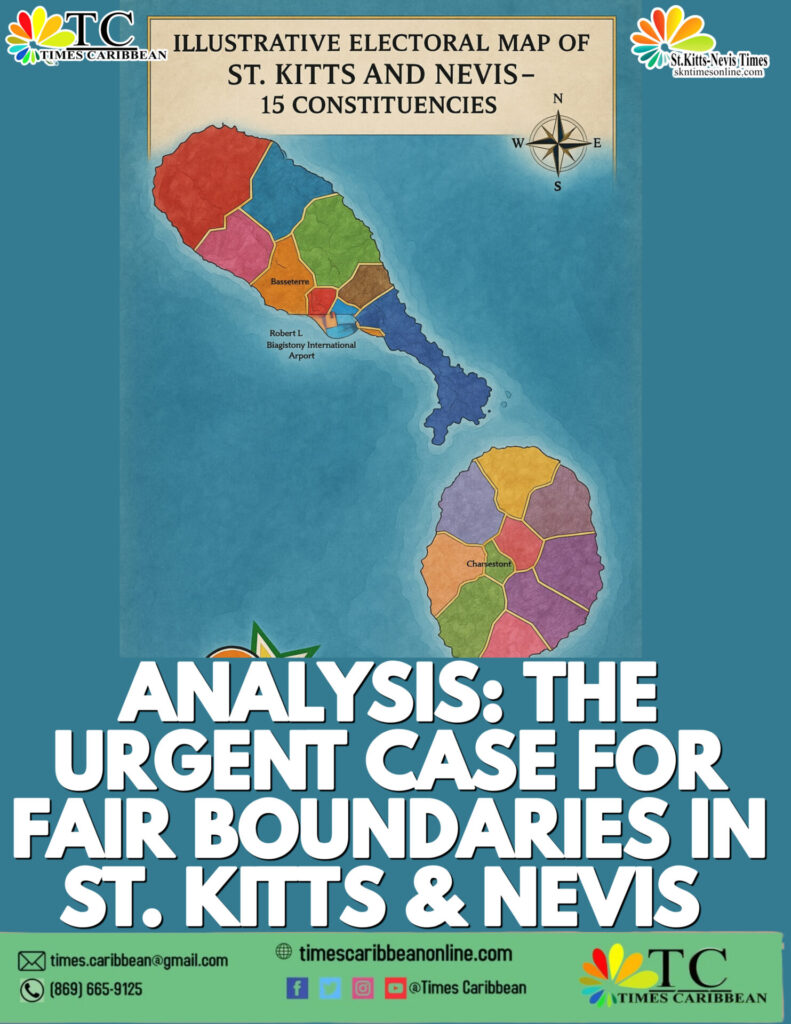
ANALYSIS: THE URGENT CASE FOR FAIR BOUNDARIES IN ST. KITTS & NEVIS

By Political Observer
The silence is deafening.
More than a year since the Constituency Boundaries Commission was ceremoniously appointed in May 2024, not a single update has been made public. No press releases. No community consultations. No proposals. Just an eerie blackout from a body tasked with one of the most critical responsibilities in any functioning democracy — the fair and timely review of electoral boundaries.
This silence is not just troubling — it is dangerous.
Why Constituency Boundaries Matter
Constituency boundaries are the invisible lines that shape our democracy. They determine:
- How many representatives are elected to speak on behalf of the people in Parliament.
- Which communities belong to which electoral district.
More importantly, boundaries must reflect population equality — that is, each vote should carry approximately the same weight. This is not an option; it is a constitutional requirement.
And yet, the glaring disparities in constituency populations in St. Kitts and Nevis today expose a system that is fundamentally flawed and ripe for constitutional challenge.
The Current Crisis: Population Imbalance
Take Constituency No. 8 in St. Kitts — it has over 9,000 inhabitants.
Compare that to Constituency No. 5, with just 2,969 people.
In Nevis, the pattern continues:
- Constituency No. 9 = 6,304
- Constituency No. 10 = 2,323
This is not simply inequality. This is electoral malpractice by omission.
The Constitution is clear: constituencies must be as equal in population as practicable. The current disparities are not minor — they are unconstitutional and undermine the principle of “one person, one vote.”
A History of Delay and Dysfunction
Since 1989, there have been four failed attempts to reform boundaries, most notably in 2009, each time ending in controversy, litigation, or political impasse.
Now, with less than two years before the next general election, we risk entering another cycle of democratic dysfunction, unless urgent action is taken.
The Case for Reform: Two Key Recommendations
1. Increase the number of elected seats:
- St. Kitts should move from 8 to 10 constituencies.
- Nevis should move from 3 to 5 constituencies.
This is not unprecedented. Consider our regional peers:
| Country | Population | Elected Reps |
|---|---|---|
| Montserrat | 4,680 | 9 |
| Anguilla | 15,000 | 11 |
| BVI | 30,000 | 13 |
| TCI | 49,000 | 19 |
| St. Kitts & Nevis | 51,000 | 11 (current) |
We are significantly underrepresented — despite having a larger population than all of the above.
2. Realign constituencies to population averages:
- St. Kitts (pop. 38,138) with 10 seats = ~3,814 people per seat
- Nevis (pop. 13,182) with 5 seats = ~2,636 per seat
Under this model, Constituency 8 (9,008 people) and Constituency 9 (6,304) are egregiously oversized and must be immediately redrawn.
Where Is the Commission?
With each passing month of inaction, the Commission risks being complicit in eroding public trust, enabling malapportionment, and violating constitutional norms.
The lack of transparency is indefensible. Are meetings being held? What criteria are guiding their review? Where is the opportunity for public consultation during the formative stages?
A credible Commission would, at minimum, issue:
- A public work plan
- Progress updates
- A timeline for consultation and draft proposals
Democracy thrives on sunlight, not shadows.
What Must Happen Now
- The Boundaries Commission must break its silence and immediately engage the public.
- Draft recommendations must be made available for scrutiny before they are final.
- Parliament must prepare for a debate and decision on any proposed boundary changes well ahead of the election cycle.
- The Electoral Commission must be briefed and empowered to manage voter registration based on updated boundaries.
The Warning
If nothing changes, the next election will be held under unconstitutional conditions, leaving the door wide open for legal challenges, political instability, and a crisis of legitimacy.
That would be a tragedy — and a self-inflicted one.
Democracy Needs Maintenance
Just as roads crumble without upkeep, democracy falters when its structures are ignored. Constituency boundaries are not just bureaucratic lines. They are the foundation of electoral fairness. And right now, those foundations are cracking.
It’s time to fix it — before the next election becomes another chapter in our history of missed opportunities.
Our democracy demands it. The people deserve it. The Constitution requires it.
















Leave a comment
You must be logged in to post a comment.