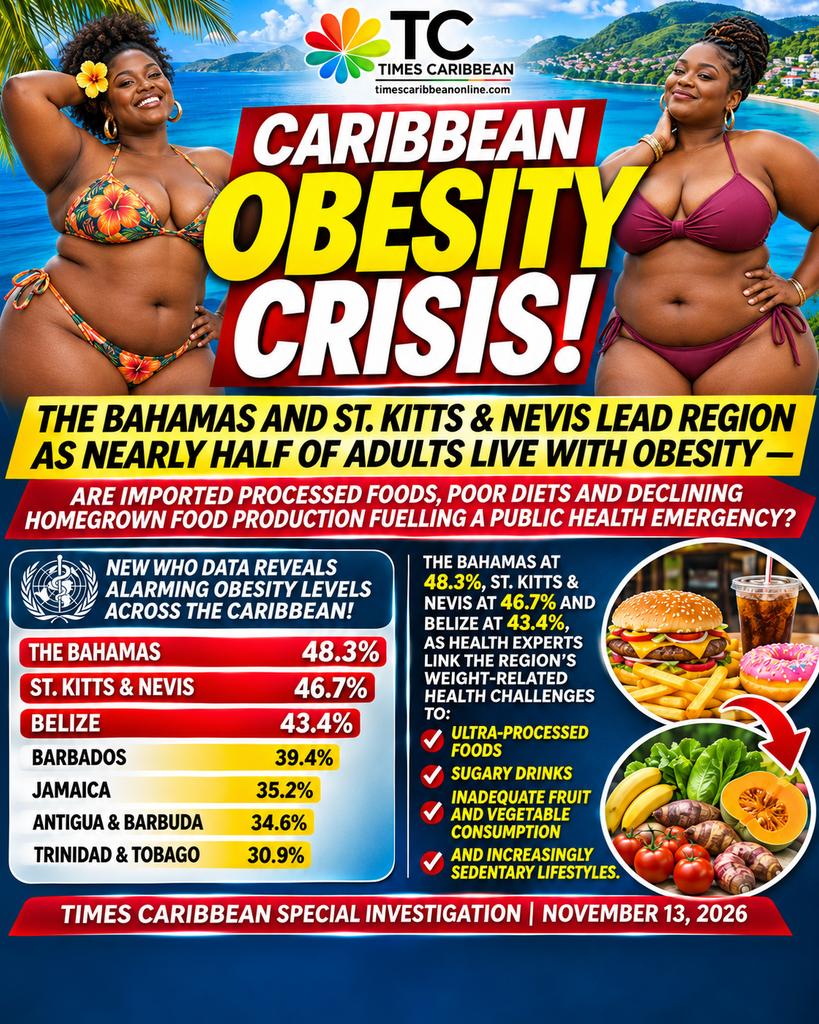
CARIBBEAN OBESITY CRISIS! THE BAHAMAS AND ST. KITTS & NEVIS LEAD REGION AS NEARLY HALF OF ADULTS LIVE WITH OBESITY — ARE IMPORTED PROCESSED FOODS, POOR DIETS AND DECLINING HOMEGROWN FOOD PRODUCTION FUELLING A PUBLIC HEALTH EMERGENCY?

NEW WHO DATA REVEALS ALARMING OBESITY LEVELS ACROSS THE CARIBBEAN! THE BAHAMAS AT 48.3%, ST. KITTS & NEVIS AT 46.7% AND BELIZE AT 43.4%, AS HEALTH EXPERTS LINK THE REGION’S WEIGHT-RELATED HEALTH CHALLENGES TO ULTRA-PROCESSED FOODS, SUGARY DRINKS, INADEQUATE FRUIT AND VEGETABLE CONSUMPTION, AND INCREASINGLY SEDENTARY LIFESTYLES.
TIMES CARIBBEAN SPECIAL INVESTIGATION | NOVEMBER 13, 2026
BASSETERRE, ST. KITTS, November 13, 2026 (Times Caribbean) — The Caribbean is facing a deeply troubling public health challenge. Two of the region’s most recognisable island nations, The Bahamas and St. Kitts and Nevis, are recording some of the highest adult obesity rates anywhere in the Americas, raising serious questions about what Caribbean people are eating, the food being imported into the region, and whether governments are doing enough to make nutritious, locally produced food accessible and affordable.
The figures are striking.
According to 2024 age-standardised estimates from the World Health Organization’s Global Health Observatory, published in its 2026 data update, approximately 48.3% of adults in The Bahamas and 46.7% in St. Kitts and Nevis live with obesity.
Belize follows at 43.4%, while Puerto Rico and Barbados also record particularly high rates.
These estimates place The Bahamas and St. Kitts and Nevis at the top of the WHO’s adult obesity standings among Caribbean countries, ahead of the United States, which records approximately 41.0% in the same dataset. PiSpace Open Data+2
And this is about far more than body weight.
It is about diabetes, cardiovascular disease, rising healthcare costs, preventable illness, declining quality of life and the growing financial pressure placed on households and national health systems.
But it is also about something much bigger.
The Caribbean’s food system is changing, and the consequences are becoming increasingly difficult to ignore.
THE NUMBERS: A REGION STRUGGLING WITH OBESITY
WHO 2024 | AGE-STANDARDISED ADULT OBESITY ESTIMATES
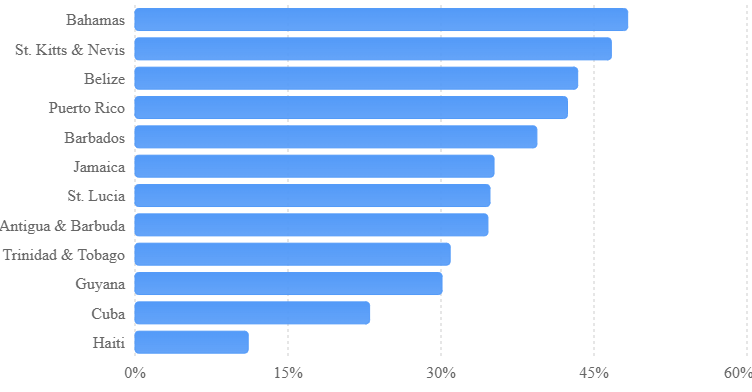
Source: WHO Global Health Observatory, 2026 data update. Figures rounded to one decimal place.
Selected Caribbean countries and territories, using a consistent WHO dataset. Obesity is generally defined as a body mass index of 30 or above. Age-standardisation supports cross-country comparison; these are modelled population estimates, not individual diagnoses. ObesitySurvey+1
Even within the wider Caribbean, the contrasts are substantial. The Bahamas and St. Kitts and Nevis are approaching the point where nearly one out of every two adults is estimated to be living with obesity, while Cuba and Haiti record substantially lower rates.
These differences deserve investigation. They may reflect variations in food environments, household income, urban development, diets, physical activity, demographic conditions and wider social and economic factors.
They should not, however, be interpreted as proof that any single factor explains why one country has a higher obesity rate than another.
The WHO’s 2022 country estimates also recorded obesity prevalence of 46.9% in The Bahamas and 45.5% in St. Kitts and Nevis. The later 2024 estimates suggest the problem remains substantial and may be worsening. datadot+1
THE CARIBBEAN’S FOOD PARADOX: SURROUNDED BY FERTILE LAND AND SEA, YET DEPENDENT ON IMPORTED FOOD
Across the Caribbean, generations grew up with diets that included fresh fish, ground provisions, peas, beans, vegetables, fruits and other locally produced foods.
Today, many Caribbean households operate in a very different food environment.
Imported packaged meals, sweetened beverages, fried fast foods, processed meats, snack products and refined carbohydrates are widely available, often heavily promoted and frequently more convenient than preparing a balanced meal from fresh ingredients.
For a family balancing work, transportation, school expenses, electricity bills and the rising cost of living, convenience and price can determine what ends up on the dinner table.
A published regional public health study on food and nutrition security in CARICOM identified a major dietary transition toward imported, energy-dense, ultra-processed foods high in sugar, salt and unhealthy fats.
The same research highlighted inadequate consumption of fruits, vegetables and fibre, combined with physical inactivity, as important contributors to the region’s obesity challenge. PubMed Central (PMC)+1
This is a serious structural issue.
A person may want to eat more healthily but struggle to afford fresh produce, access a nearby market or find the time and facilities needed to prepare nutritious meals.
The question, therefore, cannot simply be whether Caribbean citizens are making healthy choices.
It must also be whether the Caribbean food environment is making healthy choices easy, affordable and realistic.
ST. KITTS AND NEVIS: IMPORTING FOOD WHILE STRUGGLING WITH OBESITY
For St. Kitts and Nevis, the relationship between agriculture, food imports and public health deserves particular attention.
The Federation’s own Sustainable Island State Agenda acknowledges its substantial dependence on imported food.
According to the government’s food security policy information, imports accounted for approximately 80% of national food requirements in 2017, while agriculture’s contribution to economic output remains below 1%.
That 80% figure is a historical benchmark, not a verified measurement of the country’s food import dependence in 2026. Nevertheless, it illustrates the structural challenges policymakers have been attempting to address. St. Kitts and Nevis
The government’s Agricultural Transformation and Growth Strategy 2022–2031 seeks to revitalise local agriculture, improve food production, promote healthier eating and reduce vulnerability to international supply disruptions.
Yet an important distinction must be made.
Imported food is not automatically unhealthy. Frozen vegetables, fresh imported fruits, beans, whole grains and many other nutritious products contribute positively to healthy diets.
Likewise, locally produced food is not automatically healthier if it is heavily sweetened, fried or prepared with excessive salt.
The real concern is the combination of heavy food import dependence, widespread availability of inexpensive calorie-dense products, inadequate access to nutritious foods and changing dietary habits.
St. Kitts and Nevis’ own national development reporting has connected obesity concerns to the availability and cost of nutritious foods relative to imported processed products. HLPF+1
That makes obesity not merely a healthcare issue but also an agricultural, economic and social policy challenge.
ARE CARIBBEAN CHILDREN GROWING UP IN AN UNHEALTHY FOOD ENVIRONMENT?
The challenge begins long before adulthood.
Across the Caribbean, children encounter highly marketed snack foods, sweetened drinks and processed meals at home, at school, in shops and through digital advertising.
A 2026 Pan American Health Organization examination of school food environments in Jamaica highlighted how readily available snack foods and sweetened beverages can shape children’s daily eating habits.
It also underlined the need for stronger nutrition standards in and around schools. Pan American Health Organization+1
This matters for St. Kitts and Nevis because habits developed during childhood can influence health throughout adulthood.
A schoolchild who regularly chooses a sugary drink and packaged snacks over water, fruit or a balanced meal is being influenced by a food environment that extends beyond personal preference.
Price matters. Availability matters. Advertising matters.
So does what schools and communities make convenient.
An effective national response could include healthier school meals prepared with locally grown produce, standards for foods sold on school compounds, stronger nutrition education and improved access to safe recreational spaces.
THE HIDDEN COST: DIABETES, HEART DISEASE AND PRESSURE ON NATIONAL HEALTH BUDGETS
The consequences of widespread obesity extend far beyond individual households.
Obesity is a major risk factor for type 2 diabetes, hypertension, cardiovascular disease and several other chronic medical conditions.
Not everyone living with obesity develops these illnesses, and weight alone does not determine a person’s health. But high obesity prevalence across an entire population increases the need for preventive healthcare, screening and long-term medical support.
According to the World Bank, noncommunicable diseases accounted for approximately 75% of deaths in the Caribbean in the historical figures referenced in its 2024 assessment.
The Bank also reported estimates placing the economic burden of these diseases between 1.36% and 8% of gross domestic product in Caribbean countries, depending on the setting and methodology. World Bank
For small nations, these costs carry serious implications.
More resources may be required for medication, specialist care, dialysis, diagnostic services and management of long-term complications.
Families can face additional transportation expenses, lost working hours and out-of-pocket medical bills.
Employers may experience reduced productivity when workers become ill or need extended care.
The challenge is therefore both human and economic.
Preventing chronic illness is not only about improving health outcomes. It can also help protect household finances and the sustainability of national healthcare systems.
THE BAHAMAS AND ST. KITTS AND NEVIS ARE NOT ALONE
Although the two countries lead the Caribbean obesity standings, the broader regional picture is equally concerning.
The 2024 WHO estimates place Barbados at approximately 39.4%, Jamaica at 35.2%, St. Lucia at 34.8% and Antigua and Barbuda at 34.6%.
These are substantial figures.
The fact that The Bahamas and St. Kitts and Nevis rank higher must not distract from the wider regional challenge.
A regional comparison
Bahamas
48.3%
Adult obesity, 2024
St. Kitts & Nevis
46.7%
Adult obesity, 2024
United States
41.0%
For comparison
Haiti
11.1%
Lower prevalence, not a measure of food security
Comparable WHO 2024 age-standardised estimates. Lower obesity prevalence does not necessarily mean better nutrition or overall population health. ObesitySurvey+1
Haiti’s relatively low obesity estimate is an important example of why the statistics require careful interpretation.
Low obesity prevalence can coexist with food insecurity, undernutrition and poverty.
A healthy nation is not simply one where fewer people live with obesity. It is one where citizens have dependable access to enough nutritious food, appropriate healthcare and conditions that support healthy living.
CARICOM’S FOOD IMPORT BILL: A MULTIBILLION-DOLLAR CHALLENGE
The Caribbean’s food production challenge has already attracted regional political attention.
CARICOM’s original 25 by 2025 initiative sought to reduce the region’s food import bill by 25%.
In February 2025, CARICOM leaders extended the initiative to 2030, recognising continuing challenges involving food production, trade, climate vulnerability and regional food security.
CARICOM described the region’s food import bill as exceeding US$6 billion when discussing the initiative. CARICOM+1
But reducing food imports and improving nutrition are not necessarily the same thing.
A region could produce more food domestically without meaningfully reducing obesity if its growing food supply continues to be dominated by nutritionally poor products.
Likewise, lowering the value of food imports would not automatically improve diets if households still cannot afford balanced meals.
A successful regional food strategy must therefore connect agricultural development with public health.
Farmers need stronger markets. Consumers need affordable nutritious options. Schools, hospitals, hotels and supermarkets can help create dependable demand for locally grown produce.
That approach has the potential to support livelihoods while improving the food choices available to families.
THE ROLE OF SUPERMARKETS, RESTAURANTS AND FOOD IMPORTERS
The private sector has an important role in shaping Caribbean diets.
Food retailers determine which products occupy prominent shelf space. Manufacturers and importers influence the types of packaged products available. Restaurants and food vendors help shape portion sizes, cooking methods and everyday consumption patterns.
These businesses can contribute to healthier food environments without eliminating consumer choice.
Clearer nutrition information, reasonable portions, lower-sodium options, affordable vegetables, reduced-sugar beverages and increased purchasing from local farmers can all make a difference.
The Pan American Health Organization has been supporting clearer front-of-package nutrition warnings across the Caribbean so consumers can more easily identify products containing excessive sugar, sodium or unhealthy fats. Pan American Health Organization+1
This is especially important when products are marketed as healthy despite containing high levels of nutrients associated with increased chronic disease risk.
Consumers should not need specialised nutrition training to understand what they are purchasing.
PHYSICAL ACTIVITY: ANOTHER PART OF THE EQUATION
Diet is central to the obesity discussion, but it is not the only factor.
Physical activity, sleep, genetics, medications, socioeconomic circumstances and other biological and environmental influences all contribute to body weight.
In some Caribbean communities, employment patterns have shifted toward office work, retail, driving and other activities involving extended periods of sitting.
Where sidewalks, safe recreational spaces, accessible parks and affordable sporting facilities are limited, maintaining an active lifestyle can become more difficult.
Caribbean governments therefore need to examine community planning and recreation alongside nutrition policy.
Walking programmes, accessible sporting facilities, school physical education, community exercise initiatives and safe public spaces all have potential benefits.
The objective should be better health for everyone, without stigma or discrimination toward people based on body size.
WHAT SHOULD CARIBBEAN GOVERNMENTS PRIORITISE?
The research points toward an integrated public health response rather than isolated awareness campaigns.
Six areas deserve serious national and regional consideration:
1. Expand affordable local food production. Support farmers, irrigation, protected agriculture, storage facilities, farm-to-market distribution and reliable procurement arrangements.
2. Strengthen school nutrition. Ensure children can access balanced meals, drinking water and healthier food choices, while reviewing the availability and promotion of high-sugar products in school environments.
3. Make food labels easier to understand. Advance evidence-based front-of-package nutrition warnings and stronger consumer education.
4. Review fiscal incentives and disincentives. Examine evidence-based measures, including taxes on sugary drinks and policies that make nutritious foods more affordable, while considering impacts on lower-income households.
5. Invest in prevention and physical activity. Expand early screening, community health services, nutrition counselling, physical education and accessible recreational opportunities.
6. Publish measurable national targets. Regularly report adult and childhood obesity estimates, dietary trends, food affordability, school nutrition outcomes and progress in domestic agricultural production.
Evidence from PAHO’s 2026 regional report supports appropriately designed taxes on sugar-sweetened beverages as one tool within a broader strategy. Such measures should be assessed alongside education, food access and other public health interventions. Pan American Health Organization
No single policy will reverse decades of dietary and lifestyle changes.
But coordinated, adequately funded measures could help countries begin changing the environment that contributes to poor nutritional outcomes.
THE BIG QUESTION FOR ST. KITTS AND NEVIS: ARE WE GROWING ENOUGH OF THE FOOD OUR PEOPLE NEED?
For St. Kitts and Nevis, the latest obesity estimates present an opportunity to examine the relationship between national development, agriculture and healthcare.
The Federation has set ambitions for agricultural transformation and reduced food import dependence.
Now the public health implications deserve equal attention.
How much locally produced fruit and vegetables are reaching supermarket shelves?
Are farmers receiving sufficient support to meet consistent demand?
Can families purchase nutritious meals at affordable prices?
Are schools providing healthy food environments?
And are health, agriculture, education and trade policies working together toward measurable improvements in nutrition?
These are not questions that can be answered through obesity rankings alone.
They require transparent public data, consistent policy implementation and constructive engagement between government ministries, farmers, retailers, healthcare professionals, educators and communities.
A WAKE-UP CALL FOR THE ENTIRE CARIBBEAN
The Bahamas and St. Kitts and Nevis are now estimated to have some of the highest adult obesity prevalence rates in the world outside the Pacific region.
That is an important warning sign.
But it is not a reason to shame citizens or reduce a complex health challenge to individual discipline.
The evidence points to a broader problem involving food affordability, changing diets, the commercial food environment, physical activity and the economic systems that influence everyday choices.
For too long, the Caribbean’s food security debate has concentrated heavily on the cost and quantity of imported food.
The quality and nutritional value of that food deserve just as much attention.
Producing more locally grown vegetables, fruits and other nutritious staples could contribute to healthier, more resilient food systems. But doing so must be part of a wider strategy that addresses affordability, education, healthcare and consumer access.
The Caribbean cannot measure food security only by how much food is available. It must also consider whether that food is helping its people live healthier lives.
The latest numbers from The Bahamas and St. Kitts and Nevis make the urgency of that conversation difficult to overlook.
Times Caribbean — Public Health, Caribbean Development, Agriculture and Regional Affairs.
Research and source notes
The percentages in the submitted graphic appear to combine estimates from different years and sources. For consistency, this article uses WHO’s 2024 age-standardised estimates, as published in its 2026 data update. These estimates are modelled, may be revised and should not be interpreted as direct national census counts.
Primary research references include the WHO Bahamas country profile, WHO St. Kitts and Nevis country profile, PAHO overweight and obesity surveillance, CARICOM food security initiative, and World Bank analysis of noncommunicable diseases in the Caribbean.
















Leave a comment
You must be logged in to post a comment.