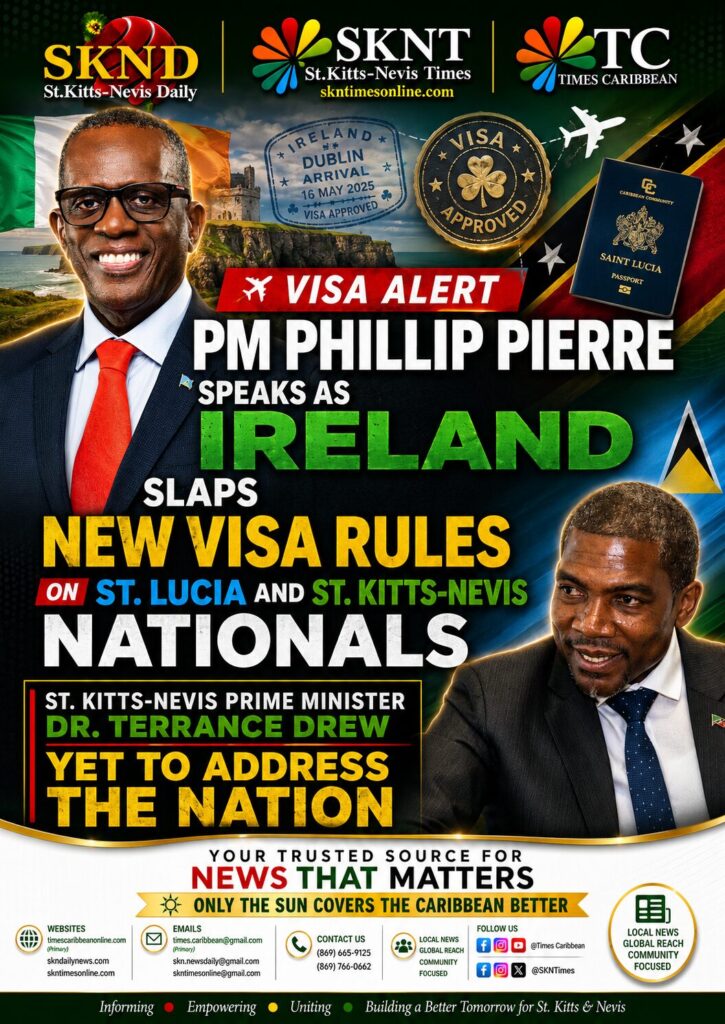
PM PHILLIP PIERRE SPEAKS AS IRELAND SLAPS NEW VISA RULES ON ST.LUCIA AN ST.KITTS-NEVIS NATIONALS; ST. KITTS-NEVIS PRIME MINISTER DR TERRANCE DREW YET TO ADDRESS THE NATION

CASTRIES, Saint Lucia / BASSETERRE, St. Kitts — In a major travel and diplomatic development now reverberating across the Eastern Caribbean, Saint Lucia’s Prime Minister, Hon. Philip J. Pierre, has publicly addressed his nation on Ireland’s new visa restrictions, while in St. Kitts and Nevis, Prime Minister Dr. Terrance Drew has, so far, remained publicly silent on the issue.
Effective Monday, June 15, 2026, nationals of Saint Lucia, Saint Kitts and Nevis, and Nicaragua will now require visas to enter Ireland. The change affects holders of ordinary, diplomatic, and service passports. Persons transiting through Ireland will also require a transit visa.
For Saint Lucians, the matter was brought directly to the public by Prime Minister Pierre during Monday’s Pre-Cabinet Press Briefing. According to the Saint Lucia Prime Minister, his government received official notification from the Embassy of Ireland in Ottawa, Canada, on Friday, June 12, advising that the new restrictions would take effect from June 15.
The announcement immediately raises practical concerns for students, business travellers, families, diplomats, sports delegations, and citizens with onward travel plans through Ireland.
Ireland has indicated that transitional arrangements will apply for certain travellers who booked their trips before June 15, 2026, and who are scheduled to enter and leave Ireland before July 14, 2026. Those travellers may still be permitted to travel under the previous arrangements, provided they can produce the necessary documentation, including a valid passport and proof of booked travel.
However, for anyone booking travel after June 15, the new visa requirement applies.
The Irish authorities have described the measure as part of a broader effort to keep Ireland’s immigration controls more closely aligned with the United Kingdom, Great Britain, Northern Ireland, and the Schengen Area.
For Saint Lucia, the government has moved quickly to inform citizens and advise those intending to travel to Ireland to review the requirements and submit applications well in advance. Visa applications are expected to be submitted with supporting documents to the Embassy of Ireland in Ottawa, Canada, by courier. Processing times are estimated at approximately eight to ten weeks.
The standard visa application fees are listed as CAD $100 for a single-entry visa, CAD $165 for a multiple-entry visa, and CAD $35 for a transit visa.
But while Saint Lucia has placed the issue before its citizens, many in St. Kitts and Nevis are now asking why there has not yet been a similar public national briefing from Prime Minister Dr. Terrance Drew or the relevant authorities in Basseterre.
The Federation is directly named in Ireland’s new visa requirement. This means that Kittitians and Nevisians are facing the same loss of visa-free access to Ireland as Saint Lucians. Yet, as of the preparation of this article, the public has not received a major national address from the Prime Minister explaining the impact, the diplomatic background, or the immediate steps citizens should take.
The silence is likely to raise questions, particularly because mobility, passport strength, diplomatic access, and international travel convenience are highly sensitive issues for small island states. For countries like St. Kitts and Nevis, visa-free access is not merely a travel convenience; it is tied to national reputation, global confidence, business mobility, education, tourism, and the value citizens attach to their passports.
The new Irish decision also comes at a time when Caribbean countries continue to face growing scrutiny from major international partners on immigration, border security, asylum concerns, and citizenship-related policy issues.
For ordinary citizens, however, the concern is immediate and practical: Can I still travel? Do I need a visa? What if I already booked my ticket? How long will processing take? Where do I send my documents? What happens if I am only transiting through Ireland?
Saint Lucia’s Prime Minister has now attempted to answer those questions for his people. In St. Kitts and Nevis, citizens are still waiting for their government to do the same.
The new requirement marks another significant shift in the travel landscape for Caribbean nationals. It also places fresh pressure on regional governments to communicate quickly, clearly, and transparently when international partners make decisions that directly affect the movement of their citizens.
For now, Saint Lucians have been formally briefed by their Prime Minister.
Kittitians and Nevisians are still waiting.
















Leave a comment
You must be logged in to post a comment.