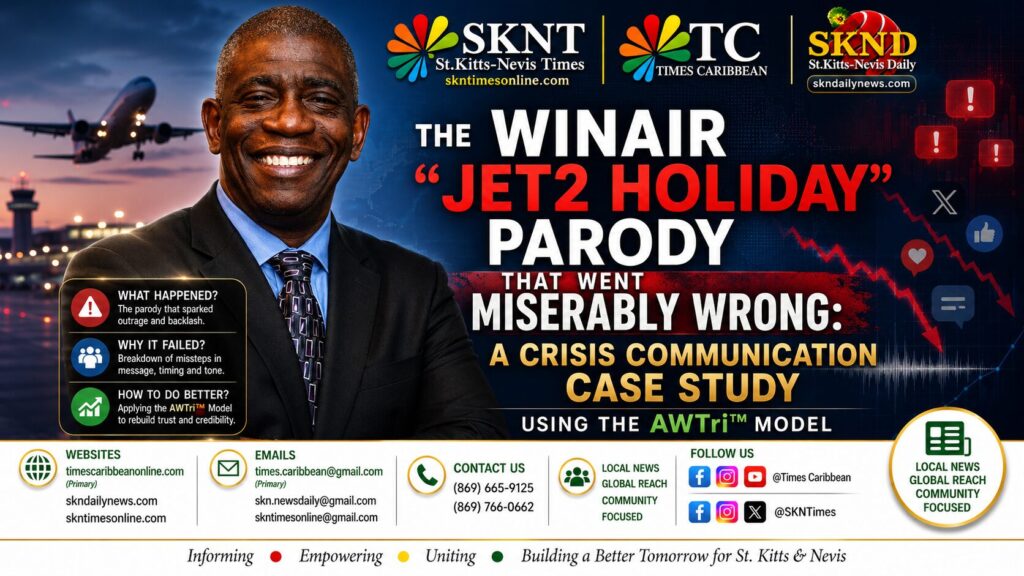
The Winair “Jet2 Holiday” Parody That Went Miserably Wrong: A Crisis Communication Case Study using the AWTri™ Model

Former Communications Specialist at Caribbean Tourism Organization
May 26, 2026
The St Maarten-based airline, Winair, created an uproar in Statia and Saba by posting a controversial parody video on its Facebook page. Understandably, residents of the two islands are livid. How dare Winair accuse the people of Statia and Saba of not wanting to pay for flights?
These are the very people who, according to Raimie Richardson, “hurricane or no hurricane, pandemic or no pandemic, the people of these islands still fly WINAIR because, frankly, many times they have no other choice.”
“So, congratulations. The biggest joke here wasn’t the video. It was an airline laughing at customers who already pay premium prices for inconsistent service because they’re left with limited options,” Raimie wrote.
The backlash that Winair received is completely understandable. For years, the people of Statia and Saba have complained about high ticket prices and poor service. Last-minute flight cancellations, lengthy delays, less-than-friendly customer service, and flight reductions are all issues that have been raised repeatedly over the years. What they get in return is more of the same, paired with even higher fares.
Currently, a return ticket for the less-than-20-minute flight to St Maarten can cost well over US$400. (By comparison, I recently paid US$143 for a flight from New York to Barbados). Yet, “people don’t ‘credit’ tickets to fly WINAIR. They sacrifice and pay because they must,” to quote Raimie again.
The Sanitised Apology
The backlash forced Winair to delete the post and issue the following statement:
“Winair acknowledges the concerns raised regarding a recent social media post involving Saba and Statia. We sincerely apologise to the communities of Saba and Statia. Winair values its longstanding relationship with both islands and remains committed to listening, learning, and serving our communities responsibly.”
Instead of pacifying the people, this apology made things worse. Public sentiment quickly soured further on the airline’s Facebook page:
· Cha Cha Woodley: “Why did you make a mockery of a community that depends on you no matter how sky high your prices are… I don’t believe one bit that you all value the longstanding relationship like you’re saying, for if that was the case, that video and wording would have never made it to social media!!!!! Sorry, but I can’t accept your apology.”
· Dihiara Pierre-Arnaud: “I find the person that actually wrote that article needs to be FIRED!”
· Dave Levenstone: “Apology not accepted, period.”
Anatomy of a Failing Apology
In my 20 years of teaching crisis communication, I’ve written, seen, and analysed many apologies. This one from Winair is lacking in many respects. While it isn’t aggressively defensive, nor did it try to justify the post as a joke, it completely fails to acknowledge that it offended the people of Statia and Saba or address the root cause of their outrage.
Instead, it reads like just another template statement and not a heartfelt apology to a community that is rightfully upset. By referring to the advert as “a recent social media post involving Saba and Statia”, Winair sanitises the issue and appears to be refusing to name its own mistake. In crisis communication, the first step is always to explicitly acknowledge your mistake.
The airline claims it is committed to “listening, learning, and serving”—another empty corporate cliché. It offers no concrete actions and no explanation as to how it will listen. Saying they “acknowledge the concerns” is nothing more than words. It breeds cynicism because it lacks substance. The post incensed residents; a stronger statement would have acknowledged that it was highly insensitive to the very real economic realities of both islands.
It also needed to detail the specific actions the airline has taken, and will take, to ensure this never happens again. Had it been sincere, it would have offered a concrete gesture within the apology, such as discounted fares for a specific period, a scheduled meeting with stakeholders to identify ways to lower fares, or both.
What a Sincere Apology Should Look Like
“Winair sincerely apologises to the residents of Saba and Statia for our recent, insensitive social media post regarding flight pricing. We missed the mark completely, and we understand why our comments caused such anger. We deeply value our long-standing relationship with both islands. To ensure this does not happen again, we have begun a detailed review of our internal marketing protocols and will implement the necessary corrective recommendations. In the meantime, we have suspended our promotional campaign. More importantly, we are committed to keeping the lines of communication open to better understand and serve the travel realities of our communities responsibly.”
The AWTri™ Strategic Framework
My company, Mazterpiece Communication, has developed a strategic framework built on three core pillars designed to drive sustainable growth, effective communication, and lasting impact: Awareness, Trust, and Relationship. It is called the AWTri™ Model, which serves as the intellectual property and signature methodology of the agency. It is used specifically to train journalists, senior officials, and communications professionals in building strategic, long-term public and media relations.
For small island communities like Saba and Statia, where air transportation is not a luxury but a critical public utility, a crisis like this cuts deep because it touches on economic survival and mutual respect. Here is how Winair could have used the AWTri™ Model to guide their response:
1. Awareness (The Foundation)
In this framework, Awareness is twofold: it requires an internal awakening to the operational reality on the ground, coupled with an external validation of the community’s perspective.
· Where Winair Failed: The airline’s apology showed zero situational awareness. They treated the backlash as an isolated “social media issue” rather than a symptom of deep-seated frustration over high regional airfares and island isolation.
· How to Apply AWTri™: Winair needed to explicitly demonstrate that they understood why the post was offensive. The response should have acknowledged the economic context: that for residents of Saba and Statia, flight pricing is a serious, everyday barrier to medical care, family connectivity, business, and leisure.
· The Strategic Shift: Instead of “acknowledging concerns raised,” the strategy dictated stating: “We are fully aware that our comments made light of a serious issue: the cost of essential air travel for residents of the two islands.”
2. Trust (The Bridge)
Trust is shattered instantly when an entity appears to mock its core consumer base. To rebuild trust, an apology must feature transparency, accountability, and a clear mechanism for redress.
· The Trust Deficit: The original apology offered generic, meaningless corporate trite (“committed to listening and learning”). This gives rise to cynicism because it lacks substance. Trust cannot be rebuilt with clichés; it requires action.
· How to Apply AWTri™: Winair needed to introduce an accountable action step to signal that internal change was happening. Trust is restored when people see a consequence or a corrective measure attached to the mistake.
· The Strategic Shift: Announce the immediate withdrawal of the campaign, initiate an internal review of marketing protocols, and offer a concrete gesture—such as discounted fares for a specific period or an immediate meeting with stakeholders to lower fares transparently.
3. Relationship (The Long-Term Anchor)
In close-knit Caribbean markets, the relationship is the most valuable asset an organisation possesses. When a crisis hits, you must lean into the history of that partnership without using it as an excuse.
· The Relationship Misstep: Winair simply stated they value the relationship. In a crisis, reminding people you have a relationship feels transactional; demonstrating that you value it feels authentic.
· How to Apply AWTri™: The framework dictates shifting from a top-down corporate broadcast to a peer-to-peer community dialogue. Because Winair has been the primary air bridge for decades, they needed to appeal to the shared history of resilience and partnership.
· The Strategic Shift: The response should have framed the mistake as a failure to live up to their own standards as a partner. Furthermore, true relationship management would involve leadership physically visiting and directly engaging with local representatives (such as tourism or government officials) to personally deliver the apology and reset the terms of the partnership.
Summary of the AWTri™ Strategic Pivot
Awareness
What Winair Did: Treated the incident as a generic “social media concern.”
What the AWTri™ Model Demands: Explicitly validated the specific economic and structural frustrations of Saba and Statia residents.
Trust
What Winair Did: Offered vague promises to “listen and learn.”
What the AWTri™ Model Demands: Provided concrete, verifiable actions (internal protocol changes and direct stakeholder engagement).
Relationship
What Winair Did: Used the “longstanding relationship” as a corporate shield.
What the AWTri™ Model Demands: Actively protected the relationship by moving from a digital broadcast to local, direct dialogue.
By using the AWTri™ Model, Winair could have moved their response from a reactive, obvious “damage control” statement to a proactive strategy focused on rebuilding trust and demonstrating its appreciation of the relationship with the people of Statia and Saba, resulting in long-term reputational recovery.
Don’t wait until a crisis hits to seek help. Contact Mazterpiece Communication at info@mazterpiece.com for your bespoke crisis communication training.
















Leave a comment
You must be logged in to post a comment.