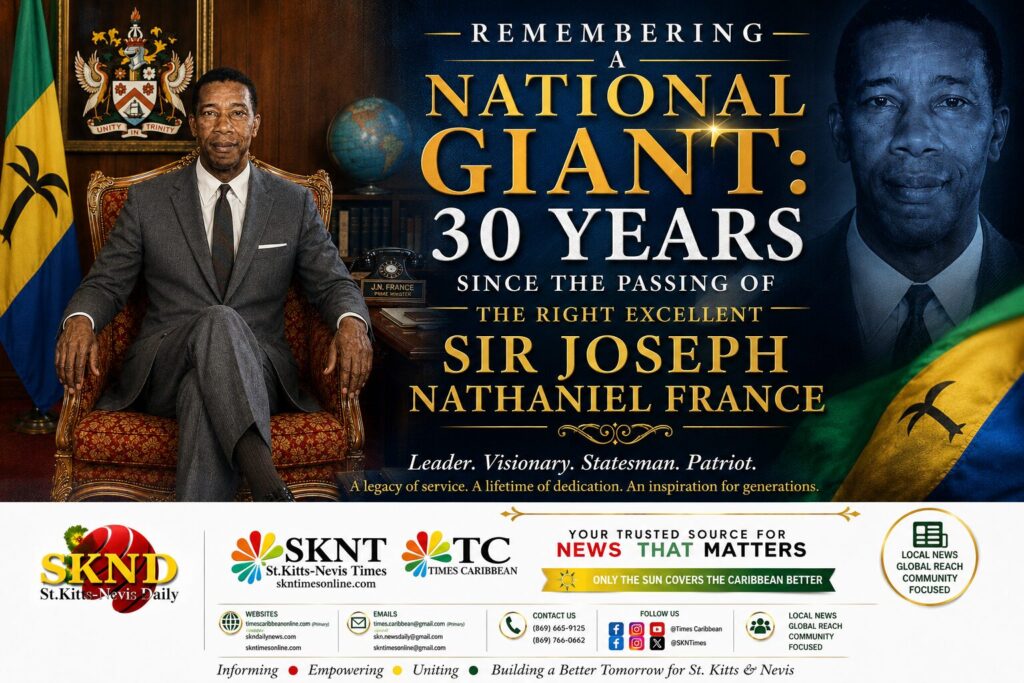
REMEMBERING A NATIONAL GIANT: 30 YEARS SINCE THE PASSING OF THE RIGHT EXCELLENT SIR JOSEPH NATHANIEL FRANCE

Today marks thirty years since the passing of one of the most towering figures in the political, labour, social and intellectual history of St. Kitts and Nevis — Sir Joseph Nathaniel France, affectionately and widely known throughout the Federation as J.N. France.
On May 21st, 1997, the nation lost a patriotic son, labour pioneer, journalist, trade unionist, legislator and nation-builder whose life’s work helped transform the social and political landscape of St. Kitts and Nevis. Three decades later, his legacy continues to echo through the institutions he helped build, the laws he helped shape, and the generations whose lives were uplifted through his service.
Born on September 16th, 1907 at Mt. Lily in Nevis to Thomas and Mary France, young Joseph Nathaniel France emerged from humble beginnings to become one of the most influential Caribbean political and labour figures of the twentieth century. His father, a road driver and small plot-holder, ensured that his son attended the Combermere School in Nevis regularly, planting the seeds for a lifelong pursuit of knowledge and self-improvement.
At just thirteen years old, France journeyed to St. Kitts during a school vacation to stay with relatives in New Town. What began as a temporary visit would become the start of a remarkable national journey. Before the holidays ended, he was offered employment as an office boy with the St. Kitts-Nevis Universal Benevolent Association (UBA) on Cayon Street in Basseterre. His parents agreed to the opportunity on the condition that he continued his education through evening classes — a commitment he honoured diligently through the UBA’s night school programme.
In those early years, the young France displayed extraordinary determination and versatility. To supplement his income, he played music at the Apollo Theatre, grinding the organ and later playing piano during silent films. His passion for literature, debate, journalism and music flourished through his involvement in the Mutual Improvement Society, where he honed skills in public speaking, essay writing, poetry appreciation and performance.
His life would soon become deeply intertwined with journalism and public advocacy. In 1921, the UBA launched The Messenger newspaper under the editorial leadership of Joseph Matthew Sebastian. France joined as a printer but rapidly evolved into a reporter, columnist and short story writer. The publication became a powerful platform through which he expressed ideas about social justice, workers’ rights and national development.
Following Sebastian’s death in 1944, France assumed the role of editor of The Messenger until its closure in the 1960s. He also served as editor of the Workers’ Weekly from 1942 to 1956, helping to shape public consciousness during a pivotal era of political awakening across the Federation.
The emergence of the St. Kitts Workers’ League in 1932 marked another defining chapter in his life. France became heavily involved in labour mobilisation and political education programmes aimed at empowering the working class. Alongside other leaders of the movement, he participated in public meetings, distributed socialist literature, petitioned colonial authorities and advocated tirelessly for workers’ rights and universal suffrage.
During the historic Buckley Riots of 1935, France emerged as a calming and stabilising figure, serving alongside other labour leaders as a mediator during one of the most explosive social uprisings in the Federation’s history.
Two years later, he was actively involved in campaigns demanding voting rights and supporting the election of labour representatives to the Legislative Council. In 1938, France appeared before the Royal West India Commission to provide evidence on the conditions facing workers and ordinary citizens.
That same year, following the death of W.A.H. Seaton, France was chosen to serve as secretary of the Workers’ League, solidifying his role within the labour movement.
One of his most enduring contributions came in 1940 with the establishment of the St. Kitts-Nevis Trades and Labour Union following the passage of the Trade Union Act. France became the Union’s first General Secretary — a position he would hold until his death fifty-seven years later.
Under his stewardship, the Union evolved into a formidable institution representing workers across multiple sectors. France’s negotiating skill, calm temperament and extensive experience in industrial relations proved invaluable during labour disputes, negotiations and social reforms.
His parliamentary career was equally distinguished. On July 30th, 1946, France, alongside Robert Llewellyn Bradshaw and Maurice Davis, was elected to the Legislature.
He later became Member for Social Services and subsequently Minister for Social Services when the ministerial system was introduced. His portfolio encompassed education, health and social affairs — areas in which his contributions would leave a permanent national imprint.
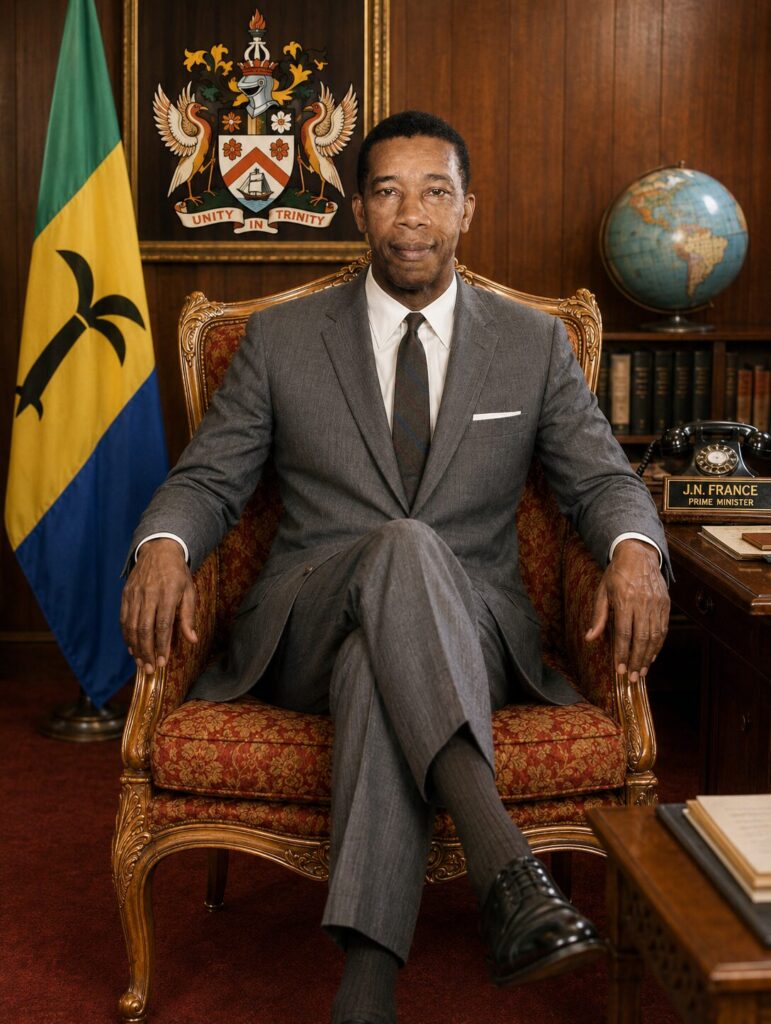
Perhaps one of the most visible symbols of his service is Joseph N. France General Hospital, named in his honour following the construction of the new hospital at Buckley’s in 1967. The naming reflected widespread recognition of his invaluable contributions to healthcare and social development in the Federation.
Throughout his distinguished political career, France successfully contested nine general elections between 1946 and 1984. He played a key role in advancing landmark legislation that strengthened workers’ rights, social protection and national development. Among these were laws establishing the National Provident Fund, CEMACO, protections for domestic workers and shop assistants, and legislation concerning the acquisition of sugar lands.
Even beyond elected office, his influence remained profound. He continued contributing to the Labour Spokesman newspaper and remained a central figure in labour affairs and national politics. Although he did not contest the 1989 General Election, his support for Sam Condor facilitated a smooth transition within the Labour movement.
By the time of his passing on May 21st, 1997 at the age of 89, Sir Joseph Nathaniel France had devoted virtually his entire life to public service, workers’ empowerment and nation-building.
Today, thirty years later, many still regard him as one of the architects of modern St. Kitts and Nevis — a disciplined organiser, gifted communicator, accomplished negotiator and unwavering advocate for the poor and working class.
As the Federation reflects on his extraordinary life and enduring legacy, the memory of J.N. France remains deeply woven into the social, political and institutional fabric of the nation.
His story stands as a powerful reminder that humble beginnings, guided by discipline, education, courage and service, can ultimately shape the destiny of an entire people.
















Leave a comment
You must be logged in to post a comment.