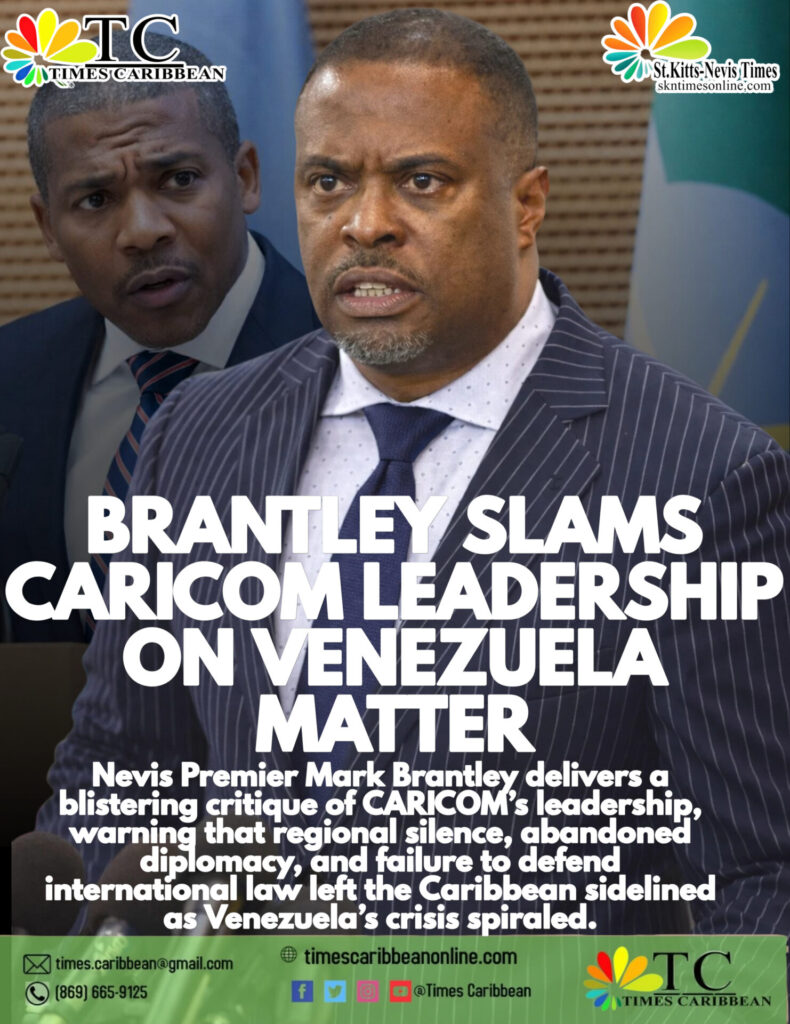
BRANTLEY SLAMS CARICOM LEADERSHIP ON VENEZUELA MATTER
TIMES CARIBBEAN — ANALYSIS & COMMENTARY
BRANTLEY BLOWS THE WHISTLE: NEVIS PREMIER SAYS CARICOM FUMBLED VENEZUELA AS REGION WATCHED SILENTLY
Nevis Premier Mark Brantley delivers a blistering critique of CARICOM’s leadership, warning that regional silence, abandoned diplomacy, and failure to defend international law left the Caribbean sidelined as Venezuela’s crisis spiraled.
In one of the most searing and intellectually devastating critiques yet to come from within the Caribbean political class, Mark Brantley, Premier of Nevis and senior regional statesman, has declared that CARICOM’s handling of the Venezuela crisis was a catastrophic failure of leadership, diplomacy, and regional nerve.
Speaking with the clarity of a former foreign minister and the bluntness of a small-state leader who understands exactly what is at stake when international norms collapse, Brantley did not mince words: the Venezuela situation was “handled poorly — all over.”
His remarks land like a thunderclap across a region now grappling with the implications of an extraordinary geopolitical rupture: the January 3, 2026 U.S. military operation inside Venezuela, which resulted in the removal and capture of President Nicolás Maduro and his wife — an act that has shocked international observers and reopened deep anxieties about sovereignty, intervention, and power politics in the Caribbean Basin.
A REGION THAT HAD TOOLS — AND CHOSE NOT TO USE THEM
At the heart of Brantley’s indictment is a devastating question: How could CARICOM, with all its diplomatic instruments, historical experience, and moral authority, have ended up on the sidelines of one of the most consequential regional crises in decades?
When pressed on whether a “stern statement” from CARICOM would have mattered, Brantley dismissed the notion as hollow symbolism.
“So CARICOM issues a stern statement — what will that achieve?”
Instead, he pointed to something far more damning: the deliberate abandonment of the Montevideo Mechanism, a Caribbean- and Latin American–backed diplomatic framework explicitly designed to avoid exactly this kind of violent outcome.
THE MONTEVIDEO MECHANISM: DESIGNED, SIGNED — THEN FORGOTTEN
Brantley reminded the region — and perhaps embarrassed many in the press — that in 2019, when he served as Foreign Minister, CARICOM helped craft a viable peace framework for Venezuela.
That effort culminated in the Montevideo Mechanism, developed alongside Uruguay and Mexico, with active participation from Caribbean leaders, including then CARICOM Chair Timothy Harris and Barbados Prime Minister Mia Mottley.
It was meant to be a living framework — rooted in dialogue, non-intervention, and international law.
Instead, Brantley says, it was “promptly forgotten.”
COVID-19 may have distracted the world, but Brantley’s argument is devastatingly clear: the crisis did not disappear — and neither did CARICOM’s responsibility.
DIPLOMACY BY ABSENCE: NO EMISSARIES, NO ENGAGEMENT, NO BACKBONE
What followed, according to Brantley, was a diplomatic vacuum so profound it bordered on negligence.
No re-engagement with Caracas.
No activation of Caribbean embassies in Washington.
No mobilization of CARICOM’s presence at the OAS or CELAC.
No dispatch of respected Caribbean elder statesmen.
Brantley revealed that days before the U.S. military action, he publicly urged a different path — proposing that regional “wise men” such as P. J. Patterson, Kenny Anthony, and Ralph Gonsalves be sent as emissaries to President Maduro.
None of it happened.
“We had all of these levers,” Brantley said. “None of that was done.”
THE CORE WARNING: SMALL STATES LOSE EVERYTHING WHEN LAW COLLAPSES
Brantley’s most chilling argument has nothing to do with Maduro’s virtues or vices.
He made it clear: this is not about defending a man — it is about defending a system.
“Once we lose the rules of international law, the powerless have no protection whatsoever from the powerful.”
For small island states like St. Kitts and Nevis, this is not theoretical.
It is existential.
Today it is Venezuela.
Tomorrow it could be any Caribbean nation that falls out of favor with a global power.
“Without the rules of international law, we fall back to the rules of the jungle.”
And as Brantley warned with unmistakable gravity: the jungle does not favor small states.
THE PETROCARIBE MEMORY — AND A FRIEND ABANDONED
Brantley also reminded the region of an inconvenient truth: Venezuela has historically stood with the Caribbean.
From President Hugo Chávez’s PetroCaribe initiative, which provided lifelines to struggling island economies, to Maduro’s personal engagement with the region — including visits to St. Kitts and Nevis — Venezuela was not a distant adversary, but a partner.
That history, Brantley implied, deserved at least an honest attempt at dialogue before tanks and troops replaced diplomacy.
THE AFTERMATH: TRUMP MOVES IN, CARIBBEAN LEFT WATCHING
In the wake of the operation, U.S. President Donald Trump has reportedly intensified pressure on American firms to re-enter Venezuela’s oil and gas sector under a new interim leadership — signaling that the geopolitical and economic reshaping of Venezuela is already underway.
And the Caribbean?
It watches — having forfeited its seat at the table.
THE VERDICT
Mark Brantley’s intervention is more than commentary.
It is an indictment of regional complacency, a warning to Caribbean leaders who believe silence equals safety, and a reminder that sovereignty is not defended by statements, but by sustained, strategic action.
CARICOM, he suggests, did not just mishandle Venezuela.
It abdicated its role — and in doing so, exposed every small state in the region to the unforgiving logic of power politics.
The question now is brutal and unavoidable:
If the Caribbean cannot defend international law when it matters most, who will defend the Caribbean when its turn comes?
















Leave a comment
You must be logged in to post a comment.