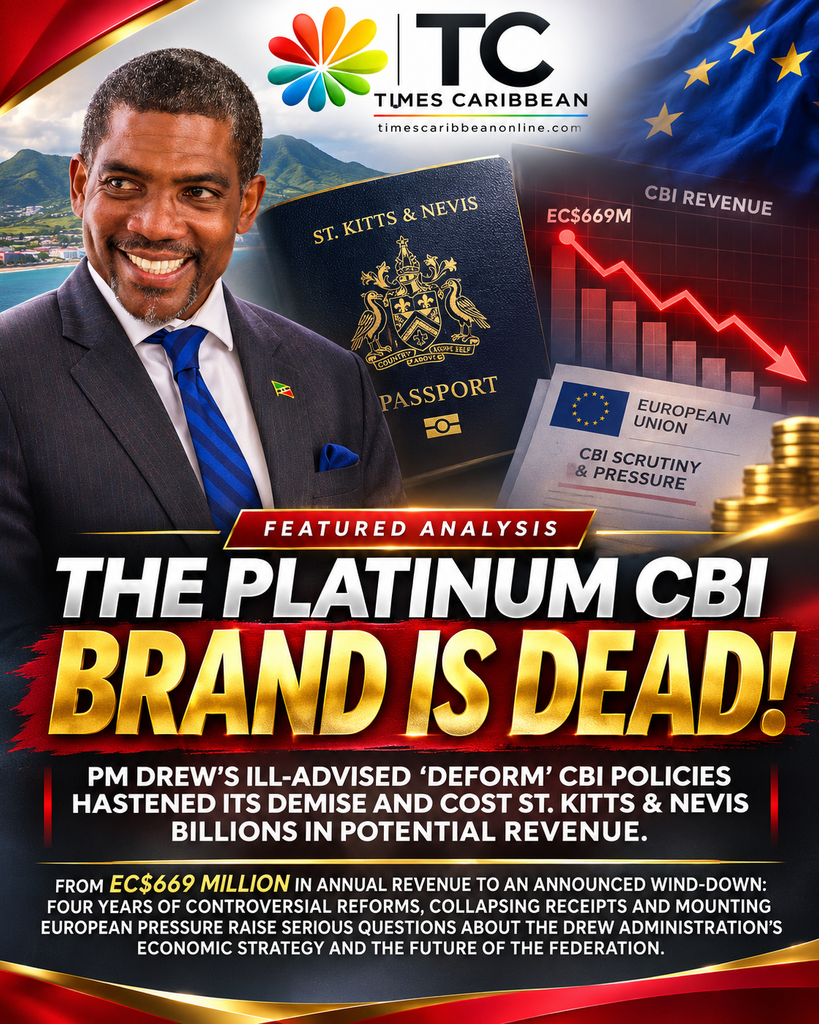
THE PLATINUM CBI BRAND IS DEAD! PM DREW’S ILL-ADVISED “DEFORM” CBI POLICIES HASTENED ITS DEMISE AND COST ST. KITTS & NEVIS BILLIONS IN POTENTIAL REVENUE.FROM EC$669 MILLION IN ANNUAL REVENUE TO AN ANNOUNCED WIND-DOWN: FOUR YEARS OF CONTROVERSIAL REFORMS, COLLAPSING RECEIPTS AND MOUNTING EUROPEAN PRESSURE RAISE SERIOUS QUESTIONS ABOUT THE DREW ADMINISTRATION’S ECONOMIC STRATEGY AND THE FUTURE OF THE FEDERATION.
TIMES CARIBBEAN | SPECIAL INVESTIGATIVE COMMENTARY | NOVEMBER 16, 2026
FROM EC$669 MILLION IN ANNUAL REVENUE TO AN ANNOUNCED WIND-DOWN: FOUR YEARS OF CONTROVERSIAL REFORMS, COLLAPSING RECEIPTS AND MOUNTING EUROPEAN PRESSURE RAISE SERIOUS QUESTIONS ABOUT THE DREW ADMINISTRATION’S ECONOMIC STRATEGY AND THE FUTURE OF THE FEDERATION.
BASSETERRE, ST. KITTS — The Platinum Brand is approaching the end of an era. And the economic consequences could be felt across St. Kitts and Nevis for generations.
For decades, the Federation’s Citizenship by Investment (CBI) Programme was much more than an internationally recognised investment-migration product. It was a powerful source of national revenue, a contributor to economic stability and one of the country’s most valuable international economic assets.
Under the administration of former Prime Minister Dr. Timothy Harris, particularly between 2017 and 2022, the programme became widely promoted as the Platinum Brand, supported by exceptional revenue performance in its later years.
Now, just four years after Harris left office, Prime Minister Dr. Terrance Drew has formally announced that St. Kitts and Nevis will wind down the very programme his administration declared it had saved in October 2024.
The announcement came on November 13, 2026, following sustained pressure from the European Union. The final closure timetable remains subject to negotiation, and applications continue in the meantime. WINNFM 98.9 +2
The announcement deserves more than a passing headline.
It demands an examination of political decisions, economic consequences and the enormous gap between the government’s assurances and the financial reality confronting the Federation.
Did Prime Minister Drew inherit an industry already facing unavoidable international restrictions? Or did his administration’s rhetoric, abrupt pricing decisions and controversial reforms accelerate the decline of a programme that had generated hundreds of millions of dollars annually?
The evidence points to a serious domestic policy problem, even while recognising that external pressure from Europe predated Drew’s administration.
And the numbers are too significant to ignore.
THE HARRIS YEARS: WHEN THE PLATINUM BRAND DELIVERED HUNDREDS OF MILLIONS
The success of the St. Kitts and Nevis CBI Programme during the later years of the Timothy Harris administration is not simply a political talking point. It is supported by official government revenue figures.
The programme, established in 1984, benefited from decades of development. But under Harris, it emerged as an especially important source of national income, with the Federation promoting its citizenship offering as a premium international product.
Even the Drew administration’s own published figures confirm the programme’s extraordinary financial performance.
THE NUMBERS TELL THE STORY
CBI revenue — millions of Eastern Caribbean dollars
Sources: Prime Minister Drew’s October 17, 2024 national address and the IMF’s 2026 Article IV report. The 2024 and 2025 amounts are rounded estimates calculated from IMF revenue-to-GDP ratios and nominal GDP figures. SKNIS +2
The peak among these reported figures came in 2022, when the programme generated EC$669 million. That was the year Harris left office and Drew assumed leadership on August 5.
Revenue remained exceptionally strong at EC$620 million in 2023, Drew’s first full calendar year in office, before the dramatic deterioration became evident in 2024.
By 2025, IMF data indicated annual CBI receipts had fallen to approximately EC$155 million.
2022 reported peak
EC$669M
2025 approximate revenue
EC$155M
Approximately 77% lower than the 2022 peak.
That is an extraordinary deterioration in an industry that once contributed a substantial share of government revenue.
It raises a simple question: How did one of the Federation’s biggest revenue-generating assets fall so dramatically in such a short period?
THE DREW REFORMS: WAS THE PRICE OF CHANGE TOO HIGH?
After taking office in August 2022, the Drew administration embarked on a major overhaul of the CBI Programme, arguing that reforms were essential to protect its integrity, reputation and international standing.
Some changes addressed legitimate concerns about due diligence and international compliance. Those concerns cannot simply be dismissed.
But the economic consequences of the government’s pricing decisions deserve equally serious examination.
According to the IMF’s 2025 review of St. Kitts and Nevis, the administration initially introduced a limited-time offer beginning in January 2023, reducing the contribution for a single applicant to US$125,000.
Then came the dramatic reversal.
In July 2023, the administration doubled the qualifying contribution for a single applicant to US$250,000. The qualifying amount for a family of four increased from US$170,000 to US$350,000.
Real-estate investment thresholds also increased sharply. Additional applicant screening requirements were introduced, including mandatory interviews and more restrictive sponsorship arrangements.
These were not minor administrative adjustments.
They fundamentally changed the price and structure of the Federation’s investment-citizenship offering. International Monetary Fund +1
And an unavoidable economic question follows.
Was the government sufficiently sensitive to the international marketplace when making these decisions?
St. Kitts and Nevis was not operating in isolation. It faced competition from Antigua and Barbuda, Dominica, Grenada and Saint Lucia, as well as other investment-migration jurisdictions.
A premium brand can command a premium price. But even premium brands must protect competitiveness, maintain investor confidence and recognise the consequences of sudden pricing changes.
The IMF subsequently confirmed that St. Kitts and Nevis experienced a particularly sharp deterioration.
Its 2025 Article IV report found that CBI applications declined sharply in 2024, alongside a fall of more than 50% in annual CBI revenue. Other regional programmes experienced more varied outcomes, with some maintaining or increasing receipts during parts of the same period.
The IMF also observed that the government’s subsequent price reductions had not produced a meaningful recovery by early 2025. IMF eLibrary
That finding matters.
It suggests that the downturn was not merely a temporary interruption in an otherwise healthy market. It had become a serious and potentially lasting fiscal problem.
The criticism of Drew’s policy strategy is therefore not based solely on political disagreement. It is reinforced by the sequence of documented policy changes and the subsequent collapse in revenue.
It does not establish that every dollar of lost business was caused by those decisions. But it establishes a legitimate basis for questioning their design, timing and commercial consequences.
DID THE GOVERNMENT UNDERMINE THE BRAND IT CLAIMED TO BE SAVING?
There is another dimension to this controversy: political communication.
During his administration, Dr. Harris consistently promoted St. Kitts and Nevis as a leader in the global citizenship industry.
The programme was presented as an asset of national pride, international prestige and economic significance.
By contrast, Prime Minister Drew’s public communications repeatedly emphasised the programme’s vulnerabilities, alleged weaknesses inherited from the previous administration and the risks of continuing without reform.
In his October 17, 2024 national address, Drew strongly criticised the previous administration’s management of CBI, arguing that the country had been placed at risk of losing valuable visa-free access. SKN Consulate in Toronto
The Prime Minister was entitled to scrutinise the programme and explain why his administration believed changes were necessary.
But governing also demands an appreciation of the difference between identifying weaknesses and damaging confidence in an economic product.
For critics of the administration, the question is whether Drew’s sustained negative public characterisation of the inherited programme contributed to uncertainty among promoters, international agents and potential applicants.
That concern deserves investigation.
However, there is no established evidence that Drew’s rhetoric caused the European Union to begin scrutinising Caribbean CBI programmes.
European concerns about investment-citizenship arrangements existed well before Drew took office. The European Commission had publicly documented risks associated with such schemes in January 2019. European Commission
Indeed, St. Kitts and Nevis continued to receive favourable industry rankings, including first place in the commercially published 2025 CBI Index.
So while the programme’s revenue performance deteriorated severely, it would be inaccurate to suggest that its international reputation had disappeared completely before the wind-down announcement. cbiindex.com
The stronger criticism is not that Drew single-handedly alerted Europe to CBI.
It is that his administration had a responsibility to preserve the programme’s commercial strength while addressing risks that were already well known.
And on the evidence of the revenue figures, that balancing act produced deeply troubling results.
THE BILLION-DOLLAR QUESTION: HOW MUCH REVENUE HAS ST. KITTS AND NEVIS MISSED?
This is where the debate becomes particularly serious.
Suppose the Federation had maintained an average annual CBI revenue stream of EC$500 million from 2022 through 2028.
That would represent seven calendar years, producing total gross revenue of:
ILLUSTRATIVE SCENARIO: 2022–2028
EC$3.5 billion
7 years × EC$500 million annually
At EC$600 million annually, the hypothetical total would exceed EC$4.2 billion.
These figures demonstrate the extraordinary earning potential of the programme. But they are not established losses: some of those years have already generated substantial revenue, while future receipts depend on uncertain demand, policy and international conditions.
A more useful calculation examines what has happened since the revenue downturn began.
For 2024 and 2025 combined, maintaining an annual EC$500 million benchmark would have produced EC$1 billion.
The IMF-derived figures indicate approximately EC$399 million was actually received across those two years.
ESTIMATED SHORTFALL AGAINST EC$500M ANNUAL BENCHMARK — 2024–2025
EC$601 million
Illustrative opportunity-cost comparison, not an audited loss or proof that alternative policies would have achieved this revenue.
That is approximately EC$601 million in potential receipts not realised against a benchmark consistent with the programme’s stronger historical performance.
And it covers only two years.
If elevated CBI demand could have continued through 2028, the wider opportunity cost might ultimately have reached well into the billions.
Equally, no responsible analysis can assume that record CBI revenues would have continued indefinitely under Harris or any other administration. European scrutiny, competition and international regulatory changes would still have affected the market.
The unanswered question is how much of the decline was unavoidable and how much resulted from domestic decisions.
That distinction requires proper examination.
But even the conservative comparison above should be sufficient to demand accountability.
Six hundred million dollars is not a minor accounting variance for a small island state.
It represents substantial potential capacity for infrastructure, healthcare, education, public debt reduction and national development.
THE IMF CONFIRMS THE ECONOMIC CONSEQUENCES
The implications extend far beyond the CBI industry itself.
In May 2026, the International Monetary Fund reported that declining CBI revenue had contributed to persistent fiscal difficulties in St. Kitts and Nevis.
Its assessment identified a fiscal deficit of 11.7% of GDP in 2025, declining government deposits and growing pressure on the country’s financial position.
The IMF also projected that public debt would rise over the medium term unless fiscal adjustments and stronger growth addressed the emerging challenges. International Monetary Fund +1
These findings demonstrate why CBI revenue cannot be dismissed as simply money from an industry the Federation must eventually outgrow.
It has been an important part of national fiscal capacity.
When such revenue declines faster than the country can develop replacement income, the consequences can affect public spending, investment and financial resilience.
A government cannot simply declare that it is diversifying an economy and expect the revenue gap to disappear.
Diversification must be measured in actual economic output, employment, exports, investment and sustainable tax receipts.
Otherwise, the word becomes a political slogan rather than an economic achievement.
There is, nevertheless, an uncomfortable truth for both administrations.
The IMF has also highlighted the dangers of excessive dependence on CBI. The substantial receipts of 2021–2023 supported increased public spending, leaving the Federation vulnerable when inflows subsequently weakened.
That dependence was a structural problem predating the current crisis.
But inheriting an economic vulnerability does not remove the responsibility to manage its transition effectively.
And that is where the Drew administration’s record deserves scrutiny.
THE EUROPEAN UNION: AN EXTERNAL CHALLENGE, NOT AN EXCUSE FOR EVERY DOMESTIC FAILURE
The European Union’s position has become increasingly difficult for Caribbean CBI jurisdictions.
In November 2025, the EU Council approved revised visa-suspension rules. These changes strengthened the EU’s ability to restrict visa-free access where a country operates an investor-citizenship programme without a genuine connection between applicants and that country. Consilium +1
The pressure is therefore regional, not unique to St. Kitts and Nevis.
Antigua and Barbuda, Grenada, Dominica and Saint Lucia have also faced difficult decisions regarding their programmes.
Regional communications have identified June 1, 2028 as a proposed wind-down date to preserve Schengen visa-free access. Antigua and Barbuda has sought an extended transition through 2030, while St. Kitts and Nevis is negotiating its own timetable. Storyblok +2
No credible analysis should pretend that Prime Minister Drew created Europe’s opposition to investment-citizenship schemes.
He did not.
But the existence of external pressure should not automatically absolve the government of responsibility for its domestic policy choices.
The administration must still answer whether a different approach could have preserved more revenue while meeting reasonable international due-diligence standards.
Could price increases have been introduced more gradually? Could investor confidence have been better protected? Could a more commercially responsive framework have produced stronger revenue during the transition?
Those are legitimate questions.
And they cannot be answered simply by repeating that Europe demanded reform.
IN 2024, DREW DECLARED CBI SAVED. IN 2026, HE ANNOUNCED ITS END.
Perhaps the sharpest political contradiction lies in the Prime Minister’s own public declarations.
On October 17, 2024, Dr. Drew addressed the nation and announced:
“The Saint Kitts and Nevis CBI programme has been saved.” SKNIS
He defended the reforms and argued that the government’s decisions had secured the future of the programme.
But on November 13, 2026, just over two years later, he announced that the Federation would wind down CBI through negotiations with the European Union.
The contrast is unmistakable.
The administration that declared the programme saved is now preparing for its closure.
To be fair, Europe’s strengthened legal framework in December 2025 materially changed the international environment after Drew’s 2024 speech. That development makes the two positions more complicated than a simple contradiction.
Nevertheless, the Prime Minister’s earlier assurance now looks decidedly premature.
The public was told reforms had secured the programme’s future.
Yet the country subsequently experienced continued weak CBI receipts, growing fiscal pressure and an announced transition away from the industry.
This raises a significant question about the administration’s assessment of the risks.
If the programme was genuinely saved in October 2024, how secure was that achievement, and what exactly had been secured?
Was the government buying time? Was it protecting temporary access to international markets? Or did it overestimate the long-term effectiveness of its reforms?
Citizens deserve a clear explanation.
DREW’S DEFENCE: FINANCIAL SECURITY AND ECONOMIC DIVERSIFICATION
The government has advanced an important counterargument.
Prime Minister Drew has warned that the risks extend beyond losing visa-free access to Europe.
At his November 2026 media roundtable, he raised concerns about possible financial blacklisting and the potential consequences for international banking relationships.
These are serious issues for a small, internationally connected economy. SKNIS
During his November 13 address, Drew outlined plans to pursue geothermal energy, solar development, tourism, agricultural production, digital services and additional international partnerships as alternatives to CBI dependence.
He argued that the government had been preparing for the transition since 2022 and that the Federation would continue to pursue sustainable economic development. CANANews
That position deserves consideration.
A responsible government must defend its citizens’ ability to travel, protect access to international banking and prevent regulatory exposure that could threaten the wider economy.
CBI revenues cannot be pursued at any cost.
But there remains an enormous difference between recognising a danger and proving that the chosen response was economically optimal.
The central question is not whether reform was necessary.
It is whether the particular reforms adopted by the Drew administration were sufficiently balanced, properly sequenced and commercially sustainable.
The IMF’s findings suggest that the revenue consequences were substantial.
The government therefore has an obligation to demonstrate that those consequences were unavoidable or justified by benefits that could not have been achieved through a less damaging strategy.
WHO WILL ACCOUNT FOR THE LOST ECONOMIC OPPORTUNITY?
Before the programme finally closes, St. Kitts and Nevis needs an independent, publicly accessible assessment of its performance between 2017 and 2026.
That assessment should establish annual application volumes, approval rates, gross revenue, net government receipts, administrative costs, investor withdrawals and the effects of each major pricing decision.
It should also examine the economic implications of the proposed EU transition.
How much CBI revenue is expected during the remaining operating period?
What are the government’s projected replacement revenues for 2027, 2028 and beyond?
How much of the promised diversification programme is financed, how much remains at the proposal stage, and when will these projects begin generating measurable economic returns?
What fiscal safeguards will be implemented if new revenue streams develop more slowly than expected?
The public deserves transparent answers supported by figures rather than political assurances.
Such an assessment should also examine the Harris administration’s legacy fairly, including the benefits of strong revenue performance, the programme’s regulatory risks and the dangers of excessive fiscal dependence.
Both achievements and weaknesses belong in the historical record.
THE PLATINUM BRAND IS ENDING. THE QUESTION OF RESPONSIBILITY REMAINS.
The St. Kitts and Nevis Citizenship by Investment Programme helped finance national development, strengthen government revenue and position the Federation prominently within the international investment-migration industry.
Its outstanding financial performance during the later Harris years is supported by the government’s own figures.
The dramatic revenue decline following the Drew administration’s major reforms is similarly documented.
And the forthcoming wind-down is no longer merely a prediction. It has been announced by the Prime Minister himself.
The evidence does not establish that Dr. Drew personally caused Europe’s decision to increase pressure on Caribbean CBI programmes. Nor does it establish that his administration has already deprived the Federation of EC$4 billion in revenue.
But it establishes something sufficiently serious to demand national attention.
Under Drew’s administration, major policy changes preceded a profound decline in CBI applications and revenue. The IMF identified a connection between the pricing and due-diligence changes and the downturn. The resulting fiscal pressures have been substantial.
That is a matter of public policy accountability, not simply partisan argument.
Prime Minister Drew may ultimately argue that the reforms protected St. Kitts and Nevis from even greater economic harm.
He may argue that international changes would have forced the programme’s closure regardless of who occupied the office of Prime Minister.
Both arguments warrant examination.
But they do not erase the revenue decline.
They do not erase the opportunity costs.
And they do not remove the responsibility to explain whether the transition could have been better managed.
For the people of St. Kitts and Nevis, this debate is not about which political leader deserves a trophy for managing the country’s most famous investment programme.
It is about the Federation’s financial security.
It is about the billions of dollars that an industry of this scale could potentially have generated over time.
It is about protecting national assets while navigating international pressure.
And it is about the future of a small nation that cannot afford costly economic miscalculations.
The Platinum Brand is being retired. But its financial legacy, the policy decisions that preceded its decline and the government’s responsibility for the transition must not be buried with it.
The final chapter has yet to be written.
And the people of St. Kitts and Nevis deserve a full accounting before that chapter closes.
TIMES CARIBBEAN | SPECIAL EDITORIAL ANALYSISThis article presents evidence-based policy criticism and editorial opinion. Revenue figures are drawn from government statements and IMF reporting; counterfactual estimates are illustrative, not independently verified financial losses. The announced CBI wind-down is pending a negotiated timetable.
















Leave a comment
You must be logged in to post a comment.