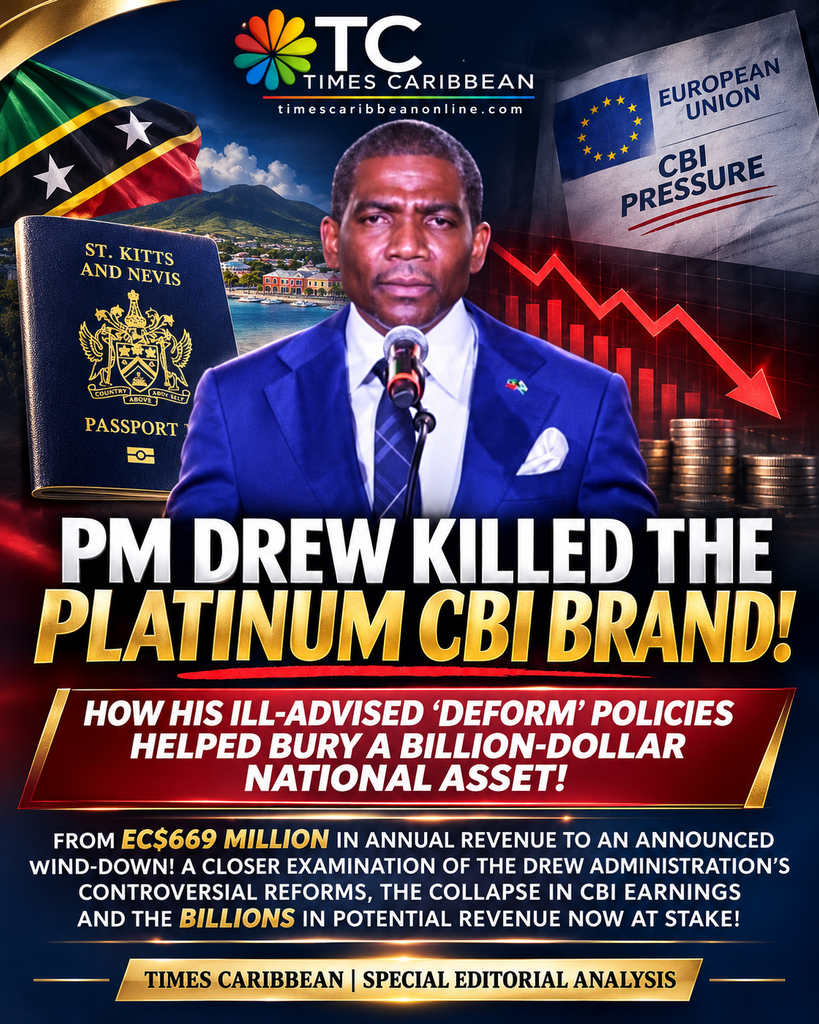
PM DREW KILLED THE PLATINUM CBI BRAND! HOW HIS ILL-ADVISED “DEFORM” POLICIES HELPED BURY A BILLION-DOLLAR NATIONAL ASSET!

FROM EC$669 MILLION IN ANNUAL REVENUE TO AN ANNOUNCED WIND-DOWN! A CLOSER EXAMINATION OF THE DREW ADMINISTRATION’S CONTROVERSIAL REFORMS, THE COLLAPSE IN CBI EARNINGS AND THE BILLIONS IN POTENTIAL REVENUE NOW AT STAKE!
TIMES CARIBBEAN | SPECIAL EDITORIAL ANALYSIS
BASSETERRE, ST. KITTS, NOVEMBER 16, 2026 — There is a difference between inheriting an economic challenge and making that challenge considerably worse.
There is a difference between reforming a successful national programme and implementing policies that undermine its financial viability.
And there is an enormous difference between declaring that an industry has been saved and subsequently announcing that the same industry must be brought to an end.
Prime Minister Dr. Terrance Drew must now confront all three distinctions.
The St. Kitts and Nevis Citizenship by Investment Programme, once celebrated internationally as the prestigious Platinum Brand, is heading towards its announced wind-down.
Its revenue has collapsed from the extraordinary levels recorded during the later years of the Dr. Timothy Harris administration. The country’s fiscal position has deteriorated. International pressure has intensified.
And the administration that promised to rescue this valuable national asset is now preparing to retire it.
The central accusation in this Times Caribbean editorial is serious: while European pressure threatens the programme’s ultimate survival, the Drew administration’s own policy decisions appear to have accelerated its commercial decline long before its announced closure.
But there is another dimension to this controversy that deserves equally serious examination.
Prime Minister Drew’s approach to the programme he inherited was, in the assessment of this editorial, politically immature, unnecessarily petty and deeply ill-advised.
Instead of consistently building upon the programme’s extraordinary financial achievements, his administration appeared determined to distance itself from the successes of its predecessor.
For much of its first two years, the Drew administration repeatedly highlighted alleged weaknesses in the programme’s previous management, while publicly questioning aspects of the Harris government’s CBI legacy.
That approach raises a troubling question about political leadership: Was the administration so preoccupied with discrediting the previous government’s achievements that it failed to give sufficient priority to protecting one of the country’s most valuable revenue-generating assets?
The implications extend beyond domestic political rivalry.
Critics argue that the government’s negative public narrative may have reinforced international concerns about the programme, potentially supplying additional arguments to European authorities already examining citizenship-by-investment arrangements.
European scrutiny had begun before Drew assumed office, so it would be inaccurate to claim that his statements initiated that scrutiny. But whether the administration’s rhetoric unnecessarily weakened the Federation’s position within an already hostile international policy environment is a legitimate question.
And one that demands answers.
That is not a conclusion based on political slogans.
It is a criticism supported by the government’s own revenue figures, the documented history of its policy changes and the findings of the International Monetary Fund.
The country deserves to examine that record without political camouflage.
1. DREW INHERITED A REVENUE POWERHOUSE — NOT A FINANCIALLY DEAD PROGRAMME!
When Dr. Timothy Harris assumed office in 2015, he inherited a Citizenship by Investment Programme that had been operating since 1984.
During the Harris administration, particularly between 2017 and 2022, the programme was aggressively positioned as a premium international citizenship product.
The Platinum Brand became a defining feature of St. Kitts and Nevis’ investment-migration identity.
And the financial performance was exceptional.
According to figures disclosed by Prime Minister Drew himself in his October 17, 2024 national address:
- 2019: EC$443 million
- 2020: EC$271 million
- 2021: EC$543 million
- 2022: EC$669 million
- 2023: EC$620 million
These are not figures invented by political opponents.
They are figures publicly acknowledged by the sitting Prime Minister.
In 2022, the programme delivered EC$669 million, its highest annual total among the years cited.
In 2023, Drew’s first full calendar year in office, the programme still generated a massive EC$620 million.
That continued strength reflected, at least in part, an established pipeline of applications and receipts from an industry built over preceding years.
No credible analyst can reasonably deny the programme’s substantial financial success.
By the most important financial measures, the Platinum Brand was a tremendous success during the later years of Dr. Timothy Harris’s leadership.
That success should have been recognised as a national achievement, regardless of which political party occupied Government Headquarters.
Harris did not create the programme in 1984. But his administration presided over some of its strongest revenue-producing years and helped establish the Platinum Brand as a prominent international marketing identity.
Yet the incoming administration’s political narrative frequently appeared more focused on identifying shortcomings in that legacy than celebrating the extraordinary earnings that the programme had delivered for the Federation.
In this editorial’s assessment, that was a serious error of political judgement.
A national economic success does not suddenly become a failure simply because the government changes.
But what happened next should concern every taxpayer.
2. THE 2023 PRICE SHOCK: WHEN REFORM BECAME A COMMERCIAL GAMBLE
Consider one of the most revealing episodes in the programme’s recent history.
In January 2023, the Drew administration introduced a limited-time offer that reduced the qualifying contribution for a single applicant from US$150,000 to US$125,000.
The offer was intended to stimulate demand.
In June 2023, the Citizenship by Investment Unit announced that the promotion would be extended until January 2024, citing overwhelming demand.
Then came July.
The administration abruptly reversed course.
The minimum contribution for a single applicant doubled from US$125,000 to US$250,000.
For a family of four, the amount increased from US$170,000 to US$350,000.
Real-estate qualifying amounts also doubled in several categories.
Additional due-diligence requirements were introduced, including mandatory interviews and restrictions on financial sponsorship.
The changes were presented as necessary to improve integrity and protect international relationships.
Those were legitimate objectives.
But legitimate objectives do not automatically make every policy decision commercially sound.
Why announce an extension of a successful promotional offer in June, only to introduce dramatic price increases the following month?
What assessment was undertaken of investor demand?
What consultations were held with international marketing agents?
What alternative pricing arrangements were evaluated?
And what revenue decline was the government prepared to accept?
These questions are fundamental because the programme operated in a competitive international industry.
St. Kitts and Nevis was not the only country offering citizenship through investment.
A premium product can command premium pricing. But doubling the entry price while imposing additional processing requirements can significantly alter the purchasing decision.
The government’s commercial gamble was enormous.
And subsequent developments suggest that the consequences were severe.
3. THE IMF EXPOSES THE REAL COST OF DREW’S REFORMS!
The most damaging evidence against the administration’s CBI strategy does not come from an opposition rally.
It comes from the International Monetary Fund.
In its 2025 Article IV assessment, the IMF documented a sharp decline in St. Kitts and Nevis’ CBI applications during 2024 following the tighter screening requirements and the substantial price increases introduced in 2023.
The IMF reported that annual CBI revenue had fallen by more than 50%.
Even more significantly, the IMF identified the pricing and due-diligence reforms as factors behind the deterioration, while recognising the wider international pressures affecting the industry.
The report also observed that other regional programmes experienced varied outcomes during the period, including stronger receipts or substantial application growth in some jurisdictions.
That comparison is important.
It challenges any attempt to dismiss the Federation’s entire downturn as an unavoidable regional phenomenon.
The Drew administration later reduced certain CBI prices in 2024 in an effort to stimulate renewed interest.
But according to the IMF, those adjustments had not produced a meaningful recovery by early 2025.
Read that sequence carefully.
The government introduced steep increases.
Demand subsequently declined.
Revenue plunged.
The government then adjusted some prices downward.
But the expected recovery failed to materialise.
Critics have described these measures as CBI “deforms” rather than reforms.
The expression is political. The economic questions behind it are real.
If government policy contributed to a major deterioration in demand, the administration cannot simply point to international pressure and refuse to examine its own decisions.
Reform should protect an industry’s long-term sustainability.
It should not leave a once-powerful revenue generator struggling to recover its customer base.
4. FROM EC$669 MILLION TO APPROXIMATELY EC$155 MILLION — WHAT HAPPENED TO THE MONEY?
By 2024, the programme’s annual revenue had fallen to approximately EC$244 million, based on figures subsequently reported by the IMF.
By 2025, IMF data indicated receipts of approximately EC$155 million, depending on the reporting classification used.
Compare that with EC$669 million in 2022.
That represents a decline of roughly 77%.
Seventy-seven percent.
For a country with the population, economic scale and development needs of St. Kitts and Nevis, that is an extraordinary deterioration.
It cannot be explained away with a press conference.
It cannot be hidden behind a political slogan.
And it cannot be corrected simply by announcing another ambitious national development strategy.
From healthcare and housing to roads, education and public infrastructure, government revenue ultimately determines the country’s ability to finance national priorities.
Every major revenue decline carries consequences.
The question is not whether CBI earnings would fluctuate. They certainly would.
The question is whether the magnitude of this particular collapse could have been reduced through better policy design and more effective commercial management.
The evidence makes that question unavoidable.
5. THE BILLION-DOLLAR OPPORTUNITY COST: WHAT COULD ST. KITTS AND NEVIS HAVE EARNED?
The scale of the potential financial opportunity deserves serious attention.
Consider a programme capable of generating an average of EC$500 million annually.
Over seven years, from 2022 through 2028, such performance would produce EC$3.5 billion in gross government receipts.
At EC$600 million annually, the hypothetical total would reach EC$4.2 billion.
These figures illustrate the earning capacity that existed during the programme’s strongest years. They are not audited losses, and they do not establish that those receipts could have continued under any administration.
The more immediate comparison is equally troubling.
If the programme had averaged EC$500 million in both 2024 and 2025, the Federation would have received EC$1 billion across those two years.
Instead, IMF-derived estimates indicate combined receipts of approximately EC$399 million.
That represents an illustrative revenue shortfall of approximately EC$601 million against a historically achievable annual benchmark.
More than six hundred million dollars.
In two years.
Now extend the debate to the programme’s remaining operating period and the economic consequences of the announced wind-down.
The cumulative potential opportunity cost could extend into billions, depending on what alternative policies might realistically have produced.
But establishing that cost requires more than extrapolation.
It requires actual application records, audited receipts, detailed forecasts and a credible analysis of how the market would have responded under different policy choices.
That is why an independent review is essential.
Prime Minister Drew should be required to explain how much revenue his reforms were expected to sacrifice, what benefits justified that sacrifice and whether the eventual financial consequences exceeded the government’s projections.
Anything less leaves the nation guessing about the price of its economic decisions.
6. THE PUBLIC RELATIONS CONTRADICTION: HOW DO YOU SELL A PLATINUM BRAND WHILE DISCREDITING ITS PAST?
There is another question the administration has not adequately answered.
What impact did its public messaging have on investor confidence?
The Harris administration consistently promoted the Federation’s CBI industry as a prestigious and internationally competitive product.
The Drew administration instead placed considerable emphasis on alleged deficiencies in the inherited programme, the need to address past management practices and the dangers associated with international scrutiny.
Where weaknesses existed, government had a responsibility to correct them.
Due diligence, transparency and sound governance are non-negotiable.
But the way a government communicates about a national revenue-generating industry matters.
A country cannot disregard the commercial consequences of publicly questioning the credibility of its own investment offering.
Investor confidence is difficult to build.
Once weakened, it is not always easily restored.
The question is whether the government’s repeated criticism of the previous CBI management arrangements, combined with abrupt regulatory and pricing changes, created additional uncertainty within the international marketplace.
That impact has not been independently quantified.
But it deserves examination.
TWO YEARS OF POLITICAL CRITICISM: DID DREW PUT POLITICAL RIVALRY AHEAD OF THE PLATINUM BRAND?
This is perhaps one of the most troubling aspects of the entire controversy.
Prime Minister Drew entered office in August 2022 after an election campaign in which the management and integrity of the CBI Programme featured prominently in political debate.
But once the election was over, his responsibility changed.
He was no longer simply an opposition politician seeking to challenge the record of Dr. Timothy Harris.
He was now the Prime Minister of St. Kitts and Nevis.
The custodian of the nation’s economic interests.
And the leader responsible for protecting a programme that had just delivered hundreds of millions of dollars in government revenue.
Yet during his administration’s first two years, Drew continued to publicly question the previous management of the CBI Programme and emphasise alleged deficiencies associated with the Harris era.
In the assessment of this editorial, the political tone and repeated negative characterisation were ill-advised.
At times, the messaging appeared politically immature and unnecessarily petty, particularly given the documented financial success of the programme under Harris.
A mature national leader should be capable of acknowledging the achievements of a predecessor while correcting genuine weaknesses.
Those responsibilities are not mutually exclusive.
Indeed, public recognition of the programme’s proven strengths could have helped reassure investors that St. Kitts and Nevis intended to preserve its established reputation while improving standards.
Instead, critics contend that the administration’s repeated public emphasis on inherited problems risked creating the impression that the Federation’s previous CBI success had been fundamentally flawed.
That was a potentially damaging message to send about a nationally important investment product.
The irony is difficult to ignore: the administration was publicly challenging the legacy of a programme whose enormous revenues had helped establish the financial foundation it inherited.
The Platinum Brand was not Dr. Harris’s personal property.
It belonged to St. Kitts and Nevis.
Its success was a national success.
And its protection should have risen above the personal and political rivalry between successive prime ministers.
What makes the episode particularly concerning is the international environment in which those political exchanges occurred.
European authorities were already scrutinising investment-citizenship arrangements.
The EU was already examining issues involving due diligence, security, transparency and the relationship between citizenship and genuine national connections.
Against that background, critics argue that repeatedly highlighting alleged weaknesses in the Federation’s past programme management was strategically unwise.
Why risk reinforcing international doubts about your own country’s programme when that programme is already facing external scrutiny?
Why devote so much public attention to discrediting the former administration’s CBI leadership rather than emphasising the continuity, commercial strength and improved safeguards of the national product?
And why allow domestic political rivalry to shape the international narrative surrounding an industry upon which the Federation depended so heavily?
These are not trivial questions.
They go directly to political maturity, economic judgement and the responsibility of national leadership.
There is no verified evidence that Drew’s statements caused the EU to intensify its scrutiny. But the possibility that such rhetoric may have reinforced existing international concerns is an issue worthy of investigation.
At the very least, the administration should explain how its communication strategy was designed to protect investor confidence and the country’s negotiating position.
Was the administration more focused on distinguishing itself politically from the Harris government than on preserving the strongest commercially viable features of the programme it inherited?
That is a fair question of public policy.
Political rivalry must never become a substitute for economic strategy.
7. THE GREAT CONTRADICTION: “CBI HAS BEEN SAVED” — THEN CAME THE WIND-DOWN!
Perhaps nothing captures the troubling inconsistency of the government’s CBI narrative more clearly than two national addresses delivered just over two years apart.
On October 17, 2024, Prime Minister Drew declared:
“The Saint Kitts and Nevis CBI programme has been saved.”
That was an emphatic statement.
His government presented its reforms as a success and argued that the programme had been rescued from serious threats to its international standing.
Fast-forward to November 13, 2026.
The same Prime Minister announced that St. Kitts and Nevis would wind down its Citizenship by Investment Programme on a timetable to be negotiated with the European Union.
What a transformation.
From rescue to retirement.
From declarations of success to preparations for closure.
The administration can reasonably argue that the European Union strengthened its legal powers in late 2025, changing the international circumstances after the 2024 declaration.
That is true.
But it does not erase the questions surrounding the Prime Minister’s earlier assurance.
What exactly had been saved?
Was it a temporary period of continued visa-free access?
Was it the programme’s international reputation?
Was it a commercially sustainable flow of applications?
Or was the government celebrating an achievement whose long-term durability had never been demonstrated?
The public needs clarity.
A government that speaks with certainty about saving a major national asset must also be willing to explain why that apparent victory proved insufficient.
8. EUROPE DID NOT CREATE THE 2023 PRICE REVERSAL!
The European Union’s position must be addressed accurately.
Europe’s concerns about investment-citizenship programmes predated the Drew administration.
The European Commission publicly identified risks associated with citizenship and residence schemes as far back as January 2019.
In November 2025, the EU approved stronger visa-suspension rules that allow action against countries operating investor-citizenship arrangements without a genuine connection between applicants and the state.
Those developments cannot fairly be blamed on Prime Minister Drew personally.
But neither can they explain every domestic policy failure.
The European Union did not decide that St. Kitts and Nevis should double its CBI qualifying contributions in July 2023.
It did not determine the exact sequence of local promotional offers and abrupt reversals.
It did not manage the Federation’s CBI marketing strategy.
And it did not decide how the government should balance international compliance with commercial competitiveness.
Those were decisions for the administration.
DID DREW’S RHETORIC GIVE EUROPE ADDITIONAL ARGUMENTS AGAINST THE PROGRAMME?
There is a further concern that cannot be ignored.
If European authorities were already seeking stronger restrictions on citizenship-by-investment programmes, was it strategically sensible for the Prime Minister of St. Kitts and Nevis to repeatedly and publicly criticise the previous management of his own country’s programme?
Critics contend that such rhetoric may have been counterproductive.
Statements intended to undermine a political predecessor at home can attract a very different interpretation abroad.
When a government repeatedly highlights alleged weaknesses in the historic management of an internationally scrutinised industry, those statements may reinforce concerns among external regulators, whether or not the criticisms are justified.
This does not prove that European policymakers relied on Drew’s statements when developing their CBI restrictions.
Indeed, the EU’s position was regional, longstanding and driven by concerns extending beyond St. Kitts and Nevis.
But it does raise an important question: did the administration’s public communications strengthen the Federation’s international negotiating position, or did they unnecessarily contribute to an already negative narrative about Caribbean CBI?
The concern is particularly significant because the programme’s financial performance under Harris was demonstrably strong.
A responsible government could acknowledge those achievements, recognise legitimate deficiencies and demonstrate how reforms would preserve competitiveness while addressing international compliance requirements.
Instead, critics argue that the administration’s political messaging often gave insufficient recognition to the successes it inherited.
In the assessment of Times Caribbean, allowing partisan rivalry to dominate public discussion of such an important national economic asset was a failure of strategic communication.
Prime Minister Drew had every right to reform the CBI Programme. But the political determination to discredit his predecessor should never have overshadowed the obligation to defend the country’s economic interests.
Drew therefore cannot be held solely responsible for Europe’s eventual position.
But his government must accept responsibility for the choices it made while responding to that pressure.
Europe may have determined that the traditional CBI model faced an uncertain future. The Drew administration still had a duty to manage its remaining economic value wisely.
The evidence raises serious doubts about whether that duty was discharged effectively.
9. THE IMF’S FISCAL WARNING: THE PRICE IS NOW BEING FELT NATIONALLY!
By May 2026, the IMF was reporting consequences that extended far beyond the citizenship industry.
St. Kitts and Nevis recorded an overall fiscal deficit equivalent to 11.7% of GDP in 2025.
Government deposits had declined.
Public debt pressures were increasing.
And lower CBI earnings had significantly reduced the country’s financial flexibility.
The IMF also highlighted the structural problem of excessive dependence on volatile CBI revenue, a weakness that developed over several administrations.
That broader warning is important.
But it does not excuse policy decisions that may have intensified the downturn.
The Drew administration has repeatedly presented economic diversification as its answer.
Geothermal energy. Solar development. Agriculture. Tourism. Digital transformation.
These may be worthwhile national priorities.
But proposed investments are not the same thing as collected revenue.
And future expectations do not automatically compensate for money no longer entering the Treasury.
If the government claims that its diversification programme has positioned the Federation to survive CBI’s closure, it should publish the figures demonstrating that claim.
How much new annual revenue has actually been generated?
How much is projected?
How much remains dependent on projects that have not yet reached full commercial operation?
And how will the government bridge any remaining fiscal gap without placing an excessive burden on households and businesses?
The people deserve figures.
Not just promises.
10. THE ACCOUNTABILITY QUESTION DREW CANNOT ESCAPE
Four years after the August 2022 change of government, the CBI debate can no longer revolve solely around whether the Harris administration left the Federation too dependent on one revenue source.
That concern has merit.
But Drew has now governed long enough to be assessed on his own record.
He inherited a programme that generated EC$669 million in 2022.
His administration introduced substantial reforms.
Applications subsequently declined sharply.
Annual revenue fell dramatically.
The IMF warned of persistent fiscal weaknesses.
And the Prime Minister has now announced a negotiated wind-down.
Those events are documented.
Their precise causal relationships still warrant independent examination.
But the administration cannot reasonably demand credit for every claimed improvement while attributing every negative outcome exclusively to its predecessor or external forces.
Leadership does not work that way.
The Prime Minister must answer for the decisions taken under his authority.
And that accountability must extend beyond pricing and administrative reforms to include the political rhetoric and communication strategy employed during the administration’s first two years.
The country deserves to know whether the government carefully assessed how its public statements about the Harris administration’s CBI management might affect international perceptions, investor confidence and relations with foreign regulators.
The country therefore needs an independent assessment of the CBI Programme, covering its actual financial performance, the economic impact of individual reforms, the government’s correspondence with international partners and the revenue forecasts used to justify the policy changes.
That assessment should evaluate both the Harris and Drew administrations fairly.
It should establish what the Federation gained, what it lost and what might reasonably have been preserved.
THE FINAL VERDICT: EUROPE MAY HAVE SET THE DEADLINE, BUT DREW MUST ANSWER FOR THE DECLINE!
The Platinum Brand did not become a major source of national revenue overnight.
It was developed across decades and reached extraordinary financial heights during the later Harris administration.
It helped place a small Caribbean Federation prominently on the international investment map.
It contributed hundreds of millions of dollars annually to the government’s finances.
And it offered the possibility of continued substantial earnings, subject to international regulatory conditions and changing market demand.
Now that economic era is approaching its conclusion.
Prime Minister Drew did not invent the international opposition to citizenship-by-investment programmes.
He did not control the European Union’s visa policy.
And it would be inaccurate to claim that the Federation has already suffered a proven EC$4 billion loss directly attributable to his administration.
But these qualifications do not absolve his government of responsibility for a collapse that followed its own dramatic policy interventions.
The IMF’s findings make clear that the reforms affected programme demand and revenue.
The government’s own statistics reveal the scale of the deterioration.
And the Prime Minister’s transition from declaring CBI saved in 2024 to announcing its eventual closure in 2026 raises difficult questions about his economic judgement.
But the criticism extends further.
In the assessment of this editorial, Prime Minister Drew also demonstrated questionable political judgement by repeatedly emphasising the alleged failures of his predecessor’s CBI management instead of consistently defending and building upon its extraordinary economic achievements.
The result was an unnecessary political controversy surrounding an internationally recognised national asset at precisely the time when St. Kitts and Nevis needed confidence, stability and strategic communication.
That is particularly troubling because Europe was already scrutinising the entire investment-citizenship industry.
Whether Drew’s rhetoric materially influenced subsequent European decisions remains unproven.
But a government facing such scrutiny should have been especially careful not to allow domestic political rivalries to overshadow the protection of a valuable national economic programme.
That is why critics argue that the Drew administration did not merely preside over the decline of the Platinum Brand.
Its decisions may have helped bring that decline forward, reducing the Federation’s opportunity to earn substantial additional revenue before the industry’s internationally driven wind-down.
That is the case the government must now answer.
Not with another slogan.
Not with another attack on its predecessor.
And not with another sweeping declaration that everything is under control.
With evidence.
With audited figures.
With transparent explanations.
And with a credible financial plan for the country that will exist after CBI.
The Platinum Brand is heading towards the history books. The economic accountability surrounding its decline must not go there with it.
Europe may have set the clock ticking. But the Drew administration must explain why the programme’s financial strength deteriorated so dramatically before time ran out.
For St. Kitts and Nevis, that is the billion-dollar question.
And the country deserves an answer.
TIMES CARIBBEAN | INDEPENDENT SPECIAL EDITORIAL COMMENTARY
















Leave a comment
You must be logged in to post a comment.