THE COMRADE WILL NOT FADE AWAY” RALPH GONSALVES SIGNALS END OF ELECTORAL ERA AS CARIBBEAN POLITICAL GIANT PREPARES HIS FINAL TRANSITION
TIMES CARIBBEAN | SKN TIMES | ST. KITTS-NEVIS DAILY
“
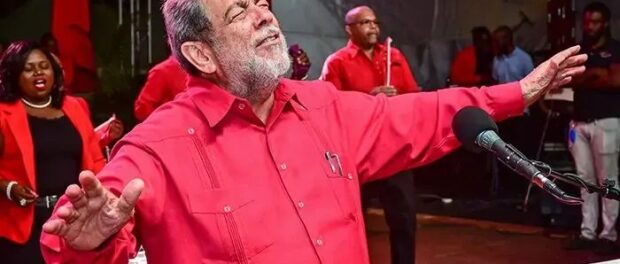
The Caribbean political landscape may be entering the end of one of its most enduring and controversial chapters.
Veteran St. Vincent and the Grenadines statesman has signaled that he is preparing to step away from the brutal frontline battlefield of electoral politics, bringing into focus what could become one of the most consequential political transitions in the modern Eastern Caribbean.
Approaching his 80th birthday this August, the longtime leader of the appears to be acknowledging what many across the region have quietly debated for years: the age of Ralph may finally be entering its sunset phase.
But if critics believed the veteran political warrior intended to disappear quietly into retirement, they may have profoundly misunderstood the man Caribbean political history has long described as “The Comrade.”
According to reports emerging from St. Vincent, Gonsalves made it clear that while the final decision ultimately belongs to the ULP, he would not encourage the party to place him at the helm for another general election campaign.
For regional observers, the statement is politically seismic.
For more than two decades, Gonsalves has towered over Vincentian politics with a rare combination of ideological conviction, intellectual firepower, grassroots populism, and relentless political stamina. Love him or oppose him, few Caribbean leaders of the post-independence era have managed to dominate national political discourse with the consistency, longevity, and intensity of Ralph Gonsalves.
Yet his latest comments arrive against the backdrop of a dramatically altered political reality.
The once-dominant political tactician now reportedly occupies a deeply diminished parliamentary position after the ULP suffered a devastating electoral collapse, securing just one of the country’s 15 constituencies in the last general election. The image is historic and symbolic: a man who once commanded the machinery of state now sitting virtually alone on the Opposition benches.
Across the Caribbean, the development has sparked intense debate about generational transition, leadership fatigue, political succession, and the future direction of progressive Caribbean politics.
But if Gonsalves is exiting electoral leadership, he is doing so on his own terms.
In characteristic fashion, the veteran leader reportedly rejected any suggestion that he intends to vanish from public life.
“The good Lord doesn’t intend for me to do that,” he reportedly declared in response to suggestions that political opponents hoped he would quietly disappear from the regional stage.
That statement alone captures the essence of Ralph Gonsalves’ political identity.
For decades, he has functioned not merely as a politician, but as an ideological combatant — one who consistently inserted himself into regional debates surrounding colonialism, sovereignty, reparations, economic dependency, regional integration, education, and Caribbean self-determination.
Now, rather than campaign rallies and constituency battles, Gonsalves appears poised to redirect his political energy toward what he increasingly describes as the defining moral struggle of the Caribbean: reparatory justice.
His recent appointment as senior adviser to the Repair Campaign — an initiative supporting the — signals that the veteran politician intends to transform his post-electoral years into a new phase of intellectual and diplomatic activism.
For Gonsalves, reparations are no longer simply a talking point. They are emerging as his political legacy project.
And perhaps fittingly so.
Few Caribbean leaders have spent as much time articulating the lingering economic and psychological consequences of slavery, colonial exploitation, and structural underdevelopment. In many ways, the reparations movement offers Gonsalves an arena perfectly suited to his personality: ideological, international, confrontational, and deeply historical.
Observers say his transition may also reflect a broader regional reality confronting Caribbean politics — the gradual passing of a generation of post-independence and post-Cold War political giants whose influence shaped the region for decades.
The Caribbean is increasingly entering an era defined by succession politics.
Questions are now intensifying across the region: Who replaces the old ideological warriors? Can younger political figures command the same emotional loyalty? Will Caribbean politics become more technocratic and less philosophical? And can modern leaders maintain regional influence in an age increasingly dominated by social media optics, economic anxiety, migration pressures, and geopolitical uncertainty?
Gonsalves’ departure from frontline electoral politics therefore represents more than a national transition in St. Vincent and the Grenadines.
It may symbolize the slow closing of an entire Caribbean political era.
Yet even as he contemplates political transition, Gonsalves appears unwilling to embrace political silence.
The veteran leader reportedly continues to maintain an exhausting schedule that would overwhelm politicians half his age. He is currently finalizing a nearly 480-page manuscript on Caribbean political leadership while simultaneously hosting lengthy political radio programmes multiple times weekly.
At the same time, a softer and more personal dimension of the longtime political firebrand has begun to emerge publicly.
In comments that resonated widely across the region, Gonsalves reportedly spoke warmly about spending time with his young granddaughter, describing their daily walks together and noting that she recently accompanied him on a trip to Jamaica because she “wouldn’t want me to leave her home.”
For many observers, the image was striking.
After decades of electoral warfare, regional diplomacy, parliamentary battles, fiery speeches, ideological clashes, and political survival, the aging revolutionary now appears increasingly comfortable balancing statesmanship with grandfatherhood.
Still, Caribbean political watchers caution against prematurely writing Ralph Gonsalves’ political obituary.
If history has shown anything, it is that the veteran Vincentian leader has repeatedly demonstrated an ability to reinvent himself politically, intellectually, and strategically.
The electoral battlefield may be changing.
But “The Comrade” appears determined to ensure that his voice — and his influence — remain deeply embedded in the Caribbean conversation long after he exits the campaign trail.
















Leave a comment
You must be logged in to post a comment.