THE CHRISTENA REPORT: The Inquiry That Changed Caribbean Maritime Safety Forever
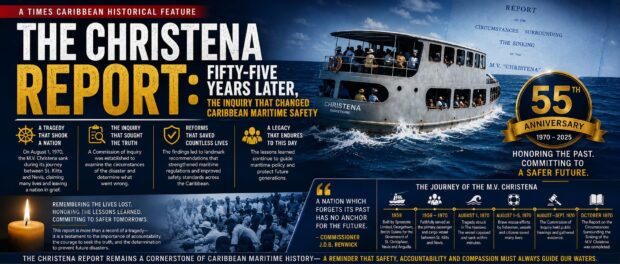
Executive Summary and Detailed Analysis of the 1970 Commission of Inquiry
A Times Caribbean Special Historical Feature
Fifty-five years after the tragic sinking of the MV Christena, the official Commission of Inquiry Report remains one of the most comprehensive investigations ever conducted into a maritime disaster in the Eastern Caribbean. Far more than a record of one catastrophic afternoon, the report chronicles the events leading to the tragedy, evaluates the government’s oversight of the vessel, examines eyewitness testimony, and recommends sweeping reforms that would influence maritime safety for generations.
Commissioned under the Commissions of Inquiry Act shortly after the disaster of 1 August 1970, the inquiry sought to answer three fundamental questions:
- What caused the MV Christena to sink?
- Could the tragedy have been prevented?
- What reforms were required to ensure such a disaster would never happen again?
The inquiry heard evidence from 45 witnesses during public hearings in Charlestown and Basseterre before Commissioner J. D. B. Renwick submitted his report in October 1970.
A Nation’s Greatest Maritime Tragedy
The sinking of the MV Christena remains the deadliest peacetime disaster in the history of St. Kitts and Nevis.
On what should have been a routine afternoon voyage from Basseterre to Charlestown during the busy August holiday weekend, hundreds of people—including workers, students, vendors, parents and children—crowded aboard the government-operated ferry.
Within minutes of entering The Narrows separating St. Kitts and Nevis, the vessel rolled heavily, capsized and disappeared beneath the surface.
The disaster devastated families across both islands and permanently altered the nation’s collective memory.
The Vessel
The Commission describes the MV Christena as:
- Built by Sprostons Ltd. in Georgetown, British Guiana (now Guyana)
- Completed in May 1959
- Steel-hulled with two decks
- Approximately 66 feet in length with a 16-foot beam
- Powered by two Caterpillar diesel engines
- Designed for regular inter-island passenger and cargo operations.
The ferry quickly became the principal transportation link between St. Kitts and Nevis, carrying commuters, students, farmers, merchants and families on an almost daily basis.
Intended Capacity
According to the Commission, the vessel was designed to carry approximately:
- 130 passengers
- Five tons of cargo
- Five crew members
Passenger regulations also imposed legal limits tied to vessel dimensions and tonnage.
Operational History
Evidence presented to the inquiry showed the Christena maintained an intensive operating schedule between the islands.
The report documents:
- Daily scheduled passenger service
- Routine maintenance and docking periods
- Engine servicing and repairs
- Annual inspections
Despite undergoing repairs throughout its service life, demand for the ferry remained consistently high because it served as the principal transport connection between St. Kitts and Nevis.
Administration and Government Oversight
The Commission devoted considerable attention to the administration of the vessel.
It examined:
- Ticket sales and accounting procedures
- Passenger counting systems
- Crew responsibilities
- Maintenance programmes
- Government supervision
- Compliance with maritime regulations
One of the most significant administrative weaknesses identified was the absence of an effective independent system for accurately verifying passenger numbers before departure.
Warning Signs Ignored
Among the report’s most significant findings is that concerns over overcrowding had been raised well before the disaster.
The Commission reviewed correspondence sent to government officials alleging that the vessel routinely carried passenger numbers beyond what appeared safe.
Evidence showed:
- Multiple written complaints were submitted.
- Government officials discussed the issue.
- Investigations were conducted.
- Corrective measures were either insufficient or not effectively implemented before the sinking.
These findings suggested that the tragedy did not emerge without warning, but rather followed a period during which safety concerns had already been expressed.
The Final Voyage
The Commission reconstructed the events of Saturday, 1 August 1970.
Because of the August holiday weekend:
- Passenger demand surged.
- Large numbers boarded shortly before departure.
- The vessel became heavily crowded.
- Witnesses estimated passenger numbers well beyond normal operating levels.
Passengers occupied:
- Benches
- Passageways
- Railings
- Open deck areas
- Virtually every available standing space.
Sea Conditions
Contrary to speculation at the time, the Commission concluded:
- Sea conditions were generally calm.
- Visibility was good.
- Weather was not considered the principal cause of the disaster.
This shifted the investigation toward vessel loading, stability, operational procedures and regulatory oversight rather than environmental conditions.
The Capsize
Witness testimony consistently described the vessel:
- Developing a list
- Rolling heavily
- Taking on water
- Capsizing rapidly
Passengers were thrown into the sea while others became trapped inside the vessel as it overturned. Nearby boats and fishermen began rescue efforts almost immediately.
Extraordinary Rescue Efforts
The Commission commended the courage displayed by:
- Fishermen
- Private boat operators
- Nearby vessels
- Volunteers
- Survivors who helped rescue fellow passengers
These spontaneous rescue efforts saved many lives despite limited emergency resources available at the time.
Technical Findings
The inquiry examined numerous possible technical causes, including:
- Hull condition
- Vessel stability
- Steering systems
- Structural design
- Cargo distribution
- Trim and loading
The Commission found no evidence that a single catastrophic mechanical failure alone caused the disaster. Rather, it concluded that several interrelated factors combined to produce the sinking.
Overcrowding as a Critical Factor
A substantial portion of the report focuses on overcrowding.
Evidence suggested:
- Passenger numbers greatly exceeded the vessel’s intended capacity.
- Passenger concentration affected weight distribution.
- Large crowds gathered on the upper deck and stern.
- Passenger movement influenced vessel stability.
The inquiry treated overcrowding as one of several major contributing factors rather than the sole explanation for the disaster.
Life-Saving Equipment
The Commission reviewed the availability and accessibility of:
- Life jackets
- Lifebuoys
- Seating arrangements
- Escape routes
Although life-saving equipment was carried aboard, the report concluded that the rapid speed of the capsize left many passengers with insufficient time to locate or effectively use it.
Institutional Weaknesses
Beyond the physical circumstances of the sinking, the report identified broader institutional shortcomings, including:
- Weak enforcement of passenger limits
- Inadequate monitoring systems
- Deficiencies in government oversight
- Insufficient follow-up after earlier complaints
- Operational safeguards that did not adequately address known risks
The inquiry concluded that these systemic weaknesses increased the likelihood of a serious maritime accident.
Principal Conclusions
Commissioner Renwick determined that the tragedy resulted from multiple interconnected failures, including:
- Serious overcrowding
- Weak enforcement of passenger regulations
- Administrative deficiencies
- Stability issues arising from loading conditions
- Insufficient operational safeguards
- Limited emergency preparedness
The report emphasizes that no single isolated event fully explained the disaster. Instead, it arose from a combination of technical, operational and administrative factors.
Landmark Recommendations
Among its most enduring contributions were recommendations for sweeping maritime reform:
- Strict enforcement of passenger limits
- Mandatory vessel inspections
- Comprehensive stability testing
- Improved crew certification and training
- Modern licensing procedures
- Enhanced radio communication systems
- Stronger maintenance standards
- Improved life-saving equipment
- Clearly defined legal responsibilities for operators and regulators
- Stronger penalties for breaches of safety regulations
Many of these recommendations anticipated safety practices that later became standard within Caribbean maritime transport.
Historical Legacy
The significance of the Christena Report extends far beyond the events of 1 August 1970.
It remains:
- One of the most important historical documents ever produced in St. Kitts and Nevis.
- A detailed public record of the nation’s greatest maritime tragedy.
- A landmark study in public administration, transportation safety and government accountability.
- A continuing reminder that effective regulation, consistent enforcement and timely responses to safety concerns are essential to protecting lives.
More than five decades later, the Commission’s findings continue to offer valuable lessons for governments, regulators, vessel operators and the travelling public throughout the Caribbean.
Overall Assessment
The Commission portrays the sinking of the MV Christena as a tragedy caused not by a single defect, but by a convergence of operational, regulatory and administrative failures. Its enduring message is that public safety depends on vigilant oversight, sound engineering, effective enforcement, proper vessel loading and the willingness of authorities to act decisively when warning signs emerge. As both a historical record and a blueprint for reform, the report remains one of the most consequential public inquiries in the history of St. Kitts and Nevis.
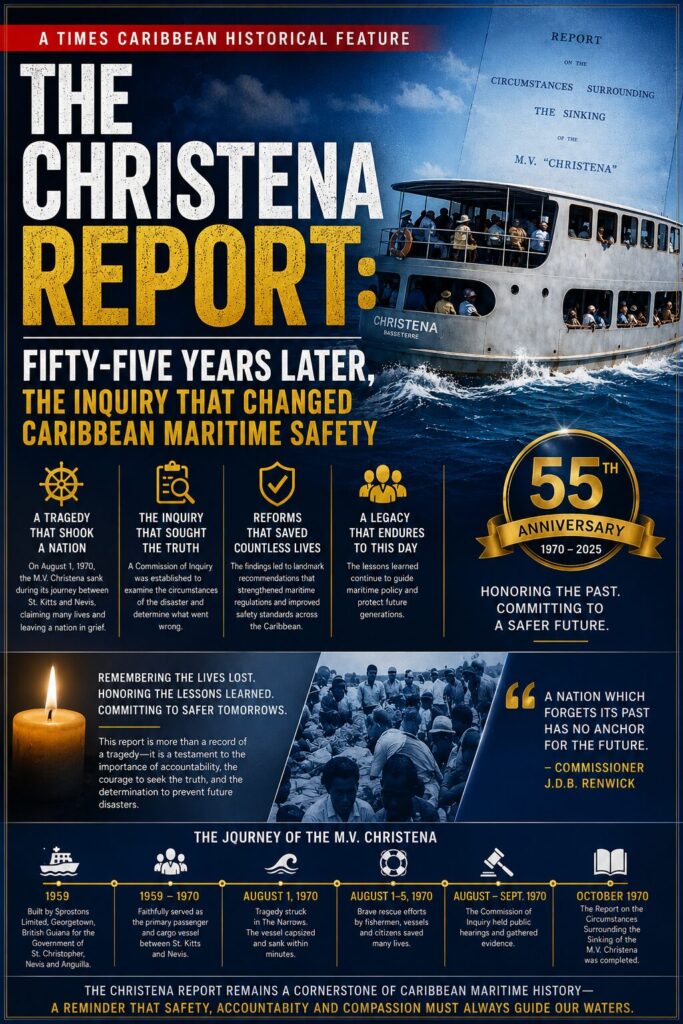
Report on the Circumstances Surrounding the Sinking of the M.V. Christena
A modern WordPress-formatted transcription of the 1970 Commission of Inquiry into one of the most consequential maritime tragedies in the history of St. Christopher, Nevis and Anguilla.
Editor’s Note: This WordPress edition preserves the substance of the extracted report while improving layout, headings, readability, and publishing structure. Because the source text was extracted from a scanned/archival document, a final proofread against the original report is recommended before official publication.
At a Glance
| Subject | The sinking of the Motor Vessel Christena during its scheduled voyage between St. Kitts and Nevis. |
| Date of disaster | Saturday, 1 August 1970. |
| Inquiry authority | Commission appointed under the Commissions of Inquiry Act, Chapter 288 of the Laws of Saint Christopher, Nevis and Anguilla. |
| Public hearings | Charlestown, Nevis: 17–19 August 1970; Basseterre, St. Kitts: 24–25 August, 1 September, and 5 September 1970. |
| Witnesses | 45 persons gave evidence before the Commission. |
| Vessel builder | Sprostons Limited, Georgetown, British Guiana; completed in May 1959. |
| Commissioner | J. D. B. Renwick. |
| Report date | 1 October 1970. |
Publisher’s Suggested Intro
This publication presents the modern-formatted text of the official Commission of Inquiry report into the sinking of the M.V. Christena. The report examined the vessel’s design, operation, passenger capacity, safety equipment, warnings of overcrowding, rescue efforts, and recommendations for reforming coastal passenger service between St. Kitts and Nevis.
It is in my view beyond question that on many occasions by whatever yardstick is used the number of passengers carried by the Christena greatly exceeded the number that she should have carried.
Commission Report
Suggested Table of Contents
- Commission Report
- The Vessel and Its Operation
- Passenger Regulations and Overcrowding Concerns
- The Final Voyage of 1 August 1970
- Capsizing, Rescue, and Recovery
- Findings on the Hawthorne Enterprise Allegation
- Recommendations for Maritime Safety Reform
- Appendix A: List of Persons Identified
- Appendix B: List of Missing Persons
- Appendix C: List of Survivors
- Appendix D: Reports Unable to Be Confirmed
- Witnesses Who Gave Evidence
Full Modern-Formatted Report Text
Commission Report
I was appointed pursuant to the provisions of the Commissions of Inquiry Act, Chapter 288 of the Laws of Saint Christopher, Nevis and Anguilla by His Excellency The Acting Governor to hold an inquiry and investigate the circumstances surrounding the sinking of the Motor Vessel Christena on her scheduled voyage between the Islands of Saint Christopher and Nevis during the afternoon of Saturday the first day of August, 1970 and to report to His Excellency in writing my findings and to make such recommendations as may seem to me meet in the special circumstances of the case. I was directed to hold the meetings of the Commission in public, to hold the first such meeting on or before the 31st day of August, 1970 and to.present my report on or before the 15th day of September, 1970. Meetings whereat evidence was taken were held at the Courthouse, Charlestown, Nevis on Monday 17th, Tuesday 18th and Wednesday 19th days of August, 1970 where 25 persons gave evidence, and at the Courthouse, Basseterre, St. Kitts on Monday 24th, Tuesday 25th days of August, 1970, Tuesday 1st and Satur day 5th days of September, 1970, where 20 persons gave evidence. The Motor Vessel Christena was designed and built by Sprostons Limited, Georgetown, British Guiana at Georgetown aforesaid for the Government of Saint Christopher, Nevis and Anguilla. and completed in May 1959. In the builders certificate she is described as follows: ”The frame, keel and deck of the vessel are of steel. She has one mast, two decks, oblique stern, elliptical stern, hard chine built. The general dimensions are as follows:
Length Main Breadth
66′ – 0” 16I – 0″
Depth in Hold 4' - 5"
Depth from top of deck al side
amidship to
5I - 6"
Nil
Her tonnage measurement is estirnated at · · 22.66 ,, The Certificate of Survey as is required by the MerchantShip. . g Acts 1894 to 1952, gives her length as 62′ 10″, and her regi· tered tonnage as 33.74. In a dd.”1t1on th e vessel h ad 5 watertight bulkheads. She Was powered by 2 Caterpillar Diesel _ D326 _F F marine engines made in 1958 by the Caterpillar Tractor Company: Peoria, Ill1no1s, U.S.A. The vessel was designed to carry a maximum of 5 tons in the forward hole, 100 second class passengers on the main or lower deck, 30 first class passengers on the upper deck and a crew of 5 The makers however increased the number of passengers to be carried on the lower deck to 120. From the drawings which were produced in evidence I found the following:-
The Ministry of Communications, Works and Transport was responsible for the administration, operation and maintenance of the M.V. Christena. She was manned by a Captain, James Ponteen, a mate Frank Matthew, an engineer, Charles Moore and assistant engineer, Conrad Phipps, and 5 crew members. I have been unable to ascertain whether any member of her crew received any formal training in navigation. The probability is that their experience was purely practical. Tickets for each trip were sold during the voyage by Captain Ponteen, or, during his absence, by a clerk in the Ministry who was especially assigned to dealing with matters concerning the Christena. Each morning after the Christena had returned from Nevis, the clerk would check the number of passenger and cargo tickets sold against the actual cash receipts. Having verified that, he would make out a deposit slip to the bank and hand over the
Length of upper deck
44′
cash and deposit slip to the Captain, and the latter would make the
Uncovered portion of upper deck Height of cabin on upper deck From ceiling of upper deck
13I 9” 6′ 10″
deposit in the bank. The Captain would then lodge the deposit slips half monthly at the Treasury. The Christena was docked as follows:- From 28/ 3/60 – 27/ 4/60 in Barbados at a
to lower deck
13I 9″
cost of
$ 9,529.65
Draught Freeboard
3I 5” 2′ 1″
12/12/60 23/11/61
3,419.12 14,800.00
The M.V. Christena provided a scheduled passenger and cargo service between the islands of St. Kitts and Nevis. From Monday 26th August 1968 (except when away for docking) she made two return trips to Nevis daily except on Thursdays and Sundays. She was also available for charter. Passengers on the upper deck paid $1.00 each way, while those on the lower deck The charges for freight were as follows:- Small packages, baskets of goods and sacks of flour 10¢ each I
27/ 2/63
24/ 4/64
20/10/64
14/ 8/65
9/ 2/70 –
7/ 5/70
in Tortola at a cost or Barbados Barbados
7,416.30
6,485.75
4,007.93
31,388.39
14,543.00 22,344.88 42,282.79
Bags of sugar (large)
50¢ each
The Central Foundry Limited of Barbados, a firm of Dock and
Small stock
35¢ per head
Foundry Owners, Ship-builders, Marine and General Engineers, re paired the M.V. Christena whenever she was docked in Barbados.
Passengers were allowed one handpackage free.
During her last docking repairs were effected t:o the engines, pro peller sha assembly, toilets and wash basins, life rafts, bilge
deck, hatch,
From all this it can be seen that the Christena was docked annually when all necessary repairs were effected. The Christena returned to St. Kitts on Tuesday 17th May 1970 and resumed her normal schedule beginning with the afternoon trip on the 19th May. The passenger carrying capacity of ships plying between St. Kitts and Nevis is fixed by the Passenger Regulations, Chapter 155 of the Laws of Saint Christopher Nevis and Anguilla, Revised edition 1961, I The Regulations state as follows:- ” 2. Number of Passengers (1) The number of pas passengers to be carried by ships of over 20 feet of keel between the islands of St. Kitts and Nevis, or going coastwise in either island shall not exceed two passengers for each one foot of keel, or not to exceed six passengers for each registered ton.” The Passengers (Motor Boats) Regulations which were made some 15 years later modified regulation 2 (1) of the Passengers Regulations above quoted and provided as follows:- ” 3. Number of Passengers Restricted. Notwith standing anything to the contrary contained in the
tena determined. From that it naturally follows that the requirement that ”the number of passengers so determined shall be legibly painted in a conspicuous place on such motor boat to the satisfac tion of the Comptroller of Customs” was not observed. Julian Byron Cox, the Permanent Secretary, 1inislr)’ of Com munications, Works and Transport, deposed that he had personally never received any information or complaints about the Christena being overloaded. He went on however to produce from the records two letters dealing ,vith this matter. The first ,vas dated 1st July 1959 from W. L. Maguire, arden of Nevis and the other ,vas dated 26th January 1960 and was from Delisle Walwyn & Co. Ltd. Suffice it to say that no reply ,vas sent toir. iaguire lhile the reply sent to Messrs. Delisle Wal,vyn & Co. Ltd. ,vas not as polite as it should have been and the action therein promised,,,as nottaken. I have however con1e across another letter ,vhich in part deals with this matter. This letter was addressed to the Honourable Min
? Passengers Regulations, the number of passengers
ister of Communications & Works and a cop)1 placed on the personal
which may be carried at any one time in any motor boat shall not exceed the number determined by the Comptroller of Customs on the written application of the owner of such motor boat, and the number of passengers so determined shall be legibly painted in a conspicuous place on such motor boat to the satisfaction of the Comptroller of Customs.” In these Regulations the expression ”motor boat” means any motor boat carrying passengers between the islands of St. Christo- pher and Nevis. I ,,1:t1 the.Passenger Ordinance, Chapter 155, the word ”passen ger 1s defined as follows:-
” ‘passenger, means any person carried in a ship, except (a) a person on board the ship on the business of the ship, (b) a person on board the
file of the Captain of the M.V. Christena. The letter is dated 20th fay 1961 and ,vas written by Cecil O. Byron, then Acting Warden of Nevis. The first paragraph of this letter reads as folloY.1s:- ” I travelled yesterda)’ to St. Kitts, by the M.V. Christena for business ,vith His Honour the Adminis trator. Captain Ponteen was a,varo of my presence on the launch as I had reason to suggest to him, soon after we embarked, that he should consider ,vhether it ,vas advisable to take the 1otor Vessel back to the Charlestown Pier in vie,v of the large number of pas passengers on board and the somewhat disconcerting experience,ve had suffered in regard to the balance of the v ssel as soon as it had set out its course. The Captain however decided to proceed and ,ve ar rived at Basseterre without further incident.”
It will be noted that in this paragraph the acting Warden dealt with two matters viz., the large number of passengers on board, and the balance of the vessel. I shall deal with the second of these matters later. I his letter the Acting Warden dealt with other facets of the opera ion of the Christena. I was unable howeve to find on the file any reply to any of the points made by the Acting Warden orof any action taken as a result of that letter. These three letters were written to the Ministry responsible for the running of the vessel and each letter contained anallega tion of an expressed concern over the overcrowding of the vessel. These warnings apparently evoked no action from the Ministry. I am of the opinion that as time v.·ent by people having become more accustomed to and confident in the vessel, were not as alarmed by thevessel being continuously overcrowded as they had beensoon after she went into service.
011 Tuesday 12th July, the Captain of the Christena at his ownrequest was permitted to make two trips to Nevis at theend of that day’s play in the final match of the Leeward IslandsCricket Tournament played between St. Kitts and Nevis. Mr. Coxsa,vthe Christena leaving for Nevis on the first of her said trips. He was of the opinion then that she was overloaded. Next day hecalled in the Captain and told him that the boat had beenoverloaded. This the Captain denied. A check of the cashreceipts by him showed that the boat Was not overloaded. Mr. Cox then Wenton to state that he told the Captain that he was notsatisfiedwith the amount of people he had seen on the boat and that he,the Captain, was risking people’s lives and if he didn’t care about his, heshould have some thought for young children, women and old people on the boat.
I would like to point out that checking the cash receipts would not reveal whether the boat was overloaded on any one trip,since the receipts covered 2 round trips to Nevis and inthe case of the check on 13th July related to 5 round trips,viz. 1 on Saturday, 3 on Sunday and 1 on Monday. The revenue returns clearly show at for every period covered, more passengers travelled first class than second cl ass. I find this hard toaccept and itsh uld have alerted the Ministry and the Audit Department, I w ich audited he accounts that a physical check of the passengers using the Christena was necessary. Besides the exhortation to the Captain by the Penn anent Secretary, nothing was done. Iti in my view beyond question that onmanyoccasions by
whatever yardstick is used the number of passengers carried by the Christena greatly exceeded the number that she should have carried. As the mate said whenever the Christena was the only passen ger boat on the St. Kitts-Nevis run she would be overloaded. Dulcita Browne, a witness who impressed me as being honest and truthful and was a regular commuter said ”Sometimes when the Christena put out the amount of people, you think is a steamer bring these amount of people.” On Saturday 1st August, 1970, at about 3. 30 o’clock in the afternoon the M.V. Christena cast off and began leaving the Treasury Pier, in Basseterre. There were three late comers and the Cap tain brought the vessel back to the Pier and picked them up. The boat was crowded with passengers. This was August Bank Holiday weekend. In addition to the usual tum-hands i.e., those who had come from Nevis to sell their vegetables and other produce in St. Kitts, there were holiday makers, relatives intent on spending a weekend with their loved ones and families in Nevis, Nevisians returning home after a week’s work in St. Kitts, Nuns going on retreat and others. There were more than three hundred men, women and children on board. They realized that the boat was overcrowded but thought not so much of the danger they themselves helped to create but rather of getting to Nevis. Most passengers were crowded in the stern of the vessel, as that was where the passenger accommodation was situated. Passengers were sitting wherever they could find a place to do so, even on the handrails and places where they knew they were not allowed to sit. As the vessel swung towards Nevis it rolled on the starboard side, stayed there for a while, came back on even keel and then rolled to·the port side. The sea was calm, the ,vind moderate to light and visibility was good. The Captain was obviously concerned with the trim of the vessel. He ordered his crew to move some crates of sweet drinks amidship and the passengers away from the gunwale to the middle of the boat and not to move around. While some passengers obeyed him, a goodly number heaped abuse on him. The vessel continued to roll from one side to the other and on each occasion water washed over the stern. The Captain handed over as was his custom the wheel to the mate and began collecting the fares.
A small fishing boat on its way to Nevis, was just ahead
of the
Ch stena. Wade and Parris its occupants signalled to the
There were 25 life saving jackets for adults in the Captain’s
Ch . i…
r1 to reduce speed as she was seen
b h. . e s 1pp1ng water
cabin and 58 on the rack on the upper deck. On the lower deck
. ·r · in thestern. This signal was either not seen or, 1 1t was seen, was not understood. As the Christena was about to_ enter the. Narrows i.e. the channel between SL Kitts and Nevis, but while she was still sheltered by Nags Head, she rolled over to the starboard side. Victor Swanston who was standing in the bow of the vessel jumped overboard and dived to avoid the propellers. As he came to the surface he ,vas churned up in the wake of the vessel. He started to swim and saw the vessel with only 10 feet of the bow and its mast, out of the water. People were screaming, crying and praying, trying to get out of the stricken vessel and holding on its bow and mast. In a very few short minutes at about 4.10 p.m. she sank. Why did the Christena sink after having sailed for over half an hour, having covered nearly half the voyage to Nevis and in almost ideal weather conditions? To answer this question since inspection of the hull revealed that it is tact I must refer briefly to the design of the vessel. She was a vessel which drew under 4 feet of water. In order to come alongside the Treasury Pier she had to be of shallow draught. On the other hand her superstructure was over 13 feet high and she was of normal beam. This type of construction would to my mind mean that she would roll a good deal. On this her final voyage ·she carried relatively speaking little cargo. With an overcrowded upper deck and little cargo to act as a counter balancing force it is obvious that Christena capsized. Having capsized the stern filled and.because she was buoyant in the bows this part of the vessel was the last to sink. Inspection of the hull by divers showed that the’ steering mechanism was at that time malfunctioning. It is not possible on the available evidence to state the cause of the malfunction or when it arose. The divers found that the steering wheel and rudder are locked hard starboard and that turning the steering wheel does not affect the position of the rudder. If this malfunction had arisen before the Christena capsized, the helmsman would not have been able by steering to help right the vessel on her last roll to starboard and th_i malfunction could have been a contributory cause her capsizing. In my view this malfunctioning could not by itself have caused the loss of the vessel. Why after capsizing she sank so quickly I am unable to say as inspection of the bulk heads has not been possible.
there were 95 and 40 life saving jackets for adults and children respectively. In addition there were 5 buoyant seats each with a capacity of 18 persons. In my view the Christena sank so quickly after she had rolled over, that there was not sufficient time for people to get the life saving jackets. The fact that the buoyant seats had not floated, lent weight to the evidence, which was denied by the mate, that they had recently been bolted down to the deck. The true position, however, is that the seats were not bolted but having floated jammed the companion ways and other exits. Two probable reasons for this are firstly, the vessel sank stern first thereby trapping the seats and secondly a part of the upper deck which was originally uncovered had been covered with ply wood to provide shade and shelter, this covering would naturally have t’he effect of boxing in the seats. So, tragically, what was designed as life saving equipment trapped persons in the vessel making escape therefrom nigh impossible. The exact position of the Christena was first ascertained by Captain Phillip Miller by using electric sonar equipment. This was confirmed by H. M. S. Sirius. It Was marked by a white foam buoy, a yellow anchor rope and a 12 lb. anchor. The Christena is lying in 11 fathoms of water, !attitude 17° 12.2′ N and longitude 62° 39.8′ W; 9/10 of a mile from Nags Head. This position has been confirmed by the divers. The first boat on the scene was a small fishing boat which was manned by Wade and Parris. The latter had actually seen the Christena sink. They t.ook a few people into their small boat and landed them on the rocks at Nags Head. From there they proceeded to Cockleshell Bay to get help. No one,vas there so they crossed the Narrows and went to Jones Bay, Nevis, where they met a fishing boat Sea Hunter 1. She had just returned from a fishing trip and ,vas being docked. Captain Miller had already gone ashore. Wade told the mate of the Sea Hunter 1, Winston Skeete also known as Sonny Boy that the Christena had sunk and ,vi thout further ado, Skeete together with Wade, Parris, Robert Jeffers, Rupert Maynard and Foster Huggins set off to the disaster area. In the meantime those ,vho could swim were trying to reach Nags Head. Others holding on to empty soft drink cases, some to benches and other floating objects. A number of men were holding on to an empty drum. One ,voman who had her youngest child swept out of her anns by the force of the water on the final roll of the
vessel was saved for as she put. It ” God was so merciful to me He
d a bag with 3 breadfruit 1n 1t and 1s that I held on and take me oswenn time swim t·ill ClIffDweller,s boat p1c k e up. ” Stronger
Charles Moore, the engineer on the Christena, stated in evi dence that soon after the Christena sank he saw ”the ship bows
swimmers encouraged tho “veaker ones. Upon this scone camea small J-.0pt ,v,th Mi hacl I{ing at tt10 helm. Michael King’s evidence is very important so I will deal with it in’ some detail. Let me begin by saying I accepted his evidence as the untarnished truth. He stated that he was on his way to Novjs accompanied by his wife and four daughters, brother and his wife and ]1is sister. As they were passing Nags Head one of his children drew his attention to some people waving at them from the rocks at Nags Head. His boat was bet,vcen 50 and 100 yards off Nags Head. He then turned around and saw several people swim ming in the sea further out. He then realized that the Christena must have sunk. He dropped off the ladies, children and baggage on the nearby rocks and with his brother went to the disaster area. I will continue in King’s o,vn words ”We saw the ship Hawthorne Enterprise about 4 miles off shore. Our first plan,vas .to go out to it for help but seeing so many people arou11d us drowning we stopped to pick up one and a second and then next we knew we had a boat, load. We realized that by the time we got the Hawthorne Enterprise on to the scene most of the people would have drowned. By this time ,ve had about 10 people on board the little speed boat which was all it could carry and we headed for shore. At this point we saw the Sea Hunter – we saw it in the disaster area, and we went to her to off load the survivors we had on board.” There was- one elderly lady who was actually drowning – she was going down and coming back up – and he jumped overboard and managed to savo her and get her aboard with great difficulty. He took every one he rescued to the Sea Hunter. He made about 4 such trips. The Sea Hunter then took 63 survivors and 3 dead bodies back to Jones Bay. There they were met by George Bradley, Government Secretary. The survivors were taken to the hospital where they were treated, some discharged and others detained. The Sea Hunter put back out to sea, this time with Captain Miller in command and continued rescue operations and the painful task of recovering dead bodies from the sea. One important matter demands my attention at this juncture. I refer, of course, to the allegation that a ship the Hawthorne Enterprise had been contacted by radio by the Sea Hunter and not only had_she refused to give assistance after having been told that the Christena had sunk but someone on that ship had used indecent language to So?ny Boy Skeete. This allegation is undoubtedly the only one on which there was a sharp conflict.
on to the Christena where it had gone down_,, As he was at that time heading towards Nags Head he turned back and swam towards the shipas it would be much better for him if he could be picked up early rather than have to swim all the way to Nags Head. The boat was then about 2 miles off Green Point. Suddenly he saw the boat turn away and go back to sea. He was later pi eked up by Michael King and put on the Sea Hunter. As he got on board the Sea Hunter Sonny Boy Skeete asked him to assist him with the radio and to try and call any station. Continuing Moore deposed that he called and was answered by the Hawthorne Enterprise. After the indecent language he heard Sonny Boy speaking to the Police Launch. Frank Matthew who was rescued by the Sea Hunter after Moore had already been on board, on the other hand said he could actual ly read the name of the Hawthorne Enterprise painted on the bow of that ship so close to him was she , while he was swimming. He went on to say that he overheard parts of the conversation between the Hawthorne Enterprise and the Sea Hunter including Charles Moore stating ”this matter will have to be reported.” Sonny Boy Skeete related how he asked 1oore to call as he could get nothing. Moore he said got the Ha,vthorne Enterprise and he spoke to that ship. He ,vent on to state that he also contacted a yacht and the Police Launch. It is not necessary in my vie,v to go into the alleged conversa tion with the Ha,vthorne Enterprise in detail.. It is agreed by all that Moore and Matthew ,vere landed at Jones Bay when the Sea Hunter took its first lot of survivors to Nevis. This was dono when Captain Miller ,vas not on the boat. As the evidence of the Chief of Police and Mr. Cox clearly shows the Police Launch had not left Basseterre yet and so the evidence of Moore and Skeete that they had contacted the Police Launch is not true. Further I do not believe 1atthew when he said he was able toread the name of the Hawthorne Enterprise on the bow of the shipwhile he was swimming. The most reliable witnesses estima ted the distance that that ship passed from the disaster area as being between 2 and 4 miles. I am firmly of the opinion that it is not possible to read 6 inch high by 1 inch wide letters at that distance. .
Skeete, Matthew, and Moore all gave statements to the police describing in great detail their accounts of the events. In not one
of ‘”h es0 stateinents was any reference to t.he Hahwthor.ne .Enterprise
Guard, San Juan, Puerto Rico and which was received on 27th
made.
This omission is all the more serious w en 1t 1s recalled
August –
that Moore is alleged to have said that th1.s mat er w1·11h
ave to be
reported. When each was asked by me wh he d1d not r fer to this important matter to the police, Skeete said he was doing so and was prevented from doing so b_ythe polIcen:1an who took his statement and this the policeman denied, and neither Matthew nor Moore had any comprehensible reasons for the omission. It is not surprising, therefore that I find no truth whatever 1n their accounts of their supposed contacting of the Hawthorne Enterprise. But the matter does not end there. Captain Stanley Wynter, Master of the Hawthorne Enterprise, appeared and gave evidence before me. He impressed me as an honest and trustworthy witness. He categorically denied having known anything about the sinking of the Christena or having had any radio conversation with the Sea Hunter at all. The evidence of the boats,vain added great weight to his Captain’s testimony. I am,vell aware that Captain Wynter had said that he was waiting for an important weather report from the radio station on Tortola which he got at 6.30 p.m. whereas the boats.vain had said that he did not know that the Captain was listening for a weather report and he did not hear any weather report. To my mind this shows even more clearly that their evidence ,vas true since if they were fabricating they would surely have tied off this loose end. Before finally leaving this aspect of my report I feel constrained to allude to another pertinent matter. Mr. Christian had informed me that he had cabled the United States Coast Guard in Puerto Rico, whom he said kept a 24 hour watch on 2182 kcs – the wavelength alleged to have been used throughout – and that he would like to produce this reply, whatever it contained. I told him I would permit him to produce the reply he received. This was on Tuesday, 1st September being the day on which Captain Wynter gave hj s evidence. On Saturday, 5th September Mr. Christian produced tl1e reply he had received on 1st September and which reads _
” RE: SINKING CHRISTENA BETWEEN ST KITTS NEVIS AUGUST FIRST. REVIEW OF SEARCH AND RESCUE CASE FILE NR 4271 – 70 DOES NOT INDICATE A MAYDAY MESSAGE RECEIVED SAN JUAN STATION THAT DAY.” After this telegram had been produced, the Attorney General produced the following telegram from the United States Coast
” REUR TELEGRAM 37 26 11552 BG THIS STATION HEARD NO DISTRESS CALL FR0 1 FIV SEA HUNTER AT TIMES IN QUESTION STOP THIS STATION FIRST HEARD OF POSSIBLE DISTRESS AT 2313 GMT WHEN OUR RADIO STA1’ION OVERHEARD TWO BOATS DIS CUSSING BRINGING IN BODIES ON 2182 KH2.” This latter telegram in my view shows without doubt that the reports made against the Hawthorne Enterprise are entirely without foundation in fact. The conversations overheard by the Coast Guard in San Juan fit precisely in point of time with the conversations between the Sea Hunter and the Police Launch, evidence of which was given both by Captain Miller of the Sea Hunter and the Chief of Police. The telegram by inference shows that the U.S. Coast Guard could have picked up messages transmitted by the Sea Hunter tant pis messages sent by the Ha,vthorne Enterprise. The fact that the only communication they overheard took place at 7.13 p.m. speaks volumes. It is a pity that the frankness which prompted the production of this telegram arose only after Captain Wynter had been warned that his alleged misconduct was an offence against the laws of this State, after his cross-examination and that of the boatswain of his ship and after his counsel had not only undertaken to pro duce any reply he received from the U.S. Coast Guard but had in fact produced the reply he received. Dr. Simmonds and the nursing staff of the Alexandra Hospital, Nevis, augmented later by medical and nursing personnel from St. Kitts rendered yeoman service tending the survivors. The task of recovery, identification and burial of the dead proceeded ,vith dignity and despatch. From all the available information, 57 dead bodies,vere identified. A list of these is attached hereto as appendix A. ‘hilst trusting that I do not cause further sorrow to the bereaved I must point out that t.here have been doubts expressed as to the identification of Kirsten Olivia Liburd, and I that although the body of Clarent Forbes was identified and his address given as Sandy Point, none of the residents of Sandy Point I who have been contacted can confinn the identification. Recovery of dead bodies was effected on Sunday, Monday and Tuesday the 2nd, 3rd, and 4th days of August, respectively. With the passage of time, identification of the bodies became virtually impossible and so had to be abandoned. All necessary
health precautions to prevent the outbreak of disease were taken. In Nevis 6 unidentified bodies were buried while in SL Kitt, the number of such bodies was 60. I regard the ascertainment of the number of persons who sailed on the 1st iugust as of paramount importance. With this in mind I personally prepared 3 lists, namely:- . ‘ (a) a list of the persons whose bodies were identified ( b) a list of the persons reported as having sailed on the Christena and missing (c) a list of the survivors. These lists were given wide publication and were checked by the Ministry of Health, the Government Secretary, Nevis, the Police and other interested persons. The list of missing persons is attached hereto as appendix B, and the list of survivors is appendix C. There are a few persons who were reported as missing but subsequent investigations have beoo unable to reveal anything whatsoever about them. I have attached those names as appendix D. By the terms of my appointment I was enjoined to make such recommendation::; as may seem to me meet in the special circum stances of the case. No evidence was given on this aspect during the inquiry and unfortunately in the time and with the information available I have not been able to produce as comprehensive recommendations as I would have liked. Here ho, however, are a few personal random thoughts. I feel that an immediate study should be made to determine the present pattern and future aspects of coastal trade bot}1 in passengers and cargo between St. Kitts and Nevis. This study should reveal the economic viability of such trade and whether or not it should be subsidised. It should also lead to finding out the most suitable boat for such trade.
owned vessels which were engaged in operating a scheduled passenger service between St. Kitts and Nevis were lost- one during a hurricane, one by fire, one at the Charlestown Pier and one while riding at anchor in Basseterre. Fortunately no lives were lost but the inescapable inference must be drawn that these vessels were not sea worthy. I recommend that new and comprehensive legislation to govern and regulate coastal trade both passenger and cargo be enacted. ‘ I do not intend to go into detail as this will be trespassing on the l draftman’s province but I will indicate the broad topics with which such legislation should deal. In making my proposals I am deeply I conscious of the fact that coastal trade must not be made difficult or expensive and that getting from one island to the other must be achieved with the minimum of inconvenience and red tape. However the safety of passengers must be the prime consideration. . In the first place the legislation should provide for the licensing of all vessels irrespective of o,,,nership and size engaged in 1 coastal trade. The licence should be of not more than 12 months’ duration and should be issued by the Comptroller of Customs ,vho should keep a register of such licenses. A licence should only be granted after the vessel has been inspected and certified as being safe for the carriage of passengers by some competent person or authority. To qualify for such a certificate a vessel will have to:- (a) possess an adequate amount of watertight bulkheads; (b) pass a stability test; (c) possess sufficient life saving equipment viz. life buoys, life saving jackets and rafts; (d) be equipped with adequate fire protection device; (e) be equipped ,vith efficient radio receiver and transmitter; and
The present statutory provisions governing coastal trade between St. Kitts and Nevis are to be found in more than one Act, ‘ Ordinance and Statutory Rules and Orders. The legislation is quite old, and while it contains provisions which deal with the safety of passengers, it is in the main geared to curb smuggling, e.g. the
(f)
where appropriate have efficient mechanical and electrical installations, special emphasis being paid to any equipment which is a necessary part of any system vital to the safe navigation of the vessel, such as propulsion and steering systems.
only vessels which trade coastwise that have to be registered are those of under 30 tons. The records show that in the past twelve years 4 privately
A certificate as being safe for the carriage of passengers should be of not more than 12 months duration. As regards the number of passengers which a vessel will be
licensed to carry the present provisions that this should be based on the length of the keel or registered tonnage of the vessel al though already modified by the Passengers (Motor Boats) Regula tions before cited needs closer examination, and expert advice on this sl,ou]d be obtained. The legislation should lay down the criterion to be followed when determining the maximum number of passengers a vessel will be allowed to carry. Breach of this provision should be severe ly punish able. As far as I am aware no legislative provision here exists for issuing certificates of competency to Captains of ships engaged
like to point out that cargo dangerous in itself should not be carried with passengers. In a community as small as ours it is not surprising that many and varied rumours,vere circulated following news of the disaster of the 1st August. I am pleased to state that although I relaxed the rules of evidence, those giving evidence showed remarkable candour and appreciation of the task I was asked to perform. I wish to put on record my gratitude to all and especially the people of Nevis who never said or did anything to cause me embarrassment in this Inquiry. My profoundest sympathy goes out to all the bereaved.
‘ in carrying passengers coastwise. I recommend that this be intro
Dated this 1st day of October, 1970.
duced. In the beginning the legislation should provide that Captains of such ships should satisfy the examiner that:- (a) their eyesight is normal as regards fonn and colour vision; (b) they have a working knowledge of the Regulations for P reven ting Collisions at sea; (c) they have a thorough knowledge of the different lights carried at night by all types of craft; (d) they understand how to go alongside piers and jetties; (e) they know what action to take in case of fire, man over board, taking a boat in tow, being taken in tow, losing a rudder, engine breaking down etc.; · (f) they can use ship to shore radio etc. More subjects should be added to the preceding list dependent on whether the ship will be operated at night and the number of passengers she will be permitted to carry. In my view to be a Captain of a ship carrying over 100 passengers, such a person should hold at Ieast a valid 3rd Mate’s Certificate. In order more easily to control the number of passengers being carried by a ship, the practice of collecting fares during the voyage should be stopped immediately. All tickets should be numbered consecutively and sold to would be passengers before they board the ship. These tickets should be presented by the passenger when about to board the ship. Never should more tickets be sold than the number of passengers the ship is licensed to carry. Regulation of cargo traffic coastwise will in the main be a matter for Customs and there are ample provisions elsewhere in the Caribbean which can be adapted to suit the local needs. I would
J. D. B. RENWICK Commissioner.
16 17
Appendices and Witness Lists
APPENDIX ”A”
## APPENDIX ''A''


### Christena Inquiry


### List of Persons Identified


### List of Persons Identified


NAME ADDRESS

1. Arthurton, Rodney Jessups Village
2. Bussue, Lillian Webbes Grant
3. Belle, Franklyn Upper Market Street
4. Bertie, Sherwin Cayon
5. Bloyce, Adolphus St. Pauls
6. Browne, Robert ' Needsmust Estate
7. Condelle, Anthony Rawlins Road
8. Condelle, Irene Hermitage
9. Comeau, Sister Amelia The Convent
10.
Dineen, Sister Patricia
The Convent
11.
Duporte, Amelia
Government Road
12.
Elliot, James
Morning Star
18.
Esdaille, Florence
Brown Hill
14.
Forbes, Clarent
Sandy Point
15.
Forbes, Emily
Brown Pasture
16. Francis, Klui vert H. St. Pauls
17. Freeman, Tamar Stoney Hill
18. Griffin, Lorraine Butlers
19. Hanley, Bertram Buckley's Site

NAME

37. Liburd, Marion
38. Martineau, Maude Lucilla
39. McQuilkin, Linda
40. Mills, Vivian
4.1. Morris, Ursula
42. Nisbett, Herbert
43. Nisbett, Lilian
44. Pemberton, Helen
45. Phillips, Berdie
46. Ponteen, James
47. Powell, Marion
48. Richardson, Yvonne
49. Stanley, Vivian
50. Stapleton, Yvonne
51. Sutton, StanIey
52. Swanston, Hanschell
53. Sweeney, Samuel
54. Tross, Marilyn
55. Tyson, Theodosia
56. Weekes, Avonell
57. Williams, George (Jinks)

ADDRESS

Church Ground The,Factory Brick Kiln Jessups Village Carty Alley Gingerland Hennitage
Zion Village
United Kingdom Newtown
Beach Road Pi nneys Road
Burden Pasture
Brick Kiln Maynard Yard River Path College Street Rices Village Cotton Ground Tabernacle Government Road

20. Hanley, Eglantine Church Ground
I 1: 21. Hanley, Zena Beach Road

N. B. Doubts have been exptessed with regard to the identification of the following:-

22. Henry, Rosalyn St. Kitts
23. Hendrickson, Marilyn Clay Ghaut

Claren t Forbes Kirsten Olivia Liburd
Sandy Point
- Greenlands

24. Herbert, Maxwell King

Clifton Village

Herbert Nisbett

- Gi ngerland

25. Huggins, Alice Jessups Village
26. Hutton, Frances Cotton Ground
27. Jones, Olga Cotton Ground
28. Jeffers, Rosalie Agatha Jessups
29. Jones, Edith Government Road
30. Jones, Oretha Mount Lily
31. Joseph, Carmen Newcastle
32. Joseph, Venetta Godwin Ghaut
33. Le Blanc, Sister Marie The Convent
34. Liburd, Mrs. E. P. Greenlands
35. Liburd, Elvira Cole Hill
86. Liburd, Kirsten Olivia Greenla.nds
18 19
APPENDIX ”B”
## APPENDIX ''B''..


### Christena Inquiry


### List of Missing Persons


NAME

LIST OF 11SSING PERSONS (CONT'D)

ADDRESS

NAME ADDRESS

37.
38.

David. Christena David, Joseph

Keys Village Keys Village Sandy Point Keys Village

1. Allen, Ezekiel
2. Allen, Miriam
3. Allen, Shirley
4. Archibald, Floretta
5. Archibald, Samuel
6. Arthurton, Amy
7. Arthurton, Bertranne
8. Arthurton, Emily
9. Audain, Valentine
10. Bartlette, Errol
11. Bartlette, Froncille
12. Barzey, Ellen
13. Barzey, Mavis
14. Belle, Austin
15. Browne, Monroe
16. Browne, Muriel
17. Browne, Harold

Cayon
Rawlins Village Rawlins Village Brick Kiln
Bath Village
Jessups Village Cotton Ground Jessups Village The Factory Government Road Government Road Bath Village Bath Village Market Street River Path Government Road Government Road

43.
44.
45.
46.
47.
48.
49.
50-
51.
52.
53.
54.
55.
56.
57.
58.

Daniel, Leontine Dore, Claristene Dore, Jessica Dore, Myra 1
Duporte, Wendell '
Elliot, Kennedy Esdaille, Albertha Farrell, Zenneth Ferguson, Albertine Ferguson, Emile French, Daniel Frank, Moses Freeman, Augusta Glasford, James Gumbs, Melvina
Halliday, Lilian

Keys Village Cotton Ground Cayon
Pond Hill Pond Site Rice's Village
Government Road Morning Star Craddock Road Durrant Avenue Wehbe Ground Wehbe Ground Saddlers
Cotton Ground ,
River Path
Craddock Road Tabernacle
Jes sups Village

I 18. Browne, Josephine

Zion Village

Hanley, Conrad

Taylor's Pasture

19. Browne, Olga
20. Budgeon, Gwendolyn
21. Byron, Millicent
22. Cable, Allan
23. Carr, Orilda
24. Chapman, Sharon
25. Charles, Clementina
26. Clarke, Anita
27. Clarke, Brenda
28. Clarke, Euphina
29. Clarke, Leslie
30. Clarke, Sarah
31. Claxton, Dahlia
32. Claxton, James
33. Claxton, Vernon
34. Condelle, Christine
35. Cornelius, Loretta
36. David, Carl

Brick Kiln Jessups Village Greenlands Nevis Street Cayon
Crooks Ground
Newcastle Fountain , Simmonds Village Craddock Road Government Road Simmonds Village Cox Village Jessups Village Chicken Stone Hermitage Road Craddock Road Keys Village
59.

60.
61.
&2.
63.
64.
65.
66.
67.
68.
69.
70.
71.
72.
73.
74.
75.
76.
77.

Hanley, Hugh Hanley, Melford Hanley, Rose Hi11, Bethi a
Hobson, Marilyn Myrna Holland, Emily Huggins, Nelson Leroy Irvine, James
James, Esther James, Vernon Jeffers, Clifford Jeffers, Dwight Jeffers, Maurina Jeffers, Ralph Johnson, Clotilda Johnson, Michael Jones, Emily Jones, Iris

Clay Ghaut Brown Pasture Govemmen t Road Morning Star Bucks Hill
348W118 St. N.Y.C.54
Church Ground Lodge Project Bath Village Dorset Village Maynard Yard Jessups Village Mount. Lily
Bath Village Jessups Village Nevis Government Road Government Road


### List of Missing Persons


NAME ADDRESS


### List of Missing Persons


-NAME ADDRESS

78. Jones, Vida Cotton Ground

118.

Nolan, Tessa .

West Pond Site

79. Joseph, Louisa Godwin Ghaut
80. Joseph, Sheila Godwin Ghaut

119.
120.

Parris, Florence Craddock Road
Parris, Hannah Craddock Road

81. Kelly, Avril (Cynthia)

Zion Village

121.

Pemberton, Calvin Bath Village

82. Kelly, Eugene Zion Village

122.

Pemberton, Rufus Webbe Ground

83. Lanns, Verna

Liverpool Row

123.

Phipps, Conrad Sandown Road

84. Lewis, Calvin Morning Star

124.

Powell, George Jessups Village

85. Liburd, Beryl Brown Pasture
125.
Powell, Miriam

Stoney Hill

86.

Liburd, Castro

Brown Hill ,
126.
Powell, Sheryl Grove Park

87. Liburd, Edric Paul Greenlands
127.
Powell, Yvette

Brown Hill

88. Liburd, Emerson

Bucks Hill
128.
Prentice, Evanston

Mount Lily Village

89. Liburd, Evelyn P. Brown Pasture
129.
Prince, Anthony .

Lodge Village

90. Liburd, Iris Brown Pasture
91. Liburd, Kirsten Olivia Greenlands
130.
Reid, Austin Craddock Road
131. Richards, Assinette Cotton Ground

92. Liburd, Kirtley

Brick Kiln '
132.
Ritchens, Joseph Craddock Road

93. Liburd, Elvira Cole Hill
94. Liburd, Lillian Brown Pasture
95. Liburd, Louisa Brown Pasture
96. Liburd, Marianne Wehbe Ground
97. Liburd, Thomas Government Road '
98. Liburd, Samuel Rawlins Village
99. Martineau, Sheryl Kittstoddarts
100. Marson, Eva Basseterre
101. Masters, Leroy Government Road
102. Maynard, Charles Sandy Point
103. Maynard, Sadie Sheriffs Village
104. Michael, Idetha Phillips Village
105. Mills, Hennetta Low Street
106. Mills, Maude Cox Village
133.
Rouse, Leroy St. Johnston Village
134. Saddler, Vernarine Maynard Hill
135. Scarborough, Alicia Gingerland
136. Scarborough, Duane Gingerland
137. Scarborough, Inez Gingerland
138. Smith, Edward Zion Village
139. Smithen, Ivan Cayon
. 140. Smithen, Christina Craddock Road
141. Springette, Keith River Path
142. Swanston, Daryl Jessups Village
143. Swanston, David Craddock Road
144. Swanston, Theodosia Craddock Road
145. Thompson, Marilyn Brick Kiln
146. Trotman, Alton Cole Hill

Sherriffs Village
Sherriffs Village Government Road
147.
Trotman, Iris Cole Hill
148. Trotman, Irvine Rawlins Village
149. Tross, Alston Rices Village

Maynard Hill
150.
Tyson, Dave

Cotton Ground

111. Morton, Orville

Brown Hill .'
151.

Tyson, Kirsten
Wa.de, Yvette

Cotton Ground
Bath Village

112. Morton, Pearl Maynard Hill I
152.

Pond Pasture

113. Natta, Annie Phillips Village
114. Nisbett, Govan Simmonds Village

158. Wallace, Candy Pond Pasture
154. Wallace, Lorna Bucks Hill

115. Nisbett, Tony St. Kitts

' 'I
155.
Walters, Judith

St. Pauls

116. Nolan, Doldria Greenlands ' 156. Walters. Virginia Bath Village

117. Nolan, Eulita Nurses Headqua.rters (

157.
Walwyn, Wentworth (Parks)


### List of Missing Persons
APPENDIX ”C”
## APPENDIX ''C''


### List of Survivors


158. Wattley, Violet
159. Watts, Velcine

Fawcett Village Gingerland

NAME ADDRESS

160. Wehbe, Adina

167. Weekes, Rita
168. Wheeler, Amelia
169. Williams, Kirtly
170. Williams, Vernon

Rawlins Village

Tabernacle Craddock Road Brick Kiln Clay Ghaut

1.
Allen, Reuben
2. Arisbeth, Carlton
3. Bartlette, Joseph
4. Benjamin, Vincent
5. Blake, Robert
6. Brisbane, Michael
7. Brookes, Ivor
8. Browne, Arrington 8a. Browne, Orrington
9. Browne, Clifford
10. Browne, Dulcita
11. Browne, Edna
12. Browne, Franklyn
13. Browne, Franklyn
14. Browne, Leonard
15. Browne, Roger
16. Budgeon, Joseph
17. Budgeon, Luella
18. Carlton, Tom
19. Chapman, Livingstone
20. Charles, Meredith
21. Clarke, Edward
22. Crandell, Wilson
23. Davis, Everson
24. Denning, William
25. Depusoir, William
26. Duzan, Terrence
27. Edwards, Lionel
28. Elliott, Ivan
29. Foster, Bertram
30. France, James
31. Francis, Rudolph
32. Freeman, Samuel
33. Hanley, Eustace

Montserrat Brown Hill
Craddock Road Coram Alley Jessups
North Square Street
Brick Kiln Lambert Inn Liburd Hill Brick Kiln Keys Village
Jessups Village Camps Village Camps Village
Prince William Street Camps Village Jessups Village Jessups Village
Brown Hill
Nevis
Low Street Government Road Hermitage
Cotton Ground St. Kitts Brick Kiln Bro,vn Hi11
Round Hill House
Gingerland

Clifton Village Po,vells Village Rawlins Village
Gingerland


### List of Survivors


NAME ADDRESS


### List of Survivors


NAME ADDRESS

34. Harris, Vincent
35. Hendrickson, Ronald
36. Herbert, Alice
37. Hinds, Robert
38. Huggins, Fitzroy
39. Huggins, Phillip
40. James, Jonathan
41. James, Leroy
42. Jeffers, Belinda
43. Johnston, Charles
44. Johnston, Charles
45. Johnston, Llewellyn
46. Kelly, Edmund
47. Kelsick, Ian
48. Lake, Samuel
49. Liburd, Devon
50. Liburd, Edwin
51. Martin, Joseph

54. Mason, Samuel
55. Matthews, Frank
56. Merchant, Edward

St. Johnston's Village Gingerland

Round Hill House Cotton Ground Fothergills

Bath Village Bath Village Cayon
Jessups Village Jessups Viilage
Gingerland Cayon Street
Brighton Estate Cole Hill

Craddock Road

Conaree Cayon

70.
71.
72.
73.
74.
75.
76.
77.
78.
79.
80.
81.
82.
83.
84.
85.
86.
87.
88.

91.
92.

Sage, Leroy Sargeant, Laughton Sargeant, Livingstone Scarborough, Clive Simmons, Malcolm Simmons, Victor Stapleton, Vincent Storrod, Earl Swanston, Victor
Trass, Grenville Trotman, Livingstone Tyson, Oswald
Uddenburg, Herman
Walwyn, St. Clair Ward, Job
Warner, Cecil
Weekes, James Wenham, James Wilkinson, Wendel

Wilson, Aubrey Wilson, Lewis Solas

Ponds Pasture Cotton Ground Cotton Ground Craddock Road Low Street Crooks Ground Happy Hill Alley Hickman's
River Path
Nevis
Rices Village Cotton Ground
Cayon Street Craddock Road

#### St. Kitts


#### St. Kitts


Church Ground 1ain Street
Cotton Ground Jessups Village

57. Moore, Charles
58. Morton, Franklyn

Cayon ·" Gingerland

N.B.

There is a likelihood that there are duplications on this list.
Those likely to be are:-

59. Morton, Vincent
60. Mulraine, Shernelle
61. Nisbett, Carlton
62. Prentice, Gerard
63. Procope, Conrad
64. Rawlins, Clive
65. Richard, Euste
66. Richardson, Alice
67. Richardson, Wendell
68. Roberts, Copeland
69. Robertson, Joseph

Cayon
The Factory
Brown Hill '
Police Headquarters Dorset Village

St. Kitts Gingerland Bath Village Ponds Pasture Low Street Cayon

Arrington Bro,vne Orrington Browne
Charles Johnston Charles Johnston
Joseph Martin Joseph Martin

Lambert Inn Liburd Hill
Cayon
Jessups Village
Craddock Road

#### St. Kitts
APPENDIX D
## APPENDIX n


LIST OF PERSONS WHO WERE REPORTED MISSING BUT SUBSEQUENT ENQUIRIES HAVE BEEN UNABLE TO CONFIRM THE REPORTS

1. Huggins, Samuel
2. Lawrence, Dawne


### Witnesses Who Gave Evidence Before Commission of Inquiry


#### NEVIS

(Monday, August 17th, 1970)

NAME ADDRESS OCCUPATION
1. Julian Byron Cox La Guerite Civil Servant
Basseterre

3. Liburd, James '
2.
Herbert Hanley Taylor's Range Civil Servant

4. Morton, Rose l Basseterre
5. Smithen, Calvin I 3. George Bradley Government House Civil Servant

6. Vernon, Joseph

Nevis

¦ 4. Joseph Martin Craddock Road Pedlar
7. Weekes, Marion I Charlestown, Nevis
5. Victor Swanston River Path Butcher
Gingerland, Nevis
6. Helena Liburd Brown Pasture Home Domestic
Nevis
7. William Depusoir Brick Kiln Labourer
Nevis
8. Mignol Mills Chicken Stone Carpenter 1
Nevis
9. Lincoln Dore Charlestown Taxi-driver
Nevis
10. Hubert Richens Craddock Road Porter Nevis
11. Wilston, Solas Jessups Labourer
Nevis
12. Dulcina Liburd Rice's Village Housewife
Nevis
13. P.C. Gerard . Basseterre Police Policeman Prentice tt 338 Station
14. W.P.C. Rosalie Charlestown Police Voman Police Petty 11332 Station
15. P.C. Landall Charlestown Police Policeman Wattley 11222 Station
28 29


### Witnesses Who Gave Evidence Before Commission of Inquiry


### Witnesses Who Gave Evidence Before Commission of Inquiry


NAME


#### NEVIS

(Tuesday, August 18th, 1970)

ADDRESS OCCUPATION


#### ST. KITTS

(Monday, August 24th, 1970)

NAME ADDRESS OCCUPATION

16. Phillip Miller Estate of Cliff Captain of the
Dwellers, Nevis Sea Hunter I
17. Edwin Liburd Bath Village Fisherman
1.
Michael Lynch Olivees Company Director King Basseterre
2. Phillip Ian Cayon Street Pilot

Nevis

Kelsick

Basseterre

Civil Servant

19. Frank Matthew Cayon Village Mate - Motor
St. Kitts Vessel Christena
20. Charles Moore Cayon Engineer - Motor
St. Kitts ' Vessel Christena
21. Winston Skeete Nevis Motor-Mechanic (Sea Hunter I)
4.
Cpl. Leonard Chariestown Cpl. of Police Lewis 1t 172 Police Station
5. Herman Ja.mes Cayon Street Architect Uddenberg Basseterre
6. Rev. Michael Sandy Point Methodist Minister Dash St. Kitts

22. Rupert Wade r Happy Hill
Nevis

,. ,{I

Fisherman '
7.
James France Herbert Street
Basseterre

Lightennan

23. Robert Hinds Round Hill Student - Mc Gill - 8..Dulci ta Browne Key's Village Home Domestic

Nevis

University

I . . t St. Kitts

24. Evan Nisbett Potworks Civil Servant
Nevis

(Wednesday, Aueust 19th, 1970)

25. John Martin Charlestown Asst. Supt. of '
Martineau Police

9. Zygmunt St. Kitts Master of thei/V Starzynski Barfish
10. Jean Daniel Fiennes Ave. Home Domestic
Basseterre
11. Lilian Joseph Conaree Housewife

#### St. Kitts


(Tuesday, August 25th, 1970)

12. Catherine Nicholls Seaside Hotel
Basseterre
13. Radford Merchant Old Road

#### St. Kitts

14. John Lynch Wade Basseterre

#### St. Kitts

30 31

ianageress of Seaside Hotel
Civil Servant Chief of Police


### Witnesses Who Gave Evidence Before Commission of Inquiry

BEFORE COMMISSION OF INQUIRY (CONT'D)

NAME


#### ST. KITTS

(Tuesday, August 25, 1970) (Cont'd)

ADDRESS OCCUPATION

15. Herbert Hanley (Recalled)

Basseterre St. Kitts

Civil Servant

(Tuesday, September 1st, 1970)

16. Stanley Wynter

17. Stephen King

Jamaica

St. Vincent

Master of ''Hawthorne
Enterprise''
Seaman ''Hawthorne
Enterprise''

18. Phillip Miller

19. Arthur Anslyn

(Saturday, September 5th, 1970)

Estate of Cliff Captain of Dwellers, Nevis Sea Hunter I
Charlestown, Nevis Seaman

20. Reginald
Yearwood

West Square Street Basseterre

#### St. Kitts


Student at the College of the Virgin Islands.

Printed at the Govt. Printery, St. Kitts, W. I.
















Leave a comment
You must be logged in to post a comment.