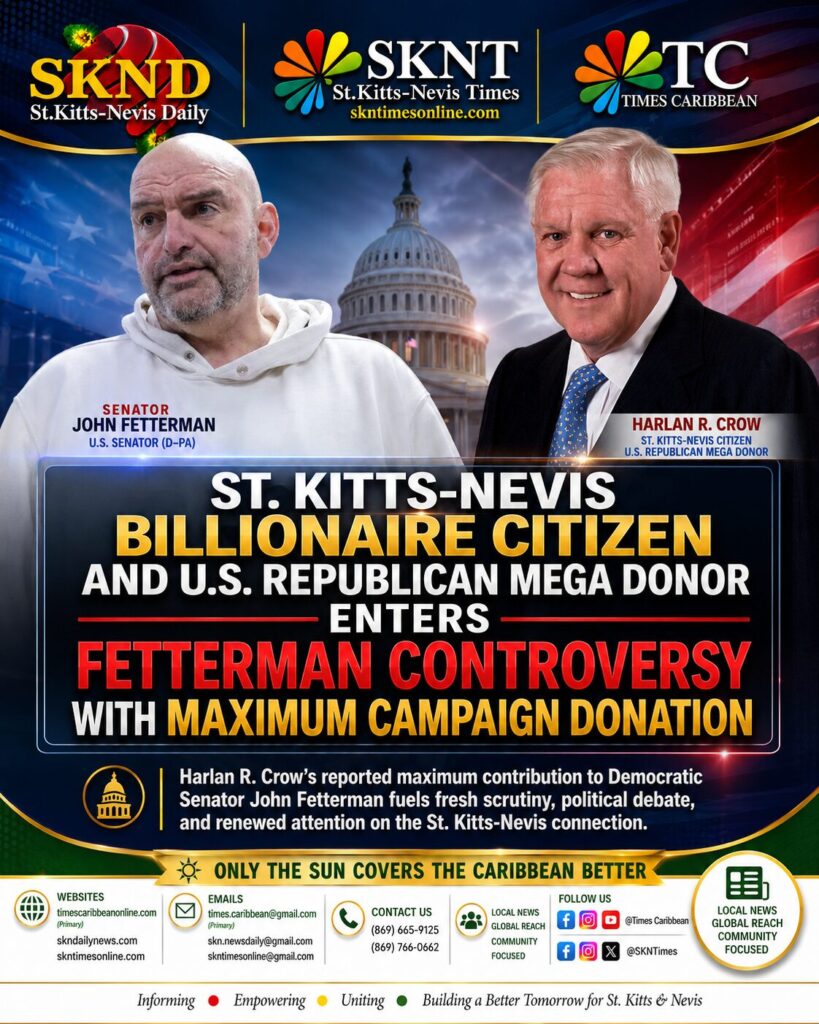
ST.KITTS-NEVIS BILLIONAIRE CITIZEN AND US REPUBLICAN MEGA DONOR ENTERS FETTERMAN CONTROVERSY WITH MAXIMUM CAMPAIGN DONATION
Harlan Crow’s US$7,000 contribution is legally permissible—but its timing, political symbolism and Caribbean connection are triggering major questions about money, influence and Senator John Fetterman’s dramatic transformation
WASHINGTON, D.C. — A billionaire Republican powerbroker with documented citizenship-by-investment ties to St. Kitts and Nevis has delivered the maximum legally permitted contribution to one of the most politically controversial Democrats in the United States Senate.
Harlan R. Crow, the Texas real-estate magnate best known as a longtime Republican donor and financial benefactor of conservative Supreme Court Justice Clarence Thomas, contributed US$7,000 to the campaign of Democratic Pennsylvania Senator John Fetterman on June 30, according to a Federal Election Commission filing first reported by The Intercept.
The contribution combines the US$3,500 maximum permitted for each of two elections. Federal Election Commission rules currently allow an individual to give a candidate US$3,500 per election during the 2025–2026 cycle.
The amount may appear modest beside Crow’s enormous political spending, but its significance is not measured merely in dollars.
It represents an extraordinary convergence: a Republican megadonor closely associated with conservative institutions, a Democratic senator increasingly alienated from his own political base, and a billionaire whose acquisition of a St. Kitts and Nevis passport previously placed the Federation’s Citizenship by Investment Programme in the centre of an international transparency debate.
A filing that raises questions—but does not prove concealment
The Intercept reported that Crow identified his employer on the Fetterman contribution as the Trammell Crow Company and described himself as a real-estate developer. In several earlier filings, he reportedly listed himself as chairman of Crow Holdings.
Trammell Crow was Harlan Crow’s father and founder of the family’s real-estate empire.
That discrepancy deserves scrutiny because employer and occupational information assists journalists, regulators and citizens in tracing patterns of political money. However, it is important to distinguish legitimate questions from proven wrongdoing.
Crow’s name reportedly remained visible on the filing. Consequently, the alternative employer description does not, by itself, establish that he illegally concealed the donation, misled regulators or violated campaign-finance laws. It may have made his current corporate position less immediately apparent, but motive cannot responsibly be declared without further evidence or an official finding.
The more defensible conclusion is that the filing creates a transparency question, not yet a proven campaign-finance offence.
Why would a Republican billionaire finance Fetterman?
Crow has overwhelmingly supported Republican candidates, conservative organisations and right-leaning policy institutions. Yet he has occasionally donated to moderate or business-friendly Democrats, including politicians positioned outside their party’s progressive wing.
Fetterman now appears to fit that pattern.
The Pennsylvania senator entered national politics with a rebellious, working-class and broadly progressive image. Since entering the Senate, however, he has increasingly separated himself from Democratic colleagues on immigration enforcement, presidential nominations, Middle Eastern policy and several Trump administration initiatives.
He has remained one of Washington’s most outspoken supporters of Israel and recently established Common Ground PA, an unusual joint fundraising committee with Pennsylvania’s Republican senator, Dave McCormick. Federal filings identify the campaigns and leadership political action committees of both senators as participants.
Fetterman insists that bipartisanship does not mean he is preparing to become a Republican. He has argued that he still votes overwhelmingly with Democrats and says he has no present plans to abandon the party.
Nevertheless, Crow’s maximum contribution strengthens the perception that Fetterman is becoming politically attractive to a class of conservative donors who may once have viewed him as an opponent.
The donation does not prove a political bargain. Campaign contributions do not automatically establish control, agreement or improper influence. But political money is rarely interpreted in isolation. It is read as a signal—particularly when the donor and recipient occupy traditionally opposing camps.
A senator increasingly rejected by Democrats—and embraced by Republicans
The political realignment surrounding Fetterman is no longer merely anecdotal.
A Quinnipiac University poll released this week found that 77 per cent of Pennsylvania Republicans approved of Fetterman’s performance, while only 19 per cent of Democrats approved. Sixty-nine per cent of Democrats disapproved.
Even more remarkably, 52 per cent of all voters surveyed said they wanted Fetterman to leave the Democratic Party. Among Democratic respondents, 57 per cent wanted him out, while only 32 per cent wanted him to remain. The poll surveyed 895 registered Pennsylvania voters and carried a margin of error of 4.3 percentage points.
These numbers describe a political inversion almost without precedent for a sitting senator: a Democrat more popular among Republican voters than among members of his own party.
Against that background, Crow’s cheque does not look like an accidental crossing of partisan lines. It appears consistent with a broader movement of Republican approval, conservative donor interest and Democratic estrangement.
The Clarence Thomas controversy follows Crow everywhere
Crow’s political activities have received heightened attention since ProPublica documented his relationship with Justice Clarence Thomas.
Reporting found that Crow provided luxury travel aboard private aircraft and a yacht, purchased property belonging to Thomas and his relatives, and paid private-school tuition for Thomas’s grandnephew. Thomas later amended financial disclosures to address aspects of the real-estate transaction and some travel. Crow has maintained that he never sought to influence Thomas on legal or political matters.
Crow has also drawn public fascination and criticism over his historical collection. His Dallas estate contains what he calls the “Garden of Evil,” featuring statues of Lenin, Stalin, Mao and other authoritarian figures. His collection has included a signed copy of Mein Kampf, paintings attributed to Adolf Hitler and other Third Reich-era objects.
Crow has said the material is preserved to remember the dangers of totalitarianism—not to celebrate those ideologies. Reporting by The Atlantic also cautioned against falsely characterising him as a Nazi merely because he collects such artefacts.
That distinction matters. The existence of disturbing historical objects may invite criticism about judgment and sensitivity, but it should not be converted into an unsupported accusation about Crow’s personal ideology.
The St. Kitts-Nevis connection—and an important correction
Documents examined by the Project On Government Oversight and The Intercept indicated that Crow and members of his family received St. Kitts and Nevis passports in 2012 through the Citizenship by Investment Programme after making substantial financial contributions.
However, those passports were reportedly valid for ten years. Investigators said in 2023 that it remained unclear whether they had been renewed.
Crow should therefore be described most precisely as a billionaire with documented past dual-citizenship and passport ties to St. Kitts and Nevis, rather than definitively presented as a current citizen without updated confirmation. The same investigation explicitly stated that there was no evidence Crow’s citizenship was connected to illegal activity.
For the Federation, the episode carries an uncomfortable but necessary lesson.
Once economic citizenship is granted, the international conduct and political activities of the recipient can become permanently associated with the country—even when those activities occur entirely overseas and have no direct involvement from the St. Kitts and Nevis Government.
The Federation is not responsible for Crow’s donations, his relationship with Justice Thomas or Fetterman’s ideological evolution. Nor is there evidence that his St. Kitts and Nevis passport played any role in the contribution.
Yet his continued appearance in global political controversies demonstrates why citizenship programmes require not only strong initial due diligence, but continuing monitoring, clear renewal standards and credible mechanisms for protecting the country’s international reputation.
A small cheque with enormous political symbolism
The central story is therefore larger than US$7,000.
It is about a Democratic senator whose former supporters increasingly believe he has abandoned the political identity on which he was elected. It is about a Republican billionaire recognising—or attempting to encourage—that transformation. And it is about how a Caribbean passport acquired more than a decade ago can continue resurfacing in controversies involving American political money, Supreme Court ethics and elite influence.
Crow’s donation is legal unless authorities determine otherwise. It does not prove corruption, concealment or control.
But politically, it is explosive.
When one of America’s best-known Republican megadonors reaches across party lines to fully fund the legally permitted contribution to John Fetterman, the transaction sends a message far louder than its dollar value:
Conservative America increasingly sees something in Fetterman that many Democrats no longer recognise as their own.
















Leave a comment
You must be logged in to post a comment.