St. Kitts and Nevis Moves Toward 100% Renewable Energy Future with EU, UNDP and GTI-Backed Roadmap
BASSETERRE, St. Kitts and Nevis — The Government of St. Kitts and Nevis has officially launched a major initiative aimed at transitioning the Federation to 100 percent renewable electricity generation, marking a significant step toward a cleaner, more sustainable and low-carbon energy future.
The initiative is being supported by the European Union through the Euroclima Caribbean programme and implemented by the United Nations Development Programme (UNDP), in partnership with the Greening The Islands (GTI) Foundation.


At the heart of the project is the development of a national renewable energy roadmap that will identify the policies, investments and technologies required to transform the country’s energy sector. The roadmap falls under the European Union’s Global Gateway Investment Agenda and is expected to guide efforts to expand renewable energy, strengthen national energy security, reduce dependence on imported fossil fuels and support St. Kitts and Nevis’ target of reducing carbon dioxide emissions by 61 percent by 2030.
The roadmap development process is expected to take approximately 18 months and will include consultations with public and private sector stakeholders, technical assessments and investment planning.
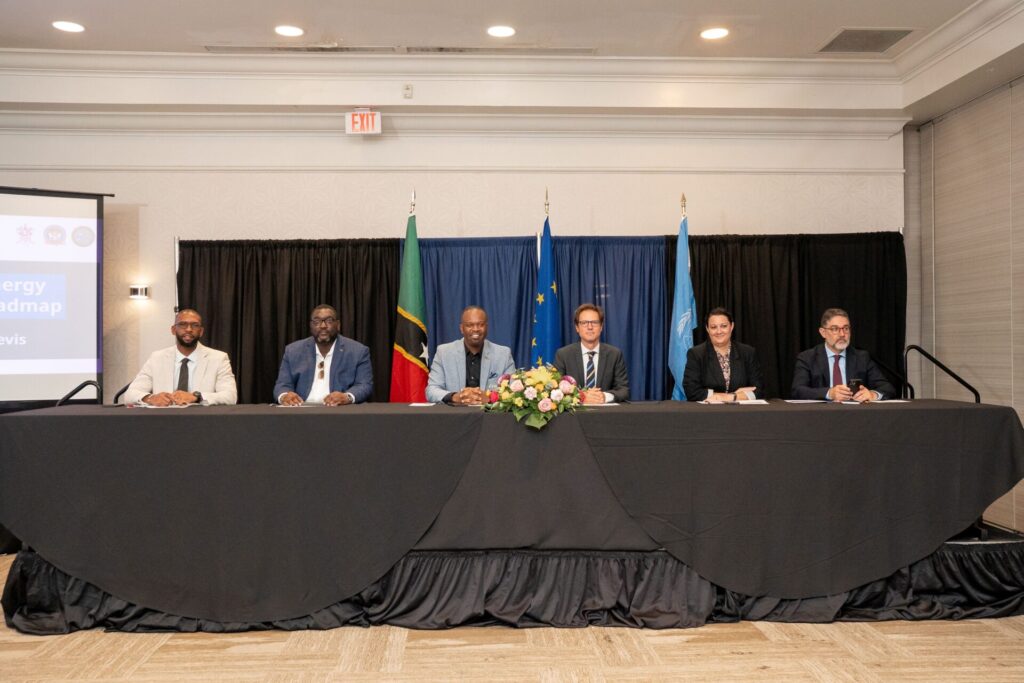
The initiative was officially launched during a two-day workshop held from June 3 to 4 at the St. Kitts Marriott Resort. The workshop marked the formal kick-off of the global 100% RES Islands Initiative in St. Kitts and Nevis, bringing together government officials, energy experts and international partners to assess the current state of the energy sector, identify opportunities and challenges, and agree on the next steps toward achieving the Federation’s renewable energy ambitions.
Minister of Public Infrastructure, Energy and Utilities, Domestic Transport, Information, Communication and Technology and Posts, Hon. Konris G. Maynard, said several major energy-related projects are already at various stages of development. These include the Electric Vehicle Transition Policy and Action Plan, the Solar Integration for Sustainable Energy Program, geothermal development in Nevis, a 50 MW solar PV plant with 30 MWh of battery storage, shore power for cruise ships, Advanced Metering Infrastructure, and microgrids and solar PV systems on government buildings.
“Every single one of these projects highlights the immediate need for the study we are launching today,” Minister Maynard said. “We need this roadmap to harmonize these initiatives, and to guarantee that our infrastructure can handle this green revolution.”
Ms. Karima Degia, Cluster Manager for Nature, Climate and Energy at UNDP Barbados and the Eastern Caribbean, commended the Government of St. Kitts and Nevis for its ambitious vision, noting that the energy transition will require strong partnerships and sustained cooperation across government, utilities, the private sector and development partners.
“The commitment to achieving a fully renewable energy future is both ambitious and forward-looking and UNDP is here to support translating this ambition into action,” Degia said. She added that UNDP is working to connect national priorities with international best practices while ensuring that solutions remain rooted in the realities and needs of Small Island Developing States.
Mr. Luca Trinchieri, Team Leader for Green Deal at the EU Delegation to Barbados, the Eastern Caribbean, OECS and CARICOM/CARIFORUM, said the European Union is proud to support St. Kitts and Nevis as it advances toward a cleaner, more resilient and sustainable energy system.
“A clear and credible roadmap will help identify the investments, policies and technologies needed to expand renewable energy, strengthen energy security and reduce reliance on imported fossil fuels,” Trinchieri said.
He further noted that the transition to renewable energy is not only a climate imperative, but also an economic and development opportunity for the Federation.
Mr. Gianni Chianetta, Founder and Chair of the Greening The Islands Foundation, said St. Kitts and Nevis has the potential to become a renewable energy leader not only in the Caribbean, but globally.
“St. Kitts and Nevis has set out to become a renewable energy leader, not only in the Caribbean but globally, and the political will to get there is already strong,” Chianetta said. “Our role is to help turn that will into reality.”
Through its 100% RES Islands Initiative, which St. Kitts and Nevis joined in November 2025, GTI works with island communities to co-design integrated roadmaps for full renewable energy and build pipelines of bankable projects.
As the implementing agency for the Euroclima programme in the Caribbean, UNDP continues to partner with the European Union and national governments to accelerate climate action, strengthen resilience and support the transition to cleaner and more sustainable energy systems.
The renewable energy roadmap is expected to play a central role in shaping the Federation’s energy future, helping St. Kitts and Nevis reduce fuel import dependence, attract sustainable investment, and build a more secure, competitive and environmentally responsible economy.
















Leave a comment
You must be logged in to post a comment.