SMALL ISLANDS, GLOBAL POWER: BARBADOS, ST. KITTS-NEVIS AND OECS NATIONS DOMINATE CARIBBEAN PASSPORT RANKINGS IN 2026
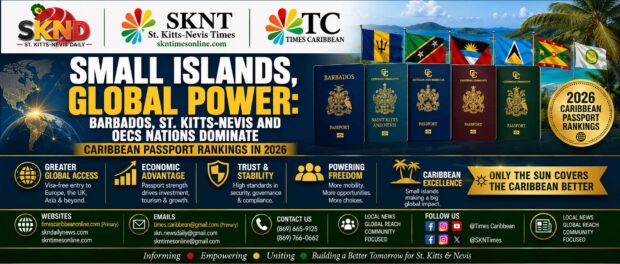
As global mobility becomes one of the most valuable modern assets, several Caribbean nations are quietly emerging as major international powerhouses through the strength of their passports.
According to 2026 global mobility estimates based on visa-free and visa-on-arrival access, Caribbean passports continue to rank among the most attractive travel documents in the developing world — with several small island nations outperforming countries with populations and economies many times their size.
Leading the regional rankings is , whose passport now reportedly provides access to approximately 162 destinations worldwide without the need for a traditional visa. That places Barbados at the very top of the Caribbean and among the strongest passports globally for a small island developing state.
Closely behind is with roughly 158 visa-free destinations, benefiting from longstanding diplomatic ties with the United Kingdom and Europe.
But perhaps most remarkable is the continued dominance of several Eastern Caribbean microstates — particularly those operating Citizenship by Investment (CBI) programmes — which have transformed passport strength into a strategic economic pillar.
ST. KITTS-NEVIS REMAINS A GLOBAL CBI GIANT
continues to hold one of the Caribbean’s most internationally recognized passports, with estimated access to between 148 and 155 destinations worldwide.
Widely regarded as the birthplace of the modern Citizenship by Investment industry, St. Kitts and Nevis has spent decades marketing its passport as a premium mobility product to high-net-worth individuals seeking greater travel freedom, tax efficiency, and global flexibility.
Despite growing international scrutiny surrounding investment migration programmes worldwide, the federation’s passport continues to command strong demand globally due to access to the United Kingdom, Europe’s Schengen Area, and key parts of Asia and Latin America.
Analysts say the enduring strength of the St. Kitts-Nevis passport demonstrates how diplomacy, international compliance standards, and strategic foreign policy can significantly elevate the influence of even the world’s smallest nations.
OECS COUNTRIES PUNCHING FAR ABOVE THEIR WEIGHT
The 2026 rankings also underscore the extraordinary rise of the Organisation of Eastern Caribbean States (OECS) as a bloc with outsized global mobility influence.
ranked fourth overall with access to approximately 154 destinations, while continued its rapid climb with an estimated 145–148 destinations.
Meanwhile, stunned many observers with an estimated 156 visa-free destinations — one of the highest levels of access anywhere in the Caribbean despite its relatively small size and limited geopolitical footprint.
also remains uniquely positioned internationally due to its access to the United States E-2 Investor Visa Treaty, a major advantage that continues to attract global investors and entrepreneurs.
Regional analysts note that these mobility rankings reflect far more than tourism convenience. Increasingly, passport strength is becoming a direct indicator of:
- Diplomatic credibility
- International trust
- Border security standards
- Financial transparency
- Global political relationships
TRINIDAD & JAMAICA SHOW DIFFERENT MODELS OF INFLUENCE
Outside the OECS and CBI-driven economies, remains one of the Caribbean’s strongest non-CBI passport holders, with access to roughly 146 destinations.
Its position is largely driven by its energy economy, longstanding diplomatic networks, and regional economic influence.
, despite being one of the Caribbean’s most globally recognized cultural brands, ranked lower in visa-free mobility with approximately 85–90 destinations.
However, analysts caution that passport power and global influence are not always the same thing. Jamaica’s cultural dominance through music, sports, tourism, and diaspora influence remains among the strongest in the Caribbean despite comparatively lower mobility access.
THE NEW GLOBAL VALUE OF PASSPORTS
Across the Caribbean, passports are no longer viewed merely as travel documents.
They are increasingly seen as:
- Economic assets
- Investment tools
- Emergency relocation instruments
- Wealth protection mechanisms
- International lifestyle gateways
In an era marked by geopolitical uncertainty, tighter immigration controls, global instability, and rising wealth migration, Caribbean passports have become highly sought after by investors, entrepreneurs, digital nomads, and globally mobile families.
For many small Caribbean nations, the ability to maintain strong diplomatic relations while preserving international visa-free agreements has become one of the region’s most valuable strategic advantages.
TOP 10 MOST POWERFUL CARIBBEAN PASSPORTS (2026)
| Rank | Country | Estimated Visa-Free Access |
|---|---|---|
| 🥇 | ~162 destinations | |
| 🥈 | ~158 destinations | |
| 🥉 | ~148–155 destinations | |
| 4️⃣ | ~154 destinations | |
| 5️⃣ | ~145–148 destinations | |
| 6️⃣ | ~156 destinations | |
| 7️⃣ | ~140–147 destinations | |
| 8️⃣ | ~146 destinations | |
| 9️⃣ | ~136–145 destinations | |
| 🔟 | ~85–90+ destinations |
While exact rankings may fluctuate slightly between different passport indexes and diplomatic updates throughout the year, one reality remains increasingly clear: the Caribbean — particularly the Eastern Caribbean — now holds some of the most globally mobile passports in the developing world.
For nations with populations smaller than many cities abroad, that represents extraordinary geopolitical leverage.
















Leave a comment
You must be logged in to post a comment.